Feeding birds in winter in Quebec: which seeds, which feeder, which mistakes to avoid
A well-stocked feeder is the best show of a Quebec winter. You still need to offer the right seeds, in the right feeder, and keep it clean. Here is what ornithologists say, myths included.
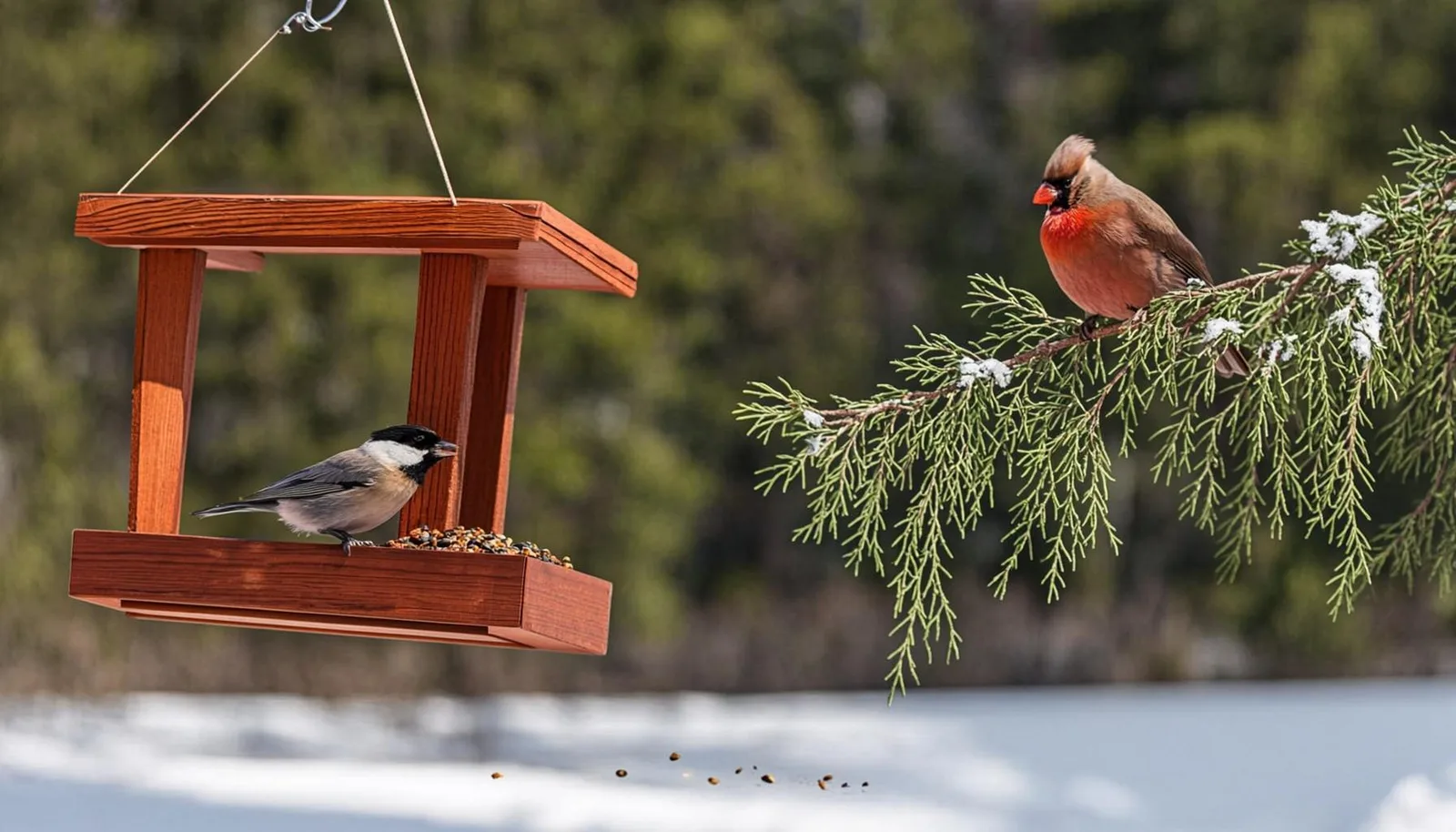
With the first snow, chickadees, nuthatches and cardinals rediscover our yards. Putting up a feeder is simple, but hardware store aisles overflow with mixes, cylinders and cakes of every kind, and the advice going around is contradictory. The result: many people buy seeds birds ignore, forget to clean the feeder or set it up in the worst possible spot relative to their windows.
We sorted through what the Cornell Lab of Ornithology (and its citizen science program, Project FeederWatch), Birds Canada, Environment and Climate Change Canada, Bird Protection Quebec and a few university extension services have to say. You will find a seed comparison, the right type of feeder for each bird, the cleaning routine and the myths to forget.
The seed showdown: which one is really worth your money?
If you only buy one bag, make it black oil sunflower. The Cornell Lab describes it as a high-energy seed with a thin shell, preferred by a host of species: cardinals, chickadees, finches, sparrows. Virginia Tech points out that it is smaller and higher in fat than striped sunflower, and that hulled sunflower (no shells) ranks second in preference but costs more. Bird Protection Quebec, a Montreal bird protection organization, calls it a nearly universal seed.
The other seeds each have their fans. Here is how they compare, based on the sources consulted.
| Food | Who loves it | Strengths | Weaknesses |
|---|---|---|---|
| Black oil sunflower | Chickadees, nuthatches, cardinals, goldfinches, sparrows | High energy, thin shell, pleases the most birds | Leaves shells under the feeder |
| Hulled sunflower | The same | No shells to clean up | Costs more than black oil sunflower |
| Nyjer (often called thistle) | American Goldfinch, Pine Siskin, Common Redpoll | Targets small finches | Needs a feeder with very small ports; offer it alone or it goes to waste |
| Suet | Woodpeckers, chickadees, nuthatches (insect-eating birds) | Very high energy for deep cold | Can turn rancid in hot weather |
| Peanuts | Blue Jays, chickadees, nuthatches, woodpeckers | Shelled, they suit small birds | Never salted or flavoured; jays carry many away |
| White millet | Juncos, sparrows (ground-feeding birds) | Popular on the ground or on a platform | Mostly useful on the ground, not in a tube |
| Cracked corn | Mourning Doves, sparrows | Inexpensive | Offer it on the ground or on a platform, with millet |
| Safflower | Cardinals and other big-billed birds | Cardinals like it | Expensive and less popular than sunflower |
| Milo (sorghum) | Mostly western birds | Makes mixes cheap | Often ignored in the East, so wasted |
| Bread | Nobody | None | No real nutritional value; mouldy, it can be harmful |
The verdict is clear: black oil sunflower wins on points, nyjer takes the goldfinch and redpoll category, suet and peanuts dominate when the mercury drops, and bread is disqualified. For winter, Bird Protection Quebec recommends the most energy-rich foods: suet, peanuts, black oil sunflower and mealworms. Virginia Tech notes that live mealworms beat dried ones, which are less nutritious and contain almost no moisture.
Which feeder for which birds
The feeder matters almost as much as the seed. Bird Protection Quebec suggests a simple logic based on how each bird feeds.
- Hanging feeder (tube or hopper): for birds that climb or perch, such as chickadees, nuthatches, goldfinches and woodpeckers. Winter bonus: it does not collect snow.
- Nyjer tube: with very small ports. The inverted model, where birds eat upside down, suits goldfinches and redpolls.
- Suet cage and peanut feeder: favourites of woodpeckers, chickadees and nuthatches.
- Platform: for ground-feeding birds such as cardinals, juncos, jays and doves. A mix of black oil sunflower, cracked corn and millet works well there. Choose a covered platform so snow does not bury it.
For juncos, Bird Protection Quebec also suggests scattering a little white millet at the base of a cedar hedge or a conifer; cut Christmas tree branches can serve as temporary shelter. Put the feeder where you can see it from the kitchen: you will know when to refill it, clear the snow or move it out of the squirrels' reach. Keep it full especially before a storm or extreme cold, and consider a heated birdbath, which gets a lot of visits when everything is frozen. On a balcony, a hanging feeder and a small bowl of water are enough.
One caveat about platforms: Birds Canada points out that on open trays, birds stand in their food and soil it with droppings. If you have one, clean it often. And remember that the feeder is only a supplement: the garden itself can offer shelter and food. To go further, read how to create a wildlife corner in your garden and what to leave standing in the garden in fall.
Cleaning the feeder: salmonellosis is not a legend
A feeder is a restaurant where dozens of birds eat at the same counter. Birds Canada explains that salmonellosis, a bacterial infection, is a common cause of illness in feeder birds, and that outbreaks can kill many Pine Siskins, Common Redpolls and American Goldfinches. The bacteria spread through droppings left in food and water, or through direct contact between birds.
A sick bird often looks fluffed up or thin, has swollen eyelids, is easy to approach and seems lethargic. The routine Birds Canada recommends is simple:
- every two weeks, scrub the feeder and soak it in a 10% bleach solution (one part bleach to nine parts water), rinse thoroughly and let it dry completely before refilling;
- regularly rake up the seeds and droppings that build up underneath, and move the feeder from time to time;
- throw out wet seed, where mould can grow;
- if you see a sick bird, or if an outbreak is reported near you, take the feeders down for two weeks.
Virginia Tech gives a similar routine (at least every two weeks, a wash in hot soapy water, then a 3 to 5 minute soak in one part bleach to 10 parts water) and notes that wood, being more porous, is harder to disinfect.
Windows and cats: the two real dangers around the feeder
According to Environment and Climate Change Canada (ECCC), about 270 million birds die each year because of human activities, and about 75% of those deaths are caused by domestic and feral cats. The department therefore recommends not letting your cat roam outdoors. The Cornell Lab agrees: ground-feeding birds, fledglings and feeder birds are the most exposed. If cats prowl your neighbourhood, the Tufts Wildlife Clinic suggests placing the feeder about 3.5 m (12 feet) from cover such as a hedge or a conifer, and adding chicken wire or thorny branches to protect ground-feeding birds.
Windows are the other big trap. ECCC says 90% of collisions happen at houses and that households with a feeder are twice as likely to have collisions. The fix: make the glass visible. The Cornell Lab recommends decals or markings applied on the outside, spaced evenly 5 cm (2 inches) apart over the whole surface, or cords spaced about 10 cm apart. ECCC also advises turning lights off after 11 p.m. To understand how night lighting affects animals, read our article on light pollution.
True or myth: six common beliefs about feeders
"Bread will do in a pinch." Myth.
The Tufts Wildlife Clinic is clear: fresh or stale, bread provides no real nutritional value to birds, and mouldy, it can harm them. Bird Protection Quebec sums it up: never bread.
"Once I start, I can't stop, or they'll die." Mostly myth.
In a Wisconsin study reported by Virginia Tech, Black-capped Chickadees with access to feeders got only 21% of their daily energy from them, and their survival did not differ from that of chickadees without feeders. Tufts adds that if you stop for a while, most birds will find other food sources, especially in suburban areas. The nuance: your help matters most during extreme cold, storms and late winter, so avoid leaving the feeder empty at those times.
"A cheap mix is just as good." Myth.
The Cornell Lab warns that inexpensive mixes often contain a lot of milo, a seed most eastern birds ignore: it ends up on the ground, and Virginia Tech notes that spilled seed attracts rodents. Better a bag of pure black oil sunflower than a big bag of mix that is half wasted.
"A dirty feeder is no big deal, it's outside." Myth.
Salmonellosis spreads precisely through droppings in food. The outbreaks documented by Birds Canada notably affect the Common Redpoll and the American Goldfinch, which Bird Protection Quebec lists among the regulars at nyjer tubes. Cleaning every two weeks is part of the deal.
"Within a metre or more than 9 m from the window, the feeder is safe." Depends who you ask.
That is the classic rule: within 1 m (3 feet), a bird cannot build up enough speed to be badly hurt; beyond 9 m (30 feet), it does not mistake the reflection for sky. Tufts still recommends it, and ECCC advises placing feeders within 50 cm of windows. But the Cornell Lab writes that these past distance recommendations are no longer considered valid, and that any window near a feeder should be made clearly visible, whatever the distance. The reasonable compromise: feeder very close or far from the house, and marked glass in every case.
"Suet is fine all year." False for summer.
The Cornell Lab points out that suet, usually beef kidney fat, can turn rancid in hot weather unless it has been specially processed. It is a winter food.
Should you stop feeding birds in spring?
It is not mandatory, but in Quebec there is often a good reason to: black bears. The Quebec government lists bird feeders among the attractants that bring bears onto residential properties, and recommends removing them during the periods when bears are around. Conflicts generally happen in spring and early summer. If bears have already been seen in your area, take the feeder in as soon as the snow melts.
If you keep going, adjust the menu. Tufts notes that most birds need little help in summer and suggests sticking to nectar for hummingbirds and nyjer for goldfinches, and offering fruit or nesting material in spring instead. You can also turn your attention to the garden: a few fallen leaves left in place feed the insects that will, in turn, feed the nestlings.
Sources
- Food Types, Project FeederWatch, Cornell Lab of Ornithology and Birds Canada, 2026.
- Why Birds Hit Windows—and How You Can Help Prevent It, All About Birds, Cornell Lab of Ornithology.
- Conseils pour nourrir les oiseaux en hiver (in French), Bird Protection Quebec, 2026.
- Immediate action required to assist feeder birds on the West Coast, Birds Canada.
- Protect birds, Environment and Climate Change Canada, 2021.
- Feeding Wild Birds: Should People Feed Birds and What's Best to Feed Birds?, James A. Parkhurst, Virginia Cooperative Extension, Virginia Tech, 2024.
- Birdfeeders and Wildlife, Tufts Wildlife Clinic, Cummings School of Veterinary Medicine, Tufts University.
- Pas d'ours dans ma cour : cohabiter avec l'ours noir (in French), Gouvernement du Québec.
Frequently asked questions
What is the best seed to attract the most birds?
Black oil sunflower. The Cornell Lab of Ornithology describes it as high in energy, with a thin shell, and preferred by most feeder birds: chickadees, nuthatches, cardinals, goldfinches and sparrows.
Can I give bread to birds?
No. According to the Tufts Wildlife Clinic, bread, fresh or stale, has no real nutritional value for birds, and mouldy bread can harm them. Bird Protection Quebec recommends never offering it.
How often should a feeder be cleaned?
At least every two weeks, according to Birds Canada and Virginia Tech: scrub it, soak it in a solution of one part bleach to nine parts water, rinse well and let it dry completely before refilling.
Will birds die if I stop feeding them?
Generally, no. In a Wisconsin study, Black-capped Chickadees with access to feeders got only 21% of their daily energy from them, and their survival did not differ from that of chickadees without feeders.
Should I take my feeder down in spring?
It is not mandatory, but it is wise if black bears visit your area. The Quebec government recommends removing feeders when bears are around, generally in spring and early summer.