After the holidays: tree, wrapping paper, lights… what goes where?
The day after the holidays, the living room is overflowing with crumpled paper, boxes and ribbons, and the tree is starting to drop its needles. Good news: most of these leftovers have a clear destination, as long as you know which one. Here is how to sort it all, item by item, according to RECYC-QUÉBEC and Quebec's big cities.
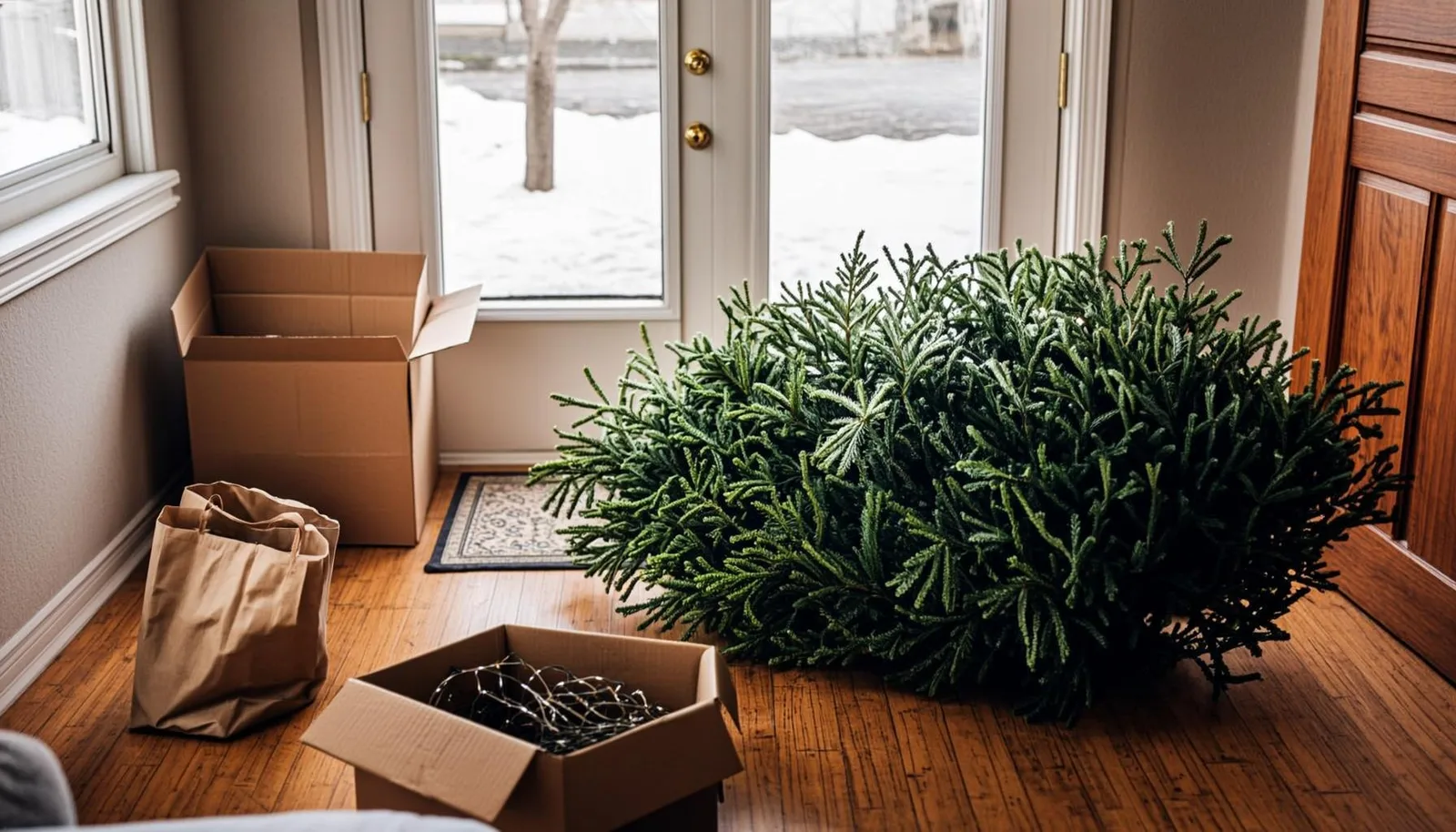
Between December 25 and mid-January, things pile up in the house: toy boxes, wrapping paper, ribbons, dead batteries, lights that no longer turn on and, of course, the tree. When in doubt, we tend to toss everything in the blue bin, figuring the sorting centre will handle the rest. Bad idea: some of these materials jam the equipment, others simply cannot be recycled, and a few can even catch fire.
So here is, item by item, what goes in the bin, in the garbage, to the ecocentre or to a special collection. The guidelines come from RECYC-QUÉBEC and the cities of Montreal and Quebec City. They vary a little from one municipality to the next: when in doubt, RECYC-QUÉBEC's Ça va où? app gives you the answer for your address. To cut the volume upstream (gifts, meals, decorations), also have a look at our guide to reducing holiday waste.
The real tree: January collection or ecocentre
Your real tree has no business in the garbage. Montreal and Quebec City hold a special collection in January, as do many other municipalities, and their ecocentres take trees too. Either way, the basic rule is the same: remove absolutely every decoration, down to the last hook and the last strand of tinsel, and do not put the tree in a plastic bag.
- Montreal: the collection dates for your address are posted shortly before Christmas in Info-collectes. Place the tree at the edge of the sidewalk, base facing the street, free of snow and without blocking the way, usually between 7 p.m. the night before and 7 a.m. on collection day (times vary by borough). In some areas, a tree left out after January 31 goes out with the garbage. After the collection, you can also take it to an ecocentre.
- Quebec City: last winter, the special collection ran from January 12 to 30, on the same day as garbage pickup. You have to cut the tree into sections no longer than 1.2 m and place them next to your garbage bin, after 7 p.m. the night before or before 7 a.m. Any tree can also go to the ecocentre.
- Laval, Longueuil, Gatineau and elsewhere: the rules change from city to city. Check your municipality's collection calendar before putting the tree out.
And then? In Montreal, trees are chipped. An essential oil is extracted from them and used to make household and cosmetic products, and the residue becomes fertilizer for gardening companies. In Quebec City, the city checks that the trees are not contaminated, then sends them to the composting centre. Before the collection, RECYC-QUÉBEC suggests other lives for your tree: give it to someone you know, or use it as mulch, firewood or decorative branches. The one exception: artificial trees. Montreal refuses them at the collection; in Quebec City, they go to the ecocentre.
Real or artificial tree: the showdown
Every December, the same question comes back: isn't the reusable fake tree greener than the real one we throw out after three weeks? The answer mostly depends on one thing: how many years you will keep the artificial one.
In 2009, a Canadian study by the firm Ellipsos compared the two options over their whole life cycle. According to a review by Dovetail Partners, an American environmental analysis organization, the results were split: the artificial tree had the greater impact in 7 categories out of 15, the real tree in 7 others. But on climate, with an assumed lifespan of 6 years, the artificial tree's impact was more than 1.5 times higher. You would need to keep it about 20 years to match the real tree on that score.
Another analysis, carried out in 2010 by PE Americas for the American Christmas Tree Association, reaches shorter thresholds: about 4 years if the real tree is composted, and at least 9 years if it ends up in landfill and you drive 16 km each way to buy it. In both cases, the distance driven to fetch the real tree is enough to shift the result: in the Ellipsos study, a 16 km trip instead of 5 km made the artificial tree the better choice from 6 years of use.
| Real tree | Artificial tree | |
|---|---|---|
| End of life in Quebec | Wood chips (Montreal) or compost (Quebec City) | Refused at tree collection; ecocentre |
| Climate impact over one year | Lower | Higher |
| Years to match a real tree | Not applicable | About 20 years (Ellipsos); 4 to 9 years (PE Americas) |
| Weak point | Driving to buy it | Has to be used for a long time to pay off |
Verdict: if you already own an artificial tree, keep it as long as possible, that is where it becomes worthwhile. If you buy a real tree, choose one close to home and send it to the collection or to compost.
Wrapping paper, ribbons and gift bags
This is where most mistakes happen. Ordinary, non-metallic wrapping paper goes in the recycling bin, and so does tissue paper, according to RECYC-QUÉBEC's guide to an eco-friendly Christmas. But not everything that shines is recyclable. In 2023, a RECYC-QUÉBEC spokesperson reminded readers of Le Soleil that metallic and glossy papers do not go to recycling.
- In the bin: ordinary matte wrapping paper, tissue paper, newspaper or magazine pages used as wrapping, kraft paper bags.
- In the garbage: metallic or glossy paper, decorative ribbons and bows, which are made of non-recyclable materials according to RECYC-QUÉBEC.
- Keep: gift bags, decorative boxes and ribbons in good condition. According to Le Soleil, most gift bags and boxes are hard to recycle because of their plastic or metallic coating; their best end of life is to be used again next year.
You have probably heard of the "scrunch test": if the paper stays balled up when you squeeze it, it is supposedly recyclable. The tip gets shared a lot, but none of the official sources consulted suggests it. Go by the guideline instead: if it is metallic or glossy, it goes in the garbage. And when in doubt, the Ça va où? app settles it.
Cardboard boxes and Styrofoam
Cardboard boxes go in the bin, emptied. For toy boxes, often made of cardboard and plastic, RECYC-QUÉBEC recommends separating the materials before recycling them: remove the plastic window, the ties and the moulded inserts. While you are at it, flatten your boxes: they take up much less room in the bin, which matters when the next pickup is two weeks away.
Styrofoam (polystyrene) is trickier, because the rule depends on the type. In Montreal, polystyrene used as a container or packaging, such as meat trays or cups, goes in the recycling bin. But protective polystyrene, those big white blocks around a new TV or game console, does not go in the bin: it crumbles into small beads that cause problems at the sorting centre. Take it instead to the LaSalle or Saint-Laurent ecocentres, which recycle it. Elsewhere in Quebec, check your local rules before putting it in the bin.
Lights, decorations and batteries: never in the bin
String lights are a real headache for sorting centres. Quebec City explains that they wrap around the equipment and force operations to stop. A 30-minute shutdown costs about $2,000 extra, a bill paid by all residents. Their place is the ecocentre, where they are handed over to a company that recovers the metal from the electrical wires. If they still work, RECYC-QUÉBEC suggests giving them to friends or family, a second-hand centre or a non-profit.
Other decorations each have their own destination. Broken Christmas ornaments go in the garbage: their glass is not the same as that of recyclable jars and bottles. Decorative garlands and tinsel are mostly made of non-recyclable materials. Better to keep them, give them away or organize a decoration swap with friends.
That leaves batteries, plentiful after a day of toys and remotes. They go neither in the bin nor in the garbage. Quebec City points out that lithium batteries can break in sorting equipment and catch fire, or even explode, on contact with air. A one-hour shutdown of the sorting centre then costs about $4,000. Take them to the ecocentre or a battery drop-off point; all the details are in our article on recycling batteries. And if an old electronic device has been replaced by a gift, here is where to recycle your old electronics.
Fact or myth: 6 common beliefs settled
- "All wrapping paper is recyclable." Myth. Metallic or glossy paper goes in the garbage. Only ordinary paper and tissue paper go in the bin.
- "Ribbons and bows are just like paper." Myth. RECYC-QUÉBEC lists them as non-recyclable materials. Keep them for next year.
- "Broken lights are metal, so they go in the bin." Myth. They wrap around the sorting equipment. Half an hour of downtime costs about $2,000. Off to the ecocentre.
- "Real trees end up in the dump." Myth. In Montreal, they become wood chips, essential oil and fertilizer; in Quebec City, they are composted. As long as you put them out with no decorations.
- "An artificial tree is always greener." Myth. Depending on the assumptions, it has to be used for 4 to 20 years to do as well as a real tree on climate.
- "Styrofoam never goes in the bin." False in Montreal. Trays and cups go in; only protective blocks go to the ecocentre.
For the rest of the year, material by material, see our guide to recycling properly in Quebec.
Free gift: get The Quebec Recipe Advent Calendar, 24 recipes ready in 30 minutes or less with local ingredients, one a day until Christmas Eve. The same page gathers all our holiday recipes and guides.
Sources
- Guide pour un Noël écoresponsable (in French), RECYC-QUÉBEC.
- Emballages cadeaux : faire mieux avec les moyens du bord (in French), Le Soleil, 2023.
- Connaître les modalités de la collecte des arbres de Noël (in French), Ville de Montréal, 2025.
- Sapin de Noël, ça va là (in French), Ville de Québec.
- Lumières de Noël, ça va là (in French), Ville de Québec.
- Piles lithium, ça va là (in French), Ville de Québec.
- Quoi faire avec le polystyrène (in French), Ville de Montréal, 2025.
- Environmental Assessment of Natural vs. Artificial Christmas Trees, Bowyer et al., Dovetail Partners, 2018.
Frequently asked questions
Does shiny wrapping paper go in the recycling bin?
No. RECYC-QUÉBEC says metallic or glossy paper is not recyclable. Ordinary, non-metallic wrapping paper and tissue paper go in the bin.
Where should I put my real tree after Christmas?
Out for your municipality's special collection in January, with no decorations and no plastic bag, or at the ecocentre. In Montreal, trees are turned into wood chips; in Quebec City, they are composted.
Can broken Christmas lights be recycled?
Yes, but not in the bin. Take them to the ecocentre: in Quebec City, they are handed over to a company that recovers the metal from the wires. In the bin, they wrap around the sorting centre's equipment.
Does Styrofoam go in the recycling?
It depends on the type and your city. In Montreal, polystyrene trays and cups go in the bin, but the big white protective blocks go to the LaSalle or Saint-Laurent ecocentres.
Is an artificial tree greener than a real one?
Not automatically. According to the Canadian Ellipsos study (2009), you would need to keep an artificial tree about 20 years to match a real tree's climate impact. Other analyses give a shorter threshold, from 4 to 9 years depending on the assumptions.


