Ecocentre: what to bring and how to prepare your trip
Paint, an old computer, drywall offcuts, a tired couch: the ecocentre takes a lot, but not on just any terms. We read the official pages of Montreal, Quebec City and Laval to tell you what to bring, which papers to show, what it costs and when to go, now that winter hours are arriving. And before you load the car, we sort out what deserves a second life instead.
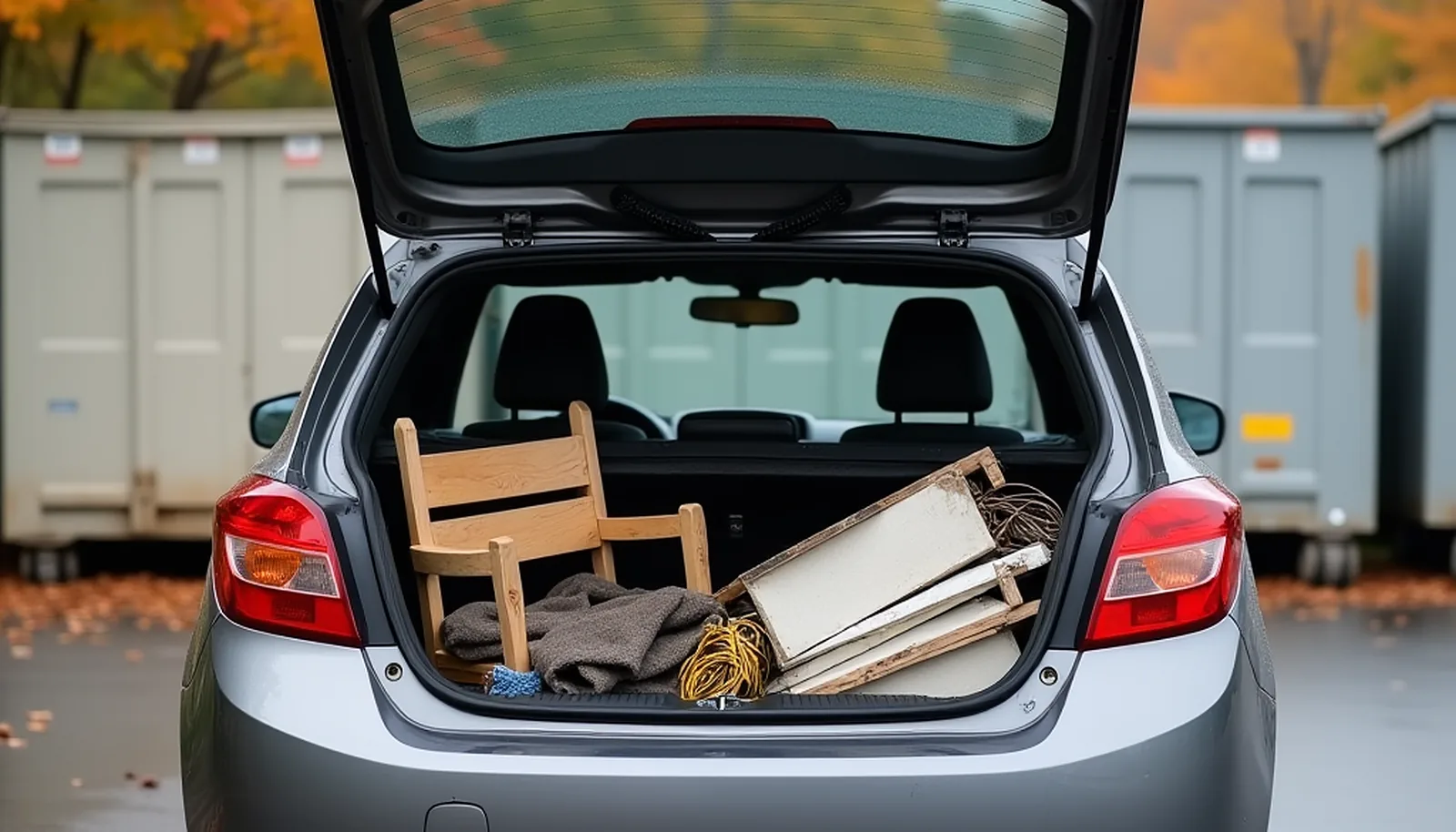
The garage is overflowing, the basement renovation left drywall offcuts and two half-used gallons of paint, and the old microwave has been waiting in a corner since spring. Fall is the season for the big clean-out, and for the question that comes with it: what can I bring to the ecocentre, and what will they turn away at the gate?
Quebec has about 430 ecocentres, drop-off points, mobile ecocentres and satellite ecocentres, according to RECYC-QUÉBEC's 2023 report. Their rules are similar, but the details change from one city to the next: who is eligible, which papers to show, how much you can bring, when they are open. In October 2026, we read the official pages of Montreal, Quebec City and Laval. What follows was accurate at the time of writing, but things change: check your city's page before you head out. And in the middle of Quebec Waste Reduction Week, let's keep one obvious point in mind: the best trip to the ecocentre is the one you don't need to make.
What the ecocentre accepts, and what it refuses
The ecocentre is the place for whatever is too big, too dangerous or too unusual for curbside collection. Montreal even describes its ecocentres as both recovery and reuse sites. The three cities we checked accept roughly the same main families:
- Household hazardous waste (HHW): paint, oils, solvents, pesticides, propane cylinders, batteries, fluorescent tubes. In Laval, it goes only to the Vimont ecocentre.
- Electronics: computers, screens, phones, game consoles.
- Construction, renovation and demolition (CRD) waste: wood, drywall, asphalt shingles, ceramics, concrete, brick. This is the bulk of the volume: according to RECYC-QUÉBEC, in 2023 it made up more than 60% of the materials recovered by ecocentres, or 307,000 tonnes.
- Bulky items and appliances: furniture, mattresses, couches, washers, dryers, refrigerators.
- Metals, tires, branches and soil, with conditions specific to each city.
In Montreal, tires are limited to 8 per day, refrigerators and freezers must be empty (10 per year maximum), and clothing in good condition and bicycles are accepted. Yard waste, however, is only taken in the summer season: for your October leaves, think about using them in the garden instead. In Laval, soil, stone and sand go only to the dry materials receiving area in Fabreville, and tires must measure less than 123 cm. In Quebec City, the list also includes broken toys and bicycles, and the city refers residents to RECYC-QUÉBEC's "Ça va où?" tool for details.
What they will turn away
In Montreal, anything that is not on the list is refused. The usual suspects, with the right place to take them:
- Garbage and table scraps: they go to regular collection and the brown bin, Montreal and Laval remind residents.
- Medications and syringes: to the pharmacy.
- Asbestos: refused in Montreal and Laval alike.
- Firearms, ammunition, explosives and fireworks: call the police.
- Vehicles and their parts: car bodies and ride-on mowers to a scrap dealer in Montreal; registered vehicles and parts to Recyc-Auto in Laval.
- Creosote-treated wood in Laval, and compressed gas cylinders other than propane in Montreal.
- Materials from businesses and industries: refused in Quebec City. In Montreal and Laval, businesses have separate rules.
Montreal, Quebec City, Laval: papers, limits and fees
Everywhere, you have to prove you live in the area served, and the free volume has its limits. Here is what the official pages said in October 2026.
| Rule | Montreal | Quebec City | Laval |
|---|---|---|---|
| Who is eligible | Residents of the agglomeration; building owners, construction companies and non-profits under other rules | Residents of Quebec City, L'Ancienne-Lorette and Saint-Augustin-de-Desmaures, at any ecocentre | Laval residents and businesses; a contractor working at your place must come with you |
| Papers | ID (Quebec health insurance card, driver's licence, passport, etc.) and one proof of address: utility bill or bank statement dated 3 months or less, tax bill, home insurance statement dated 1 year or less | Photo ID and proof of residence based on your situation: current year's tax bill, lease or electricity bill, notarial deed; a driver's licence counts as proof | Valid driver's licence with a Laval address, or photo ID and proof of residence dated 3 months or less (electricity, phone, taxes) |
| Volume and fees | Construction materials and upholstered furniture: free up to 12 m³ per year, then $31 per m³; at least 1 m³ counted per visit; 15 visits per year for each of these categories. Other materials: free, volume sometimes limited | Up to 5 m³ per visit; the page mentions no fees | Wood, branches, construction materials and soil: free up to 12 m³ per address per year, then $29 per m³; 3 m³ maximum per visit |
| Winter hours | October 15 to April 14 (see below) | November 16 to April 14: closed Monday and Tuesday | No winter schedule announced |
Three tips. First, in Montreal, each visit counts as at least 1 m³ toward your quota of materials and upholstered furniture: group small loads together rather than making many trips. Next, if you might go over the free volume, bring a way to pay; the La Petite-Patrie ecocentre, for example, takes cash, debit cards, and Visa and MasterCard credit cards. Finally, going on behalf of a parent or neighbour? In Quebec City, you need a power of attorney form, and in Montreal, the ID must belong to the person who is physically there. Even on foot or by bike, you identify yourself at the entrance.
Winter hours: what changes from October on
It is the fall trap: you plan your trip for Sunday, and the gate is closed. In Montreal, winter hours have applied since October 15 and run until April 14. At the La Petite-Patrie ecocentre, for example, it is now open Tuesday to Saturday, 10 a.m. to 6 p.m., whereas in summer it opens Tuesday to Sunday from 8 a.m. It is also closed from December 24 to January 1, and the city warns that its hours may change without notice. It also posts wait times for its ecocentres.
In Quebec City, summer hours last until November 15. From November 16 to April 14, the ecocentres are closed on Mondays and Tuesdays; they open from 9 a.m. to 5 p.m. on Wednesdays, Saturdays and Sundays, and until 6 p.m. on Thursdays and Fridays. They are closed on June 24, from December 24 to 26, and from December 31 to January 2. Two details: a load can be refused in the half-hour before closing, and the city suggests going on a weekday rather than on the weekend to wait less. Its page also announced that the Val-Bélair ecocentre would be closed for renovations until mid-December.
In Laval, the page provides no separate winter schedule: the ecocentre is open every day, from 8:30 a.m. to 5:30 p.m. on Mondays and Tuesdays, from 8 a.m. to 7:30 p.m. Wednesday to Friday, and from 8 a.m. to 5:30 p.m. on weekends, with separate hours for statutory holidays. In your own municipality or regional county municipality (MRC), the hours may be very different: that is the first thing to check.
Reuse first: what doesn't need the ecocentre
Before you fill the trunk, sort things the other way around. In the 3RV-E hierarchy, reuse comes before recycling, and the ecocentre does not guarantee a second life. According to RECYC-QUÉBEC, the ecocentres that responded to its survey received nearly 650,000 tonnes of materials in 2023. Nearly 490,000 tonnes were reused, recycled or recovered as energy, but just over 160,000 tonnes, about a quarter, went straight to disposal sites.
Reuse exists, but not everywhere: 40% of responding ecocentres offer a reuse solution for some items. Some have an on-site sales area (13%), others an area where people can pick up items free of charge (16%) or simply a drop-off point with no redistribution on site (24%). And the quantities reused are not weighed. In practice:
- Furniture that is still good deserves better than a dumpster. In Montreal, items in good condition brought to the ecocentre (furniture, toys, books, clothing, small appliances, sports or garden equipment) are handed over to the company that manages the city's reuse centres. On the other hand, mattresses and upholstered furniture are generally accepted there without being recycled, except at the Saint-Laurent ecocentre, which recycles mattresses and box springs. Same for non-working CDs, DVDs and VHS tapes: accepted, but not recycled. A clean couch has a better future at a neighbour's place: here is how to give away, sell or transform an old piece of furniture.
- Clothing in good condition is accepted in Montreal and Laval, but damaged textiles are refused in Montreal and go to the garbage in Laval. You are better off donating or selling them directly.
- In Quebec City, the city invites residents to "pay it forward": it suggests contacting a ressourcerie (a reuse centre) through the Bottin du réemploi, the reuse directory of the Communauté métropolitaine de Québec.
- A gallon of paint is not worth a trip. Éco-Peinture has 1,200 drop-off points in Quebec, including paint retailers that usually accept about a dozen containers. For batteries, our article on recycling old batteries covers the options.
When in doubt, RECYC-QUÉBEC's free "Ça va où?" app, available in French and English, tells you what to do with your materials and finds the nearest drop-off points and ecocentres.
Sort your load before you leave
On site, nobody will help you unload: Montreal, Quebec City and Laval all say so. A well-prepared load means a shorter visit and fewer unpleasant surprises.
- Group things by category in the trunk: electronics, paint, wood, metal, drywall, as Laval and Montreal suggest.
- Keep hazardous products in their original containers, clearly labelled and never mixed. In Montreal, each container must hold no more than 20 L of liquid or 20 kg of solids.
- Protect lithium batteries: in Montreal, you cover their terminals with tape, leaving the brand and chemistry visible, or slip each battery into a sealed clear bag. Batteries are limited to 2 L in total per visit.
- Empty small engines (lawn mower, snowblower) of their gas and oil before you leave, Quebec City asks. In Montreal, each liquid goes in its own container, and transferring liquids on site is not allowed.
- Empty the fridge: Montreal only accepts refrigerators, freezers and air conditioners when they are empty.
- Leave your bags open: in Laval, their contents are checked, and you empty the materials into the container without the bag.
- Plan to unload by hand: in Quebec City, dumping a trailer directly from the dock is prohibited, and in Laval, dump trailers and dump trucks are not allowed into the ecocentre.
The pre-trip checklist
Before you turn the key, run through this list:
- I checked my city's or my ecocentre's page for today's hours, closures and any work under way.
- I have my ID and a recent enough proof of residence (3 months or less in Laval).
- My load respects the allowed volume (5 m³ per visit in Quebec City, 3 m³ in Laval), and I know where I stand on my annual quota in Montreal or Laval.
- I have a way to pay if I might go over the free volume.
- Anything still usable is set aside for donation, sale or a ressourcerie.
- Materials are sorted by category, hazardous products are in their original containers and lithium batteries are protected.
- Small engines and the fridge are empty.
- Nothing refused is in the trunk: garbage, table scraps, medications, asbestos.
- I have gloves, closed-toe shoes and safety glasses, and someone to help me with heavy items.
- I am leaving early enough: in Quebec City, a load can be refused 30 minutes before closing. In Montreal, I check the wait times.
One last tip: as you unload, look at what you are leaving behind. If a good part of the trunk is impulse buys that barely got used, the real lever is before the ecocentre. Our 30-day zero waste challenge offers one small habit a day to reduce waste at the source, and our guide to 7 habits to reduce waste without breaking the bank helps you get started this week.
Sources
- Déposer des objets à l'écocentre (taking items to an ecocentre; in French), Ville de Montréal, last updated July 9, 2026 (consulted in October 2026).
- Ecocentres, Ville de Montréal, last updated May 7, 2026 (consulted in October 2026).
- Écocentre La Petite-Patrie, Ville de Montréal (consulted in October 2026).
- Écocentres (ecocentres; in French), Ville de Québec, 2026 (consulted in October 2026).
- Écocentre (ecocentre; in French), Ville de Laval, 2026 (consulted in October 2026).
- Bilan 2023 de la gestion des matières résiduelles : les écocentres (2023 residual materials management report: ecocentres; in French), RECYC-QUÉBEC, 2023 data (consulted in October 2026).
- App mobile Ça va où? (Ça va où? mobile app; in French), RECYC-QUÉBEC (consulted in October 2026).
- FAQ, Éco-Peinture (consulted in October 2026).
Frequently asked questions
Do you need proof of residence to use the ecocentre?
Yes, in all three cities we checked. In Montreal, you need ID and proof of address, such as a utility bill dated 3 months or less. In Quebec City, photo ID plus proof that fits your situation (tax bill, lease or electricity bill); a driver's licence counts as proof of residence. In Laval, a valid driver's licence with a Laval address is enough.
Is the ecocentre free?
Usually, yes, up to a limit. At the time of writing, Montreal accepts 12 m³ per year of construction materials and upholstered furniture for free, then charges $31 per cubic metre. Laval offers the first 12 m³ free, then charges $29 per cubic metre, with a maximum of 3 m³ per visit. Quebec City's page mentions no fees, but limits each visit to 5 m³.
Are ecocentres open in winter?
In Montreal, Quebec City and Laval, yes, but with shorter hours in the first two cities. In Montreal, winter hours run from October 15 to April 14; at La Petite-Patrie, for example, it is Tuesday to Saturday, 10 a.m. to 6 p.m. In Quebec City, from November 16 to April 14, the ecocentres are closed on Mondays and Tuesdays. Check your ecocentre's page before you go.
Where can I take paint without going to the ecocentre?
Éco-Peinture has 1,200 drop-off points in Quebec, including paint retailers that usually accept about a dozen containers. Municipal drop-off points sometimes set their own limit: check before you go. RECYC-QUÉBEC's "Ça va où?" app also finds drop-off points near you.
Is everything brought to the ecocentre recycled?
No. According to RECYC-QUÉBEC, about three-quarters of the materials received by ecocentres in 2023 were diverted from disposal, but just over 160,000 tonnes went straight to disposal sites. In Montreal, mattresses and upholstered furniture are accepted but generally not recycled, except for mattresses and box springs at the Saint-Laurent ecocentre. Anything still in good shape has a better future as a donation.