The 3RV-E explained: reduce, reuse, recycle, recover, eliminate
The 3RV-E is more than a poster slogan: it is an order of priority written into Quebec's Environment Quality Act. Here is each level with concrete examples at home, why the order matters, and why the word "valorisation" causes so much confusion.
Reduce, reuse, recycle, recover, eliminate: you have probably seen the acronym 3RV-E on a collection calendar or a school poster. It comes from the French words réduction, réemploi, recyclage, valorisation and élimination. People recite it like a grocery list. It is actually a ranking, from the best choice to the last resort, and it is written into a Quebec law.
Our guide to Quebec Waste Reduction Week suggests 7 habits that start at the top of the list. Here, we take the hierarchy itself apart: what the law says, what each level means at home, why the order matters and why "valorisation" is the most misunderstood of the five words.
What the law says: an order, not a list
Since an amendment passed in 2011, section 53.4.1 of the Environment Quality Act has set out the steps to follow. The government's residual materials management policy, like any plan or program the minister prepares in this area, must first give priority to reduction at source, then follow this order in treating the materials:
- reuse;
- recycling, which includes biological treatment and land farming;
- other reclamation operations, which process the materials so they can stand in for raw materials;
- energy conversion, in other words energy recovery;
- elimination.
Do the math: with reduction, that makes six management methods, while the acronym only names five. The "V" groups two levels, material recovery and energy recovery. That is where everything gets mixed up; more on that below. A note on vocabulary: the English version of the Act translates valorisation as "reclamation" and energy recovery as "energy conversion".
Two details matter. First, the section is addressed to the government, not directly to your kitchen. Second, the order is not absolute: the law allows it to be waived when an analysis based on the life cycle of goods and services justifies it. An exception has to be demonstrated through analysis; it cannot simply be declared.
RECYC-QUÉBEC, the Crown corporation responsible for these matters, says the same thing: reduction at source comes first among the 3Rs, as the most important, with reuse right behind. Its summary fits in one line: the waste that pollutes least is the waste you never produce.
Reduce and reuse: the two levels that prevent waste
The first two levels act before an object becomes waste: no bin, no truck, no plant. That is also where you have the most power.
Reduce: don't produce the waste at all
Reducing at source means consuming less, so throwing out less. Among the habits RECYC-QUÉBEC suggests:
- avoid food waste;
- buy in bulk or choose products with little packaging;
- maintain or repair an appliance before replacing it;
- borrow or rent the tool you will only use once;
- avoid single-use items, for example by bringing your own mug for coffee;
- ask your municipality how to stop receiving flyers.
As a bonus, waste avoided is often a purchase avoided: the lettuce you eat before it wilts is lettuce you don't have to buy again.
Reuse: keep the object alive
Reuse keeps the object whole, without transforming it. RECYC-QUÉBEC breaks it down into three approaches:
- extend an item's life, for example by having it repaired, which avoids both waste and a purchase;
- find another use for the same item, such as turning old door mouldings into a piece of furniture;
- buy used, all the way up to large appliances.
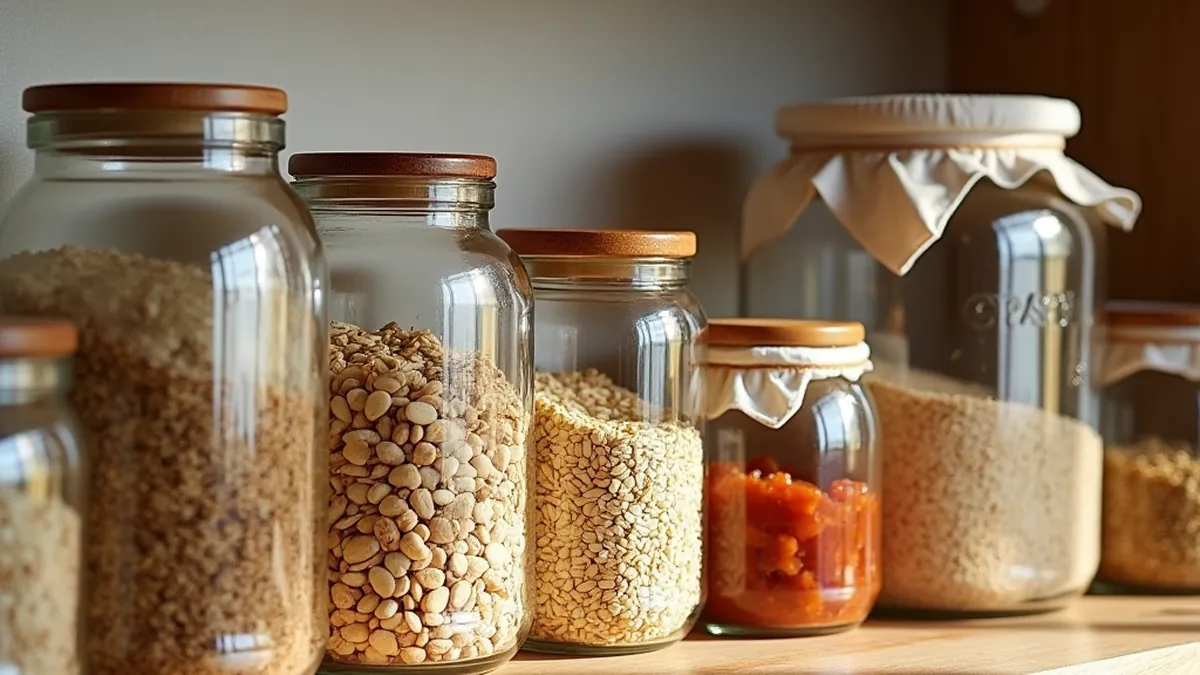
At home, that looks like the glass jar that becomes a bulk-food container, the outgrown bike you give away, the coat found at a thrift store. RECYC-QUÉBEC also lists deposit beer bottles among the containers that encourage reuse. And repair shows up on both lists: it avoids a purchase and extends an item's life. If you are torn between transforming an object and recycling it, our comparison of upcycling and recycling helps you decide.
Recycle: the material moves on, not the object
At the third level, the object disappears and only its material carries on. A guide published in 2014 by Quebec's environment ministry for businesses illustrates this with a wooden pallet beyond repair, which is turned into other wood products, such as particleboard. At home, recycling mainly goes through three doors:
- the blue bin: we explain the single list for the recycling bin and what has changed since 2025, and sorting material by material in our guide to recycling properly in Quebec;
- the deposit-return system: according to RECYC-QUÉBEC's 15th report on residual materials management, which covers 2023, 65% of single-use deposit containers were recovered, but more than 18,000 tonnes of deposit containers were eliminated. That report does not cover the modernized deposit system, rolled out since November 2023: see what you can already return and what is added in March 2027;
- the brown bin or the composter: yes, under the law, that is recycling too. More on that below.
For anything that fits in no bin, our guide on what to bring to the ecocentre and how to prepare your trip helps you sort your load.
Recycling is still a good habit, but it comes third, and there is still work to do: according to the same report, recyclable materials make up 29% of what is eliminated in Quebec. The reverse happens too: putting an item in the bin "just in case" does not make it recyclable. Our 8 golden rules of recycling and our recycling myths and facts help you avoid both traps.
Valorisation: one word, two meanings
This is the most misunderstood level, and for good reason: the same law uses the word in two senses.
The broad sense. In its definitions, the law calls valorisation (reclamation, in the English version) any operation that obtains usable products or energy from residual materials, in particular through reuse, recycling, composting, biomethanization, land farming or any other process that is not elimination. In this sense, even a reused glass jar counts as valorised.
The narrow sense, the "V". In the hierarchy, valorisation refers only to the two levels below recycling:
- material recovery: processing residues so they replace a raw material, such as wood from a worn-out pallet used as an absorbent for chemicals, in the ministry's example;
- energy recovery: getting energy out of them, for example by using that pallet as biomass fuel.
None of these examples happens at your place: in the sense of the "V", valorisation is the job of facilities. Your role ends with choosing the right door.
Compost and biomethanization: recycling
The classic trap is filing compost under the "V". Under the law, it is recycling, since recycling includes biological treatment and land farming. RECYC-QUÉBEC puts it another way: the recycling loop closes when compost or digestate goes back to the soil. Its report even refers to a recycling rate for organic materials, which reached 64% in 2023, all sectors combined.
The two processes differ in their use of oxygen. Composting relies on microorganisms that need it; biomethanization relies on microorganisms that live without oxygen, and it produces biogas along with a residue called digestate. That biogas is energy, but the operation is still classified as recycling. Which of the two handles your brown bin? It partly explains why brown bin rules change from one city to the next.
Is burning a form of valorisation?
Not automatically. In its definitions, the law counts incineration as elimination, along with dumping. Section 53.4.1 specifies that thermal destruction counts as energy recovery only if it meets the government's regulatory standards, including a positive energy assessment and a minimum energy efficiency, and if it helps reduce greenhouse gas emissions.
Quebec City, which has been incinerating its garbage since 1937, shows why words matter. Garbage from the Quebec City agglomeration and neighbouring municipalities ends up at a facility in Limoilou that the city calls the Complexe de valorisation énergétique (energy recovery complex): heat from the furnaces produces steam that is recovered for heating, and the bottom ash is fully valorised, according to the city. Recovering heat beats recovering nothing. But even when incineration meets the law's criteria, it remains second to last: what goes up in smoke will never be reused or recycled.
Eliminate: the last resort, and how much it still weighs
Under the law, elimination means getting rid of residual materials for good by putting or releasing them into the environment, notably through landfilling, storage or incineration. In practice: whatever in your garbage can heads to the landfill or the incinerator.
The ministry's guide reserves elimination for the "ultimate residue": what cannot be handled any other way, given the technology and costs of the day. We are far from that. According to RECYC-QUÉBEC's 15th report, Quebec eliminated 685 kg of residual materials per person in 2023, 5% less than in 2021, despite population growth. The characterization study in that report, which looks at materials sent to incineration or landfill, puts three categories at the top: recyclable materials (29%), construction, renovation and demolition debris (26%) and organic materials (25%).
Recyclables and organic materials alone therefore make up more than half of what we eliminate, even though both belong higher up in the hierarchy. Eliminated textiles, for their part, rose 19% compared with 2019.
At home, the true ultimate residue is often smaller than you think. To measure it, nothing beats a garbage inventory: the site's 30-day zero-waste challenge has you do one on day 1 and another on day 29. And for your city's exact list, RECYC-QUÉBEC points you to your municipality or to its "Ça va où?" mobile app.
Why the order matters: the table to keep handy
Every step down loses something. Reducing avoids everything: manufacturing, transport, collection, treatment. Reusing keeps the object whole, along with the material and energy it took to make it. Recycling saves the material, at the cost of collection, sorting and new processing. Energy recovery only recovers the energy, and elimination recovers nothing at all. According to the ministry's guide, that is the whole point of the hierarchy: lose as little raw material as possible and avoid wasting resources.
It is also what separates the habits that truly reduce from those that mostly ease your conscience. Throwing out containers that are still good to buy new "eco" ones skips reuse and sends you back to buying; our article on the logical order for replacing plastic containers shows how to do better. And calling something that burns "valorisation" does not move it up a level.
| Level | What it means | At home, for example | What you save |
|---|---|---|---|
| 1. Reduce | Don't produce the waste | Finish leftovers, buy in bulk, borrow the drill, bring your mug, refuse flyers | Everything: material, energy, transport and money |
| 2. Reuse | Keep the object in use, as is or for something else | Have it repaired, give it away, buy used, return deposit beer bottles | The whole object |
| 3. Recycle | Turn the object back into material, compost and biomethanization included | Blue bin, deposit containers, brown bin or composter | The material, not the object |
| 4. Recover (valorise) | Replace a raw material, or else produce energy | Nothing at home: it happens at the plant (wood used as an absorbent, biomass fuel, incineration that meets the standards) | Part of the material, or only the energy |
| 5. Eliminate | Landfill, store or incinerate without recovery | The true ultimate residue, once everything else has been tried | Nothing |
To put this into practice this week, start at the top of the table. The 30-day challenge suggests one small habit a day, with a 30-square chart to stick on the fridge, and here is how to do it as a family, with the kids.
Sources
- Environment Quality Act (chapter Q-2), section 1: definitions, LégisQuébec, Gouvernement du Québec, up to date as of November 1, 2024 (consulted in October 2026).
- An Act to amend the Environment Quality Act as regards residual materials management (2011, chapter 14), which adds section 53.4.1, Publications du Québec, assented to June 13, 2011 (consulted in October 2026).
- Réduire à la source (reducing at source; in French), RECYC-QUÉBEC, 2026 (consulted in October 2026).
- Réemployer (reuse; in French), RECYC-QUÉBEC, 2026 (consulted in October 2026).
- La collecte municipale des matières organiques (municipal collection of organic materials; in French), RECYC-QUÉBEC, 2026 (consulted in October 2026).
- 15e Bilan de la gestion des matières résiduelles au Québec : les efforts de la population portent fruit (15th report on residual materials management in Quebec; in French), RECYC-QUÉBEC, news release of June 17, 2025 (consulted in October 2026).
- Complexe de valorisation énergétique (energy recovery complex; in French), Ville de Québec (consulted in October 2026).
- Une saine gestion de vos matières résiduelles : un geste payant pour votre entreprise! (sound residual materials management: a profitable move for your business; in French), ministère du Développement durable, de l'Environnement et de la Lutte contre les changements climatiques, September 2014 (consulted in October 2026).
Frequently asked questions
What do the letters 3RV-E stand for?
They come from the French for reduction at source, reuse, recycling, valorisation (recovery) and elimination, in that order of priority. Since 2011, section 53.4.1 of the Environment Quality Act has required the government's residual materials management policy and the minister's plans and programs to follow this order. The "V" actually covers two levels: material recovery, then energy recovery.
Is compost recycling or valorisation?
In the law's order of priority, it is recycling: biological treatment, including composting and biomethanization, is listed there along with land farming. For RECYC-QUÉBEC, the recycling loop closes when compost or digestate goes back to the soil. In the law's broad sense, it is also "valorisation", a word that covers everything that escapes elimination.
Is burning waste to produce energy a form of valorisation?
Only under certain conditions. The law counts incineration as elimination, unless the process meets the government's standards, including a positive energy assessment and a minimum energy efficiency, and helps reduce greenhouse gas emissions. Even then, energy recovery comes second to last, just above elimination.
Does the law require me to follow the 3RV-E at home?
Not directly. Section 53.4.1 is addressed to the government: it governs its residual materials management policy and the minister's plans and programs. The order can even be waived if a life-cycle analysis justifies it. At home, the hierarchy works more like a compass for deciding what to do with an object.
Where do I start applying the 3RV-E at home?
At the top of the list, and with your garbage can. Look at what you throw out most, then tackle the biggest volumes with reduction (food waste, single-use items) and reuse (repair, give away, buy second-hand). The site's 30-day zero-waste challenge suggests one habit a day and a garbage inventory on day 1 and day 29. For an item whose destination you don't know, RECYC-QUÉBEC's "Ça va où?" app can help.