Holiday leftovers: how long to keep them in the fridge and freezer
After the big holiday dinner, the turkey, stuffing and gravy often have several good days ahead of them. As long as you follow a few simple rules about time and temperature, which Health Canada and the Quebec government spell out very clearly. Here is how long to keep your leftovers, and the myths to forget.
The day after a big holiday meal, the fridge is overflowing: half a turkey, a dish of stuffing, a jar of gravy, mashed potatoes, the end of a tourtière. That is great news for the week of suppers ahead, as long as those leftovers do not turn into food poisoning. And the risk is real: in the United States, the Centers for Disease Control and Prevention (CDC) note that most outbreaks of Clostridium perfringens, a bacterium associated with poultry, meat and gravy, happen in November and December, often linked to holiday turkey and roast beef.
The good news is that the rules are simple and the authorities agree on the essentials: time spent at room temperature, cooling speed, time in the fridge and reheating temperature. Here is what Health Canada, the Quebec government (MAPAQ) and the U.S. Department of Agriculture (USDA) say. To give your turkey a second life, then check out our 7 leftover turkey recipes so nothing goes to waste.
The 2-hour rule: the clock starts when it leaves the oven
Between 4°C and 60°C is the "danger zone": bacteria multiply quickly there. Health Canada therefore asks us to keep hot food at 60°C or higher and cold food at 4°C or lower. Cooked food left at room temperature for more than 2 hours should be thrown out. The same limit applies to a buffet: after 2 hours on the table, nothing goes back in the fridge.
Important point: those 2 hours do not start when everyone gets up from the table. The USDA counts them from the end of cooking, or from the moment the dish leaves an appliance that was keeping it hot (oven, slow cooker, chafing dish). If the turkey came out of the oven at 5 p.m., rested, was carved, then served at 6 p.m., you only have an hour of leeway left at the end of the meal. The Quebec government sums it up: after serving, refrigerate right away what you want to keep, and throw out what stayed too long at room temperature.
A practical tip for a holiday party that drags on: put serving dishes on the table in small amounts and keep the rest in the oven or the fridge. Health Canada also suggests keeping hot dishes in chafing dishes or slow cookers, setting cold platters on crushed ice and never adding fresh food to a dish that has already been served.
Cool it fast: small containers and boned turkey
Putting leftovers in the fridge is not enough: they need to cool quickly. A big pot of gravy or a whole turkey holds its heat for a long time, even in the fridge, and the centre stays in the danger zone for hours. The CDC point out that C. perfringens outbreaks mostly involve food cooked in large batches and held at unsafe temperatures.
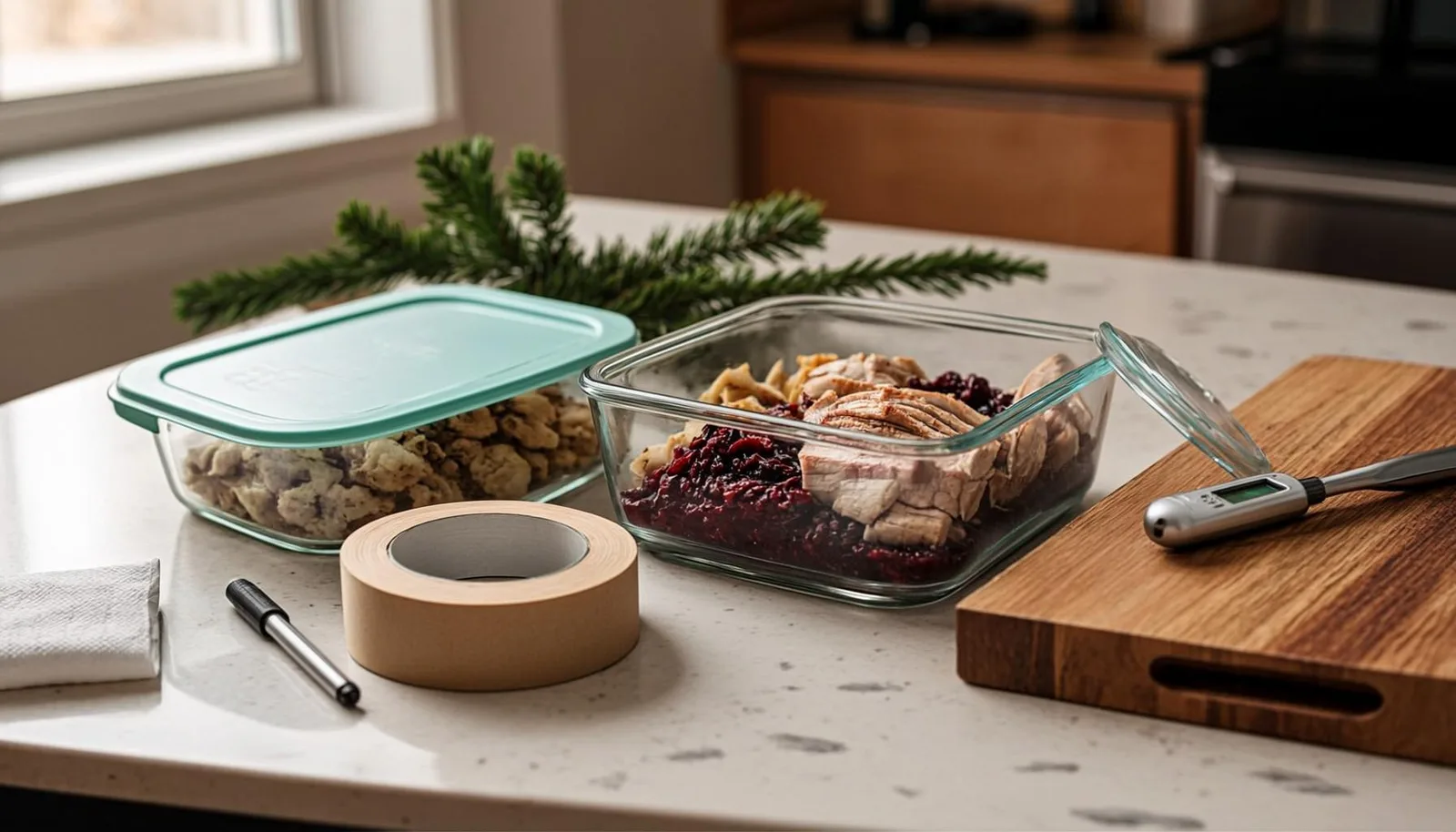
- Take the turkey off the bone. The Quebec government and Health Canada ask you to remove the meat from the carcass and divide it into small containers. The carcass goes into the pot for a turkey carcass broth.
- Choose shallow containers. The thinner the layer, the faster the cold reaches the centre. Health Canada recommends leaving them uncovered, or loosely covered, until they are cold, then closing them.
- Cool large volumes in ice water. For a big pot of gravy or soup, the Quebec government advises a cold or ice-water bath while stirring, before the fridge.
- Do not cram the fridge. Cold air needs to circulate around the containers, Health Canada reminds us.
- Separate and date. Store the turkey apart from the stuffing and gravy, as Health Canada recommends, and write the date on each container.
The fridge should stay at 4°C or lower and the freezer at -18°C or lower. During the holidays, when the door opens a hundred times a day, a small fridge thermometer is worth its weight in gold.
How many days in the fridge and months in the freezer
This is where the sources do not all say the same thing. Health Canada, on its leftovers tips page, recommends eating them within 2 or 3 days. Its leftovers infographic instead gives 3 to 4 days for cooked poultry and cooked dishes. The Quebec government and the USDA also say 3 to 4 days. The most cautious rule: aim for 2 or 3 days, and freeze anything you will not eat within that time.
| Leftover | Fridge (4°C or lower) | Freezer (-18°C or lower) | Source |
|---|---|---|---|
| Cooked turkey, no gravy | 3 to 4 days | 1 to 3 months | Quebec government |
| Cooked turkey, with gravy | 1 to 2 days | 6 months | Quebec government |
| Cooked poultry and fish | 3 to 4 days | 4 to 6 months | Health Canada (infographic) |
| Cooked dishes with eggs, meat and vegetables (meat pies, stews, casseroles) | 3 to 4 days | 2 to 3 months | Health Canada (infographic) |
| Broth, stock and gravy | 3 to 4 days | 4 to 6 months | Health Canada (infographic) |
| Soups | 2 to 3 days | 4 months | Health Canada (infographic) |
| Leftovers in general | 2 to 3 days | not specified | Health Canada (leftovers tips) |
The most telling comparison is the turkey: plain, it keeps 3 to 4 days in the fridge according to Quebec; drowned in gravy, only 1 to 2 days. If you want your turkey to last longer, store the meat and the gravy in separate containers.
In the freezer, you need to separate safety from quality. The USDA explains that leftovers kept frozen stay safe indefinitely, but lose moisture and flavour over time; it suggests 3 to 4 months for best quality. The Quebec government makes the same distinction: frozen food can remain safe while losing taste, texture and nutritional value. The times in the table are therefore quality guidelines, not expiry dates.
Turkey, stuffing and gravy: the special cases
Stuffing is the weak spot of the meal. Health Canada explains that it is moist and cools slowly, which encourages bacterial growth. Its recommendation: cook it separately, in a dish or on the stovetop, to at least 74°C. If you insist on stuffing the turkey, stuff it loosely just before it goes into the oven and remove all the stuffing as soon as cooking is done. The Quebec government adds a clear instruction: never stuff the turkey the day before.
For the cooking itself, the Quebec government and Health Canada give 82°C for a whole bird (measured with a thermometer in the thickest part), and Quebec gives 74°C for breasts cooked on their own. After the meal, the stuffing goes into its own container, separate from the meat and gravy, as Health Canada asks.
Gravy and broth also deserve attention: they are among the foods the CDC name for C. perfringens. Cool them quickly, in small jars, and freeze what will not be used within a few days. They freeze very well, 4 to 6 months according to Health Canada. A jar of homemade broth in the freezer is also a good habit against food waste; more ideas in how to avoid food waste at home.
Reheat to 74°C, only once
The number to remember: 74°C (165°F) in the centre, for turkey, potatoes, meat pies and casseroles. Health Canada and the Quebec government recommend checking it with a thermometer. Sauces, soups and gravy should be brought to a boil while stirring. The USDA notes that you can reheat frozen leftovers without thawing them first; it just takes longer.
In the microwave, heat is uneven. Health Canada advises loosening the lid, stopping halfway to stir and turning the dish if there is no turntable. The Quebec government adds to cover the food to keep it moist, then wait two minutes before eating, and to use microwave-safe containers. One last point: reheat only the portion you are going to eat. Health Canada asks that reheated leftovers that were not eaten be thrown out.
To thaw, forget the counter: the Quebec government rules it out. Use the fridge (the safest), the microwave (cooking right after) or cold water, changed regularly so it stays at 21°C or lower.
True or myth: 6 common beliefs about leftovers
"Leftovers should cool on the counter before going into the fridge." Myth.
Health Canada allows waiting until the steam stops, no longer. Then straight into the fridge, in shallow containers. The Quebec government points out that hot food does not go bad in the fridge and that the danger comes from cooling too slowly; the USDA confirms that a hot dish can go directly into the fridge. Leaving the turkey on the counter all evening is the real mistake.
"If it smells fine, it is fine." Myth.
The USDA distinguishes two families of bacteria. Those that spoil food cause bad smells and slimy textures, but rarely make people sick. Those that cause food poisoning generally change neither the taste, the smell nor the appearance. Health Canada is categorical: do not rely on your nose, your eyes or your taste buds. When in doubt, throw it out.
"In the freezer, leftovers keep forever." True, but…
In terms of safety, the USDA says yes, as long as the freezer stays at -18°C. In terms of taste, no: after a few months, turkey dries out and gravy loses flavour. The times in the table are about quality.
"You can reheat the same dish several times." Myth.
Health Canada asks that reheated leftovers that were not eaten be thrown out. Take the portion for one meal out of the fridge, not the whole dish.
"You can stuff the turkey the night before to save time." Myth.
The Quebec government rules it out, because it encourages microbial growth. Prepare the stuffing ahead if you like, but keep it in the fridge and stuff at the last minute, or cook it separately.
"The 2-hour rule starts when you leave the table." Myth.
According to the USDA, it starts at the end of cooking or as soon as the dish leaves the oven or warmer. The turkey's resting and carving time counts.
With these guidelines, your holiday leftovers can feed the family for several days, and the freezer takes over for January. For a post-holiday season with less waste overall, also have a look at our article on reducing holiday and celebration waste.
Free gift: get The Quebec Recipe Advent Calendar, 24 recipes ready in 30 minutes or less with local ingredients, one a day until Christmas Eve. The same page gathers all our holiday recipes and guides.
Sources
- Food safety tips for leftovers, Health Canada, 2025.
- Storing leftovers (infographic), Health Canada, 2024.
- Holiday food safety, Health Canada, 2017.
- Dinde et repas des fêtes (in French), Gouvernement du Québec (MAPAQ), 2024.
- Refroidir, réchauffer et décongeler les aliments (in French), Gouvernement du Québec (MAPAQ), 2025.
- Leftovers and Food Safety, Food Safety and Inspection Service, USDA.
- Refrigeration and Food Safety, Food Safety and Inspection Service, USDA.
- About C. perfringens Food Poisoning, Centers for Disease Control and Prevention, 2026.
Frequently asked questions
How long can leftover turkey stay in the fridge?
The Quebec government gives 3 to 4 days for cooked turkey without gravy, but only 1 to 2 days if it is sitting in gravy. Health Canada more cautiously recommends eating leftovers within 2 or 3 days, or freezing them.
Can you put hot leftovers in the fridge?
Yes. According to Health Canada, a very hot dish can sit on the counter until it stops steaming, then go into the fridge in shallow containers, uncovered or loosely covered. The Quebec government points out that hot food does not "go bad" in the fridge: the real problem is cooling too slowly.
What temperature should leftovers be reheated to?
To 74°C (165°F) in the centre, checked with a thermometer. Sauces, soups and gravy should be brought to a boil while stirring. Health Canada advises throwing out reheated leftovers that were not eaten.
How long does cooked turkey keep in the freezer?
Published times vary: 1 to 3 months for cooked turkey without gravy and 6 months with gravy according to the Quebec government, 4 to 6 months for cooked poultry according to Health Canada. The U.S. Department of Agriculture says leftovers kept at -18°C stay safe indefinitely, but lose quality.
If leftovers smell fine, are they safe?
Not necessarily. Health Canada reminds us that you cannot rely on smell, appearance or taste. The bacteria that make people sick generally do not change how food smells. When in doubt, throw it out.