Baby bottles and kids' dishes: is BPA still a risk in Canada?
Since 2010, polycarbonate baby bottles containing BPA have been banned in Canada, and estimated infant exposure has plummeted. But old dishes, "BPA-free" substitutes and a much stricter European opinion keep the doubt alive. Here is what is established, what is still under review and a few simple habits, without panic.
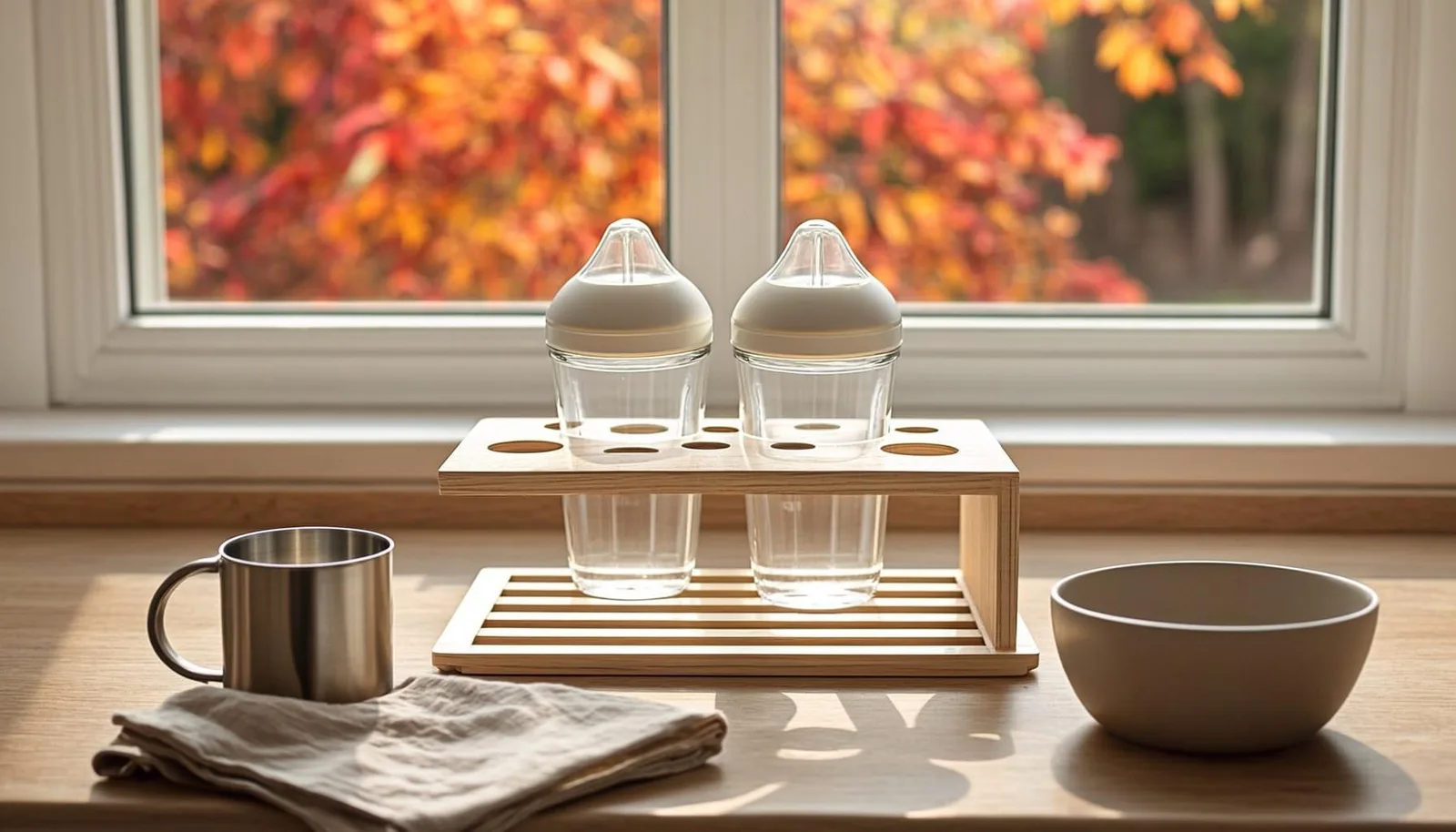
Bisphenol A, or BPA, made headlines in the late 2000s, when we learned it could move from the baby bottle into the milk. Many parents kept a reflex from that time: looking for the "BPA-free" label on anything that touches their child's mouth. Fifteen years later, the question deserves an update. BPA bottles have disappeared from Canadian shelves and infant exposure has dropped sharply, but the substitutes raise their own questions and Europe has toughened its stance.
Here, without alarmism, is what we really know, what is still being assessed and the few habits worth adopting. For the bigger picture of plastic in the kitchen, see our main guide: Microwaving plastic: what Health Canada really says about bisphenols.
What is BPA, and why baby bottles?
BPA is an industrial chemical used to make polycarbonate, a hard, clear plastic. It is also used in some resins that line the inside of food and drink cans. Health Canada notes it may be present in food storage containers, pitchers, tableware, reusable water bottles, thermal paper receipts, some packaging materials and older polycarbonate baby bottles.
The baby bottle was at the heart of the debate for a simple reason: polycarbonate releases BPA when it comes into contact with hot or boiling liquid, and a baby drinks a lot relative to its body weight. According to the 2018 federal evaluation, estimated infant exposure was 4.3 µg per kilogram of body weight per day at the time of the 2008 assessment. For the general population, Health Canada had already concluded that exposure was low to very low and posed no health risk. It was the possible sensitivity of the youngest children that justified precautionary measures.
The 2010 ban: what it covers, and what it doesn't
Since March 2010, manufacturing and selling polycarbonate baby bottles containing BPA has been prohibited in Canada, according to the federal biomonitoring report. Today, the Canada Consumer Product Safety Act governs this ban: it makes it illegal to manufacture, import, advertise or sell these bottles.
The measure worked. During inspections, only one non-compliant bottle sample was found in 2011, and none in 2013. Health Canada also worked with industry to remove BPA from liquid infant formula packaging: by December 2014, the major manufacturers had done so, and a sampling of 10 products detected no BPA. The result, according to the 2018 evaluation: estimated infant exposure fell from 4.3 to 0.18 µg/kg per day, a 96% drop, and what remains comes mostly from household dust.
What the ban does not cover: children's dishes in general. Polycarbonate cups, plates, bowls or containers are not targeted by this bottle-specific rule. In practice, Health Canada considers that exposure from food packaging does not pose a health risk to Canadians, including infants. The issue lies mostly with old items sitting in cupboards or passed from family to family.
If your child's colourful dishes are sold as "bamboo", that is a whole other question, unrelated to BPA: we explain it in our article on bamboo fibre tableware pulled in Europe.
Has exposure really dropped here?
Measurements in Canadians' urine point the same way. The Canadian Health Measures Survey detects BPA in the vast majority of people aged 3 to 79, but the concentration drops from one cycle to the next. The geometric mean went from 1.2 µg/L in 2009-2011 to 0.81 µg/L in 2016-2017, and the share of people in whom it is detected went from 93.8% to 81.5%. Among 3- to 5-year-olds, the mean fell from 1.4 to 0.94 µg/L between those two periods.
Two caveats apply. First, finding BPA in urine indicates recent exposure, not a harmful effect: Health Canada makes that point itself. Second, these data do not cover babies aged 0 to 2, since there is no repeated survey for that group, as the 2018 evaluation acknowledges. Food remains the main source for the population, notably through BPA migrating from packaging and polycarbonate containers. Health Canada also recommends keeping exposure as low as reasonably achievable.
"BPA-free" substitutes: BPS, BPF and company
The "BPA-free" label says what a product does not contain. It does not say what replaced the BPA. Health Canada acknowledges this: regulating BPA and the popularity of BPA-free products have increased the use of substitutes, making it important to understand their risks. The federal government has therefore launched a review of 343 structural analogues and functional substitutes of BPA, with a technical consultation in 2020 and a data-gathering notice in November 2021 covering 188 substances. To date, the federal page presents no risk conclusion for these substances.
On the research side, a systematic review published in 2015 in Environmental Health Perspectives analyzed 32 studies on bisphenol S (BPS) and bisphenol F (BPF). The authors conclude that these two substitutes have hormonal activity of the same order of magnitude as BPA. Keep in mind, though, that 25 of those studies were done only on cells in the lab, and seven on animals. That is not proof of effects in children, but it is a good reason not to see "BPA-free" as an absolute guarantee.
Why Europe is stricter
In April 2023, the European Food Safety Authority (EFSA) set a new tolerable daily intake for BPA of 0.2 nanograms per kilogram of body weight, about 20,000 times lower than the temporary value of 4 micrograms set in 2015. It relies on possible effects on the immune system seen in animals, and concludes that European consumers with average or high exposure exceed this threshold, in all age groups. EFSA itself describes this scenario as cautious, since it relies on exposure estimates from 2015.
Health Canada, for its part, has not changed its conclusion: dietary exposure from packaging is not expected to pose a risk, including for infants. The two agencies do not read the same data the same way. For a parent, the practical takeaway is the same on both sides of the Atlantic: reduce young children's exposure when it is easy to do, without throwing out the whole kitchen.
Simple habits worth adopting
No need to replace everything. A few reflexes cover the essentials:
- Buy new bottles. That is what the INSPQ guide Mieux vivre avec notre enfant de la naissance à 6 ans recommends, noting that bottles sold in Canada do not contain polycarbonate. Glass, plastic or disposable bags: each type has its pros and cons.
- Check old items. For an older bottle, cup or container, Health Canada advises looking for the triangle of arrows with the number 7, then the marking "PC" or "polycarbonate". Both together signal an item that may contain BPA. If in doubt, contact the manufacturer. To decode the other numbers, read our article on what the numbers in the triangle mean.
- Warm milk without the microwave. A few minutes in a bath of hot water is enough. The microwave heats unevenly and can burn the baby, glass and bags can burst, and breast milk loses some of its vitamins and antibodies. Check the temperature on the inside of your wrist, and know that milk does not need to be warm to be nutritious.
- In the microwave, for the rest of the family, use glass or food-grade plastic labelled microwave safe, and set aside containers that are visibly damaged, stained or smell bad, as Health Canada recommends.
- To store food, Health Canada suggests stainless steel, glass or food-grade plastic.
- Cash register receipts on thermal paper are also on Health Canada's list of BPA sources. Nothing dramatic, but there is no point turning them into toys for little ones.
If you want to replace your containers gradually, do it in the right order rather than throwing everything out at once: our guide to replacing plastic containers without waste helps you prioritize. To go further, our plan to cut back on plastic and our tips to limit microplastics day to day cover issues beyond BPA. For any concern about your child, Info-Santé 811 remains the right place to start.
Sources
- Bisphenol A (BPA), Health Canada, 2020.
- Bisphenol A (BPA) risk management approach: performance evaluation for BPA-HEALTH component, Environment and Climate Change Canada and Health Canada, 2018.
- Fifth Report on Human Biomonitoring of Environmental Chemicals in Canada, bisphenol A section (in French), Health Canada.
- Structural analogues and functional substitutes of bisphenol A (in French), Health Canada, 2023.
- Bisphenol S and F: A Systematic Review and Comparison of the Hormonal Activity of Bisphenol A Substitutes, J. R. Rochester and A. L. Bolden, Environmental Health Perspectives, 2015.
- Bisphenol A in food is a health risk (in French), European Food Safety Authority (EFSA), 2023.
- Choisir les biberons et les tétines (in French), Mieux vivre avec notre enfant de la naissance à 6 ans, INSPQ.
- Tiédir le lait (in French), Mieux vivre avec notre enfant de la naissance à 6 ans, INSPQ.
Frequently asked questions
Do baby bottles sold in Canada still contain BPA?
Polycarbonate baby bottles containing BPA have been banned since 2010. Federal inspections found only one non-compliant sample in 2011 and none in 2013. New bottles sold here are therefore no longer considered a source of exposure.
Can I use my older child's bottle or a second-hand one?
Better not. The guide Mieux vivre avec notre enfant de la naissance à 6 ans recommends buying new bottles. An old bottle may predate the ban: if it has the number 7 in the triangle and the marking PC or polycarbonate, it may contain BPA.
Is a "BPA-free" bottle bisphenol-free?
Not necessarily. The label only says there is no BPA, not what was used instead. Health Canada is reviewing more than 300 BPA analogues and substitutes, and a review of 32 studies found that BPS and BPF had hormonal activity of the same order as BPA, mostly in the lab.
Can I warm my baby's milk in the microwave?
It is not recommended, but not mainly because of the plastic: the microwave heats unevenly and can burn the baby, glass bottles and bags can burst, and breast milk loses some of its vitamins and antibodies. A few minutes in a bath of hot water is enough.
Why is Europe stricter than Canada?
In 2023, EFSA lowered its tolerable daily intake for BPA about 20,000-fold, based on possible effects on the immune system seen in animals. Health Canada maintains that dietary exposure is not expected to pose a risk, while recommending keeping it as low as possible. The two agencies do not read the same data the same way.


