Aronia and sea buckthorn: two hardy fruit shrubs to plant for next year
Aronia, native to Quebec, and sea buckthorn, from Eurasia, both survive Zone 2 winters and both have a strong health reputation. But one is astringent, the other thorny, and sea buckthorn produces nothing without male and female plants. Here is what you need to know this fall to choose, prepare the spot and plant in spring.
While you wait for the first frost to pick mountain ash berries and highbush cranberries (see our guide to mountain ash and highbush cranberry and our foraging calendar), it is also time to think about what you will plant in spring. Two fruit shrubs deserve your attention: aronia and sea buckthorn. Both survive Zone 2 winters and both have a strong health reputation.
Yet they are grown in very different ways: one can be planted alone and is very forgiving, while the other needs male and female plants, sun and space. Here is what agricultural sources say about them, and what their health benefits are really worth.
Two hardy shrubs, two personalities
Aronia, or black chokeberry (Aronia melanocarpa), is native to Quebec, according to the Canadian database VASCAN. This 1 to 2 m shrub blooms in May and bears small black fruit, 6 to 8 mm across, ripe in August and September, according to MAPAQ, Quebec's agriculture department. Watch the name: chokeberry is easily confused with chokecherry (Prunus virginiana), whose leaves, stems and pits contain toxic amounts of hydrocyanic acid, Iowa State University warns.
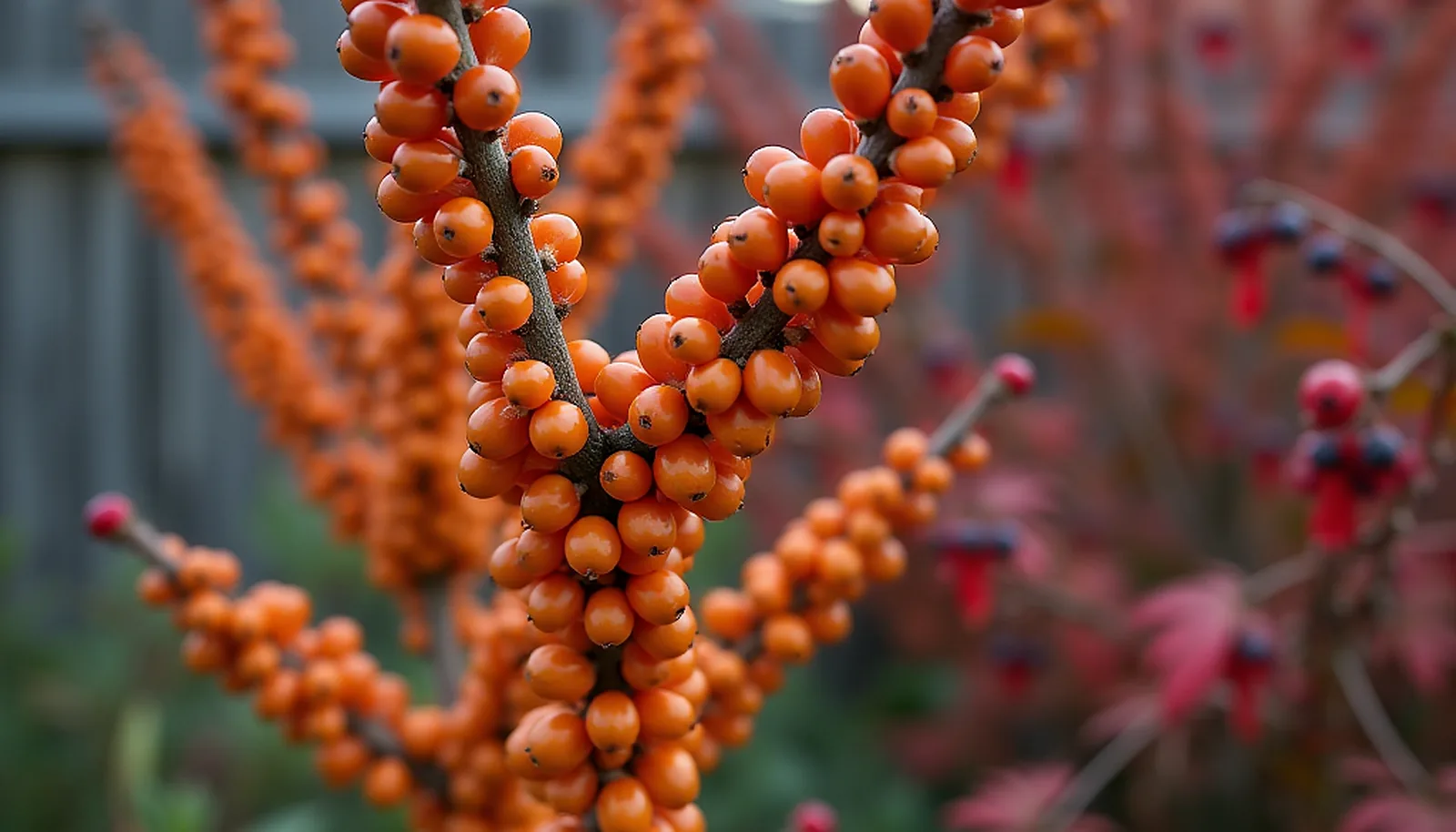
Sea buckthorn (Hippophae rhamnoides) comes from northern Europe and Asia. VASCAN lists it as introduced in Quebec, where the guide Argousier au Québec by the Cultur'Innov cooperative reports small naturalized colonies. Its thorny branches carry narrow leaves, green on top and silvery underneath, and yellow, orange or almost red fruit less than 1 cm across.
In the wild, the rule is the same for any shrub with small fruit: when in doubt, do not pick. If someone has eaten a doubtful fruit, call the Quebec Poison Control Centre (Centre antipoison du Québec) at 1 800 463-5060.
The two shrubs at a glance:
| Criterion | Aronia | Sea buckthorn |
|---|---|---|
| Status in Quebec | Native | Introduced from Eurasia |
| Height | 1 to 2 m | 1 to 10 m, depending on the cultivar and whether it is pruned |
| Hardiness | Zone 2a | Up to Zone 2b; -43°C when dormant |
| Sun | Full sun is best, tolerates part shade | Full sun required |
| Soil | Almost any; best when well drained | Well drained, at least 70 cm deep, pH 6 to 7 |
| Pollination | Self-fruitful: one plant is enough | Male and female plants; only females bear fruit |
| First fruit | Year 2 to year 4 | Year 4; full production around year 7 |
| Yield per plant | About 2.4 kg (Quebec trial) | 3 kg per female in Quebec; 5 to 7 kg according to Manitoba |
| Harvest | August and September | August to late September in Quebec, depending on the cultivar |
| Fresh flavour | Very astringent | Tart and aromatic |
| Main challenge | Birds | Thorns, suckers and picking |
Hardiness, sun and soil: choose the spot this fall
MAPAQ rates aronia as "very hardy," in Zone 2a. According to Cultur'Innov, sea buckthorn is grown in Quebec up to Zone 2b, and dormant plants tolerate -43°C. A word of caution: American extension services, such as Iowa State's (Zone 3 for aronia), use USDA zones, which do not compare directly with ours. Our article on the new Canadian plant hardiness zone map explains the difference and how to find your zone.
For sea buckthorn, surviving is not enough: the fruit also has to ripen. Some late cultivars fail to ripen their fruit in Zone 4a or colder, Cultur'Innov warns; in cold regions, favour early cultivars, such as those of Russian origin, which ripen sooner.
Aronia: easygoing
Aronia tolerates a wide range of soils, from poorly drained, almost boggy sites to well-drained loam, Ohio State University observes, putting its ideal pH between 6 and 6.5 (MAPAQ says 5.0 to 6.5). It still does best in well-drained soil and full sun, Iowa State adds. One precaution: it blooms in late spring, when frost is still possible, so avoid low spots where cold air collects.
Sea buckthorn: full sun, dry feet and room to spread
Sea buckthorn must be grown in full sun, Cultur'Innov insists. It prefers a well-drained, uncompacted loam or sandy loam at least 70 cm deep, with a pH of 6 to 7 and no standing water. Thanks to Frankia, a bacterium living in nodules on its roots, it fixes nitrogen from the air and copes with poor soils, as long as it does not lack water. It also tolerates salt, according to the Government of Manitoba, and in Quebec you see it on highway medians. That is not the place to pick.
Above all, plan for space. Most of its roots run in the top 50 cm of soil, beyond the width of the branches, and it produces suckers, shoots that quickly become independent. How many depends on the cultivar: Leikora, for example, suckers heavily. In commercial plantings, Cultur'Innov recommends 1.5 to 2 m between plants. Keep it away from the vegetable garden and flower beds, in the sunniest, best-drained corner of your yard: our article on garden microclimates will help you find it.
Prepare this fall, plant in spring
According to Cultur'Innov, bare-root sea buckthorn is planted in spring while still dormant; potted plants can also go in at the end of summer or in early fall. In mid-October, it is better to prepare the spot now and plant in spring. Start by getting rid of perennial weeds, because young plants handle competition poorly; some growers even lay their mulch the fall before. For the steps, follow our guide on how to plant a tree.
Pollination: aronia goes solo, sea buckthorn needs a pair
Aronia is self-fruitful: a single plant bears fruit, Ohio State and Iowa State universities confirm. A second cultivar can still increase the harvest, Ohio State adds.
Sea buckthorn, on the other hand, is dioecious: male and female flowers grow on separate plants, and only females bear fruit. Pollen travels by wind alone, so place at least one male near your females, on the side the prevailing winds blow from, mostly southwest or west in most of Quebec, according to Cultur'Innov. Quebec commercial plantings use about one male for 10 to 12 females; Manitoba recommends 7 to 12% pollinators, because too many males reduce the harvest. In a garden, even two females need their male.
The trap when buying: a sea buckthorn grown from seed only reveals its sex when it flowers, Manitoba warns. Choose named cultivars propagated from cuttings instead, so their sex is known. Among those Cultur'Innov describes, Lord, Gnom and Pollmix are males; Sunny, Mary, Klavdija, Chuyskaya and Leikora are females. Lord and Gnom release their pollen early, Pollmix later: ask for a male that blooms at the same time as your females. On a mature plant, female buds have two small scales; male buds have 6 to 8 and are larger. For apple trees, haskaps or dwarf sour cherries, see our article on choosing fruit trees by hardiness zone.
Where to find plants in Quebec
Look for them at garden centres, at nurseries specializing in hardy fruit shrubs or, for aronia, at native plant growers. Three habits:
- Insist on the cultivar name. For fruit, Ohio State and Iowa State name aronia cultivars such as Nero, Viking or Galicjanka; Autumn Magic is more ornamental, and McKenzie is mainly used for windbreaks.
- For sea buckthorn, check the sex on the label and add a male to your order.
- Taste before you choose: some Quebec sea buckthorn growers offer pick-your-own.
Timing, yields and harvest
Aronia: quick to bear, easy to pick
Under ideal conditions, aronia bears from its second year, according to Iowa State; MAPAQ puts the first fruit at around 3 or 4 years. IRDA researchers obtained 2.4 kg per plant in mineral soil, MAPAQ reports.
Do not rely on colour alone: Ohio State and Iowa State advise harvesting based on sugar. The fruit becomes edible at about 18% sugar and can reach 22 to 24%, and fully ripe fruit is completely black: taste before picking everything. Firm, the fruit is easy to pick by hand, according to MAPAQ. Your competitors: birds, which love ripe fruit (netting can help, according to Ohio State), then deer and rabbits, against which Iowa State advises fencing young plants.
Sea buckthorn: patience and thick gloves
Among the growers followed by Cultur'Innov in 2020 and 2021, a female plant produces nothing in its first three years (the planting year counting as the first), then about 0.3 kg in the fourth, 1.8 kg in the fifth, 2.5 kg in the sixth and 3 kg a year from the seventh on, in saleable fruit and with optimal management. Manitoba suggests 5 to 7 kg per plant instead.
In Quebec, Cultur'Innov observed ripe fruit from early August to late September in the Eastern Townships (Estrie) and Centre-du-Québec from 2019 to 2021: the date varies with the cultivar, and very hot weather speeds up ripening and shortens the harvest. In Manitoba, the fruit ripens around the end of August or the beginning of September. It is ready when its colour is intense over the whole cluster and the flesh gives slightly under your finger. It does not ripen further once picked and rarely drops, but do not wait too long: a late harvest lowers quality, and the fruit gradually turns rancid, Cultur'Innov warns.
Picking is the real challenge: the fruit clings to the branch and its delicate skin tears easily. By hand, you pick 1 to 1.5 kg an hour. In Quebec, the usual method is to cut fruit-laden branches with pruners, then freeze them: once frozen, the fruit comes off without damage. But flower buds form on two-year-old wood, so cutting too much reduces the next harvests: on a healthy plant, growers who harvest every year aim to remove about 30% of the foliage. And wear thick gloves: thorniness varies by cultivar, Russian ones generally being the least thorny.
Flavour: two fruits you process more than you eat fresh
Very astringent because of its tannins, aronia is rarely eaten fresh, MAPAQ notes, but the astringency mellows considerably once the fruit is processed, according to Iowa State. MAPAQ suggests jellies, fine vinegars and sauces, and a juice to drink on its own or mixed with apple or grape juice. Ohio State found its jams, alone or with raspberries, very tasty, and suggests adding the freeze-dried fruit to baked goods or smoothies.
Sea buckthorn stands out for its aroma and tartness; it is even nicknamed "Siberian pineapple." Fresh, it mostly appeals to people who like sour flavours, but the taste varies with the cultivar: Russian ones are generally sweeter, and Cultur'Innov ranks Chuyskaya among the most appreciated. It is made into juice, jams and jellies, the whole fruit is frozen, and its leaves make a tea that tastes like green tea.
Health benefits: what is proven, and what is not
Aronia is often sold as a "superfruit": it owes this label to its high antioxidant content, Ohio State explains, noting that the name "aronia berry" replaced "chokeberry" in the United States to market it better. Sea buckthorn, for its part, goes into cosmetics and health products, Cultur'Innov points out.
Aronia: plenty of pigments, little proof
What is established: aronia is very rich in anthocyanins and flavonoids, according to MAPAQ. What is not: a proven effect on cardiometabolic health. In 2025, a critical meta-analysis published in Nutrients pooled 10 randomized trials in 666 adults, using juice (100 to 300 mL a day) or extracts and powders in capsules. The result: no significant improvement in blood pressure, cholesterol, triglycerides, fasting blood sugar or weight, with "very low" certainty; a few signals in subgroups remain to be confirmed. Earlier meta-analyses had found lower cholesterol or systolic blood pressure, but they included non-randomized studies or poorly matched placebos, the authors explain.
Sea buckthorn: vitamin C and a few leads
What is established: sea buckthorn is rich in vitamin C, with a content that varies widely with genetics, growing conditions and ripeness, according to a University of Turku thesis in Finland. The record levels, over 1 g per 100 mL of juice, come from a Chinese subspecies. For Russian and German cultivars, like those grown in Quebec, the thesis reports 30 to 370 mg per 100 mL of juice or per 100 g of fruit instead; for comparison, oranges contain about 50 mg per 100 g. Sea buckthorn has a long history in traditional Chinese medicine, but most of the effects studied were observed in the lab or in animals, the same thesis points out.
The thesis reports two randomized placebo-controlled trials. In healthy adults, 28 g of berries a day for three months prevented neither colds nor other infections and did not change cholesterol; C-reactive protein, a marker of inflammation, did decrease, however. In people with dry eyes, 2 g of sea buckthorn oil a day for three months limited the rise in tear osmolarity during the cold season and eased some symptoms. These are leads, not solid proof, and they justify no health promises.
For heart and metabolic health, the latest evidence is thin. A meta-analysis published in 2026 in Trends in Food Science & Technology pooled 12 randomized trials of sea buckthorn in 901 adults, using whole berries, purees, powders, extracts or oils for 4 to 12 weeks. The result: no significant effect on cholesterol, triglycerides, systolic blood pressure or body mass index. Fasting blood sugar and diastolic pressure dropped slightly, but so little that the authors consider the effect clinically negligible. Their verdict: "very low" certainty for every outcome, and still too few participants to draw conclusions.
Plant them for the pleasure of harvesting hardy, colourful fruit, not for a promise on a label.
Sources
- La culture de l'aronia au Québec… un aperçu! (growing aronia in Quebec, an overview; in French), André Gagnon, agronomist, MAPAQ Saguenay–Lac-Saint-Jean, 2012.
- Argousier au Québec, section 1.2: description de la plante (sea buckthorn in Quebec, plant description; in French), and sections 1.3 (development stages), 1.4 (cultivars), 1.5 (uses of the plant), 2.1 (site selection), 2.2 (orchard layout), 2.3 (layout plan), 2.4 (site preparation), 2.5 (planting) and 5.1 (harvest), Coopérative de solidarité Cultur'Innov, 2022.
- Growing Aronia (Aronia melanocarpa) in Ohio, G. Y. Gao, R. Slaughter, E. Barrett and M. Rivera, Ohio State University Extension, 2024.
- Growing Aronia in Iowa, Joe Hannan, Iowa State University Extension and Outreach, 2015.
- Sea Buckthorn Production in Manitoba, Government of Manitoba (Agriculture).
- Aronia melanocarpa and Hippophae rhamnoides, Database of Vascular Plants of Canada (VASCAN), Canadensys.
- Impact of a Chokeberry (Aronia melanocarpa (Michx.) Elliott) Supplementation on Cardiometabolic Outcomes: A Critical Systematic Review and Meta-Analysis of Randomized Controlled Trials, O. Frumuzachi, A. Mocan, S. Rohn and L. Gavrilaș, Nutrients, 2025.
- The health effects of sea buckthorn berries and oil (doctoral thesis), Petra Larmo, University of Turku (Finland), 2011.
- Is sea buckthorn berry a sustainable intervention for the modulation of cardiometabolic risk factors? An updated, critical synthesis of randomized controlled trials with meta-analysis, trial sequential analysis, and GRADE certainty assessment, A.-G. Moroşan, A. Nicolescu, A. Mocan and O. Frumuzachi, Trends in Food Science & Technology, 2026.
Frequently asked questions
Do you need a male plant to get sea buckthorn fruit?
Yes. Sea buckthorn is dioecious: only female plants bear fruit, and they need pollen from a male plant, carried only by the wind. Place the male on the side the prevailing winds blow from, often the southwest or west in Quebec. Quebec plantings use about one male for 10 to 12 females; in a garden, even two females need their male.
Can a single aronia produce fruit?
Yes. Aronia is self-fruitful: a single plant of a single cultivar produces fruit. According to Ohio State University, a second cultivar can still aid cross-pollination and increase the harvest.
How many years do you have to wait for the first harvest?
For aronia, 2 to 4 years depending on the source: from the second year under ideal conditions according to Iowa State University, around 3 or 4 years according to MAPAQ, Quebec's agriculture department. For sea buckthorn, the Quebec growers followed by Cultur'Innov harvest a little fruit in the fourth year and reach full production around the seventh.
Do aronia or sea buckthorn lower cholesterol or blood pressure?
The trials do not show it convincingly. A 2025 meta-analysis of 10 aronia trials found no significant improvement in blood pressure, cholesterol or blood sugar, with very low certainty. For sea buckthorn, a 2026 meta-analysis of 12 trials found no significant effect on cholesterol or systolic blood pressure; the small drops in blood sugar and diastolic pressure were judged clinically negligible, again with very low certainty. They are good fruits, not treatments.
Is sea buckthorn invasive?
It suckers: its shallow roots spread beyond its branches and produce shoots that quickly become independent, more or less depending on the cultivar. Small naturalized colonies have been observed in Quebec. Plant it away from the vegetable garden and flower beds, in a spot where it has room, and keep an eye on the suckers.