Mountain ash and highbush cranberry (pimbina): the fruits to forage after frost, always cooked
When the leaves fall, two plants stay loaded with red and orange clusters: mountain ash and highbush cranberry, which Quebecers call pimbina. Bitter or musky when raw, their fruits become jellies and sauces once cooked and strained, perfect with game and cheese. Here is how to identify them with confidence, when to pick them and how to prepare them.
Only pick what you can identify with certainty, ideally with someone experienced. Some species are protected in Quebec (wild garlic, for example): check the rules before you harvest.
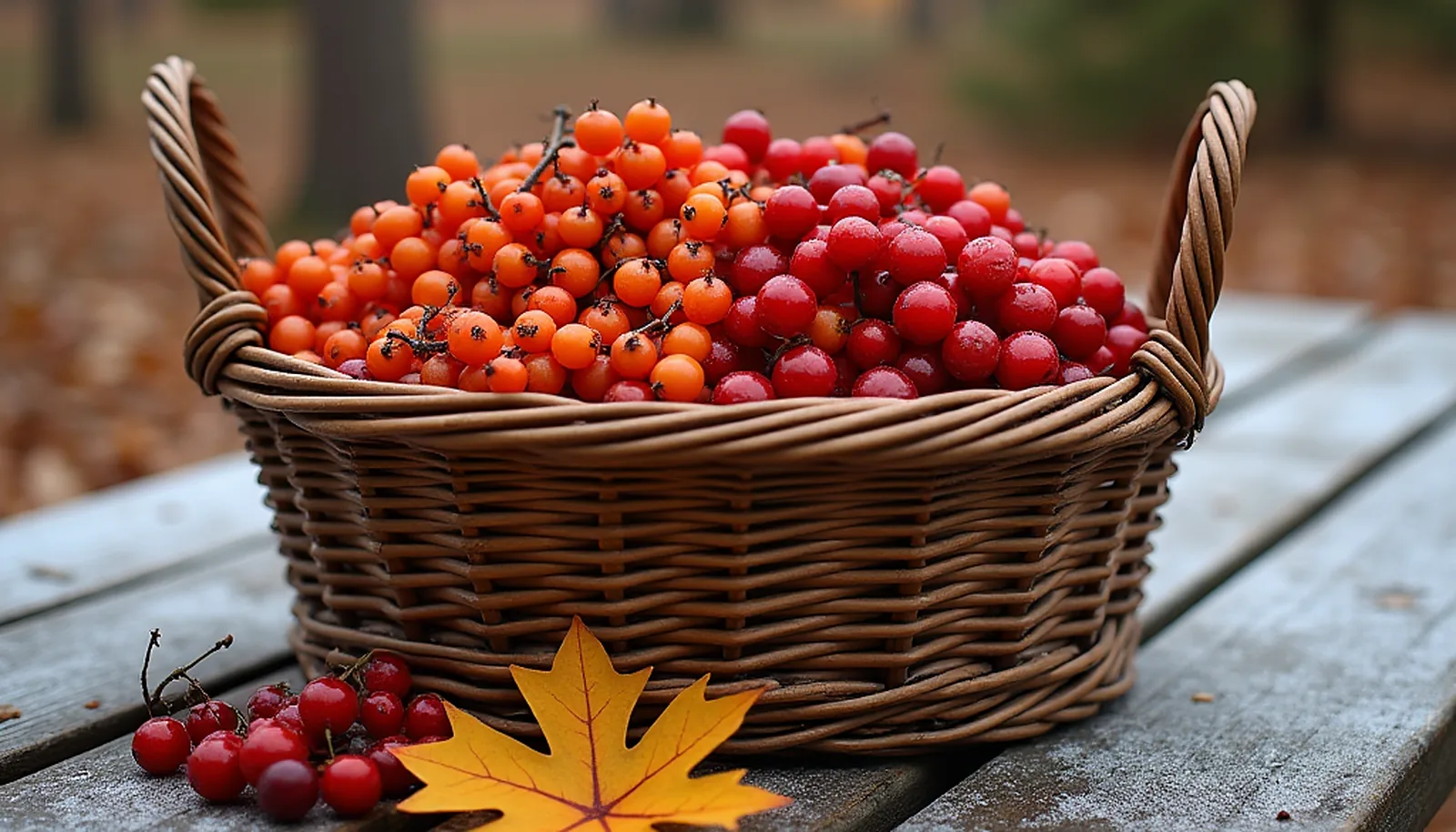
Once the maples have dropped their leaves, two plants stay loaded with red and orange clusters at the edge of the woods, by the water and even in yards, where they are planted as ornamentals: mountain ash and highbush cranberry, which Quebecers call pimbina. Raw, mountain ash berries are bitter and astringent; pimbina fruits are sour and musky. Cooked, strained and sweetened, they make jellies and sweet-and-sour sauces that go beautifully with game, lamb and cheese.
This guide helps you identify them with confidence, pick the right moment and prepare them, and it sums up why they are always eaten cooked. Our article on the small red fall berries not to confuse with rose hips touched on them briefly; it also covers the season's toxic berries. If you have already picked rose hips after the first frost, you know the drill: a well-identified fruit, a cooking pot, a strainer.
Identifying mountain ash: compound leaves and tiny orange apples
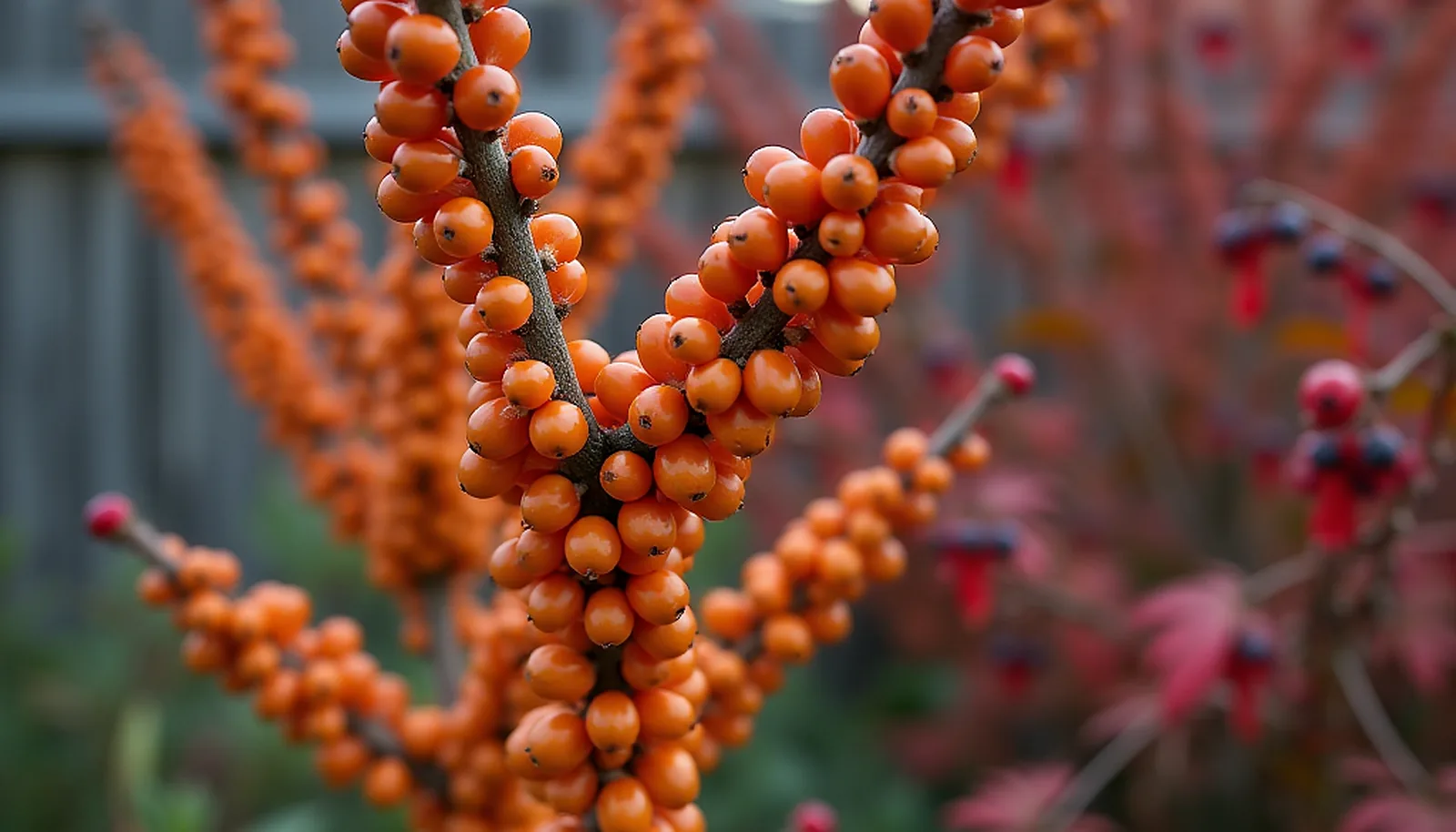
Mountain ash is a small tree in the rose family, the same family as the apple tree. Its fruits are in fact miniature apples, botanically speaking: bright orange to red, from 4 mm to about 1 cm depending on the species, in wide clusters. They ripen in late summer and often stay on the tree all winter.
The most reliable clue is the leaves. They are alternate, set one at a time along the twig, and compound: each leaf, 15 to 25 cm long, carries 11 to 19 toothed leaflets lined up on either side of a central stalk. In early summer, the tree is covered with small white five-petalled flowers, in flat or rounded clusters up to 13 cm across.
Three mountain ashes to tell apart
- American mountain ash (Sorbus americana), native to eastern North America, including southern Quebec. In Quebec French, it is also called cormier or mascouabina, a name of Innu origin, according to the Office québécois de la langue française (OQLF), Quebec's French-language office. Its leaflets are long and tapering (3.3 to more than 4 times as long as wide), its winter buds are shiny and sticky, and it can reach about 10 metres. Its fruits, 4 to 7 mm across, are smaller than those of showy mountain ash.
- Showy mountain ash (Sorbus decora), also native, found over much of the northeastern part of the continent. Its leaflets are proportionally wider (less than 3.3 times as long as wide), and both its flowers and fruits are a little larger: the fruits are mostly 7 to 11 mm across, according to the Flora of North America.
- European mountain ash, or rowan (Sorbus aucuparia), an ornamental tree of European origin that sometimes escapes from plantings. It is hairy: its leaf stalks, buds and leaflets bear hairs, and the tooth at the tip of each leaflet is no bigger than the others.
In the kitchen, the sources treat all three the same way. Just note that the data on parasorbic acid, further down, come from European mountain ash.
Identifying pimbina: maple-like leaves, lacy flowers and a flat stone
Highbush cranberry (Viburnum trilobum, also called Viburnum opulus var. americanum), viorne trilobée in French, is a native shrub up to 4 m tall, with upright, arching branches. In Quebec, it is mostly called pimbina, a word of Algonquian origin that also refers to its fruit, according to the OQLF. It grows in the woods and thickets of western and central Quebec, and the United States Department of Agriculture (USDA) describes it in wet woods, along streams and on moist wooded hillsides.
Its leaves look like those of a small maple: simple, 5 to 12 cm long, deeply cut into three lobes and coarsely toothed. They are opposite, in pairs, facing each other on the twig. Where the leaf blade meets the leaf stalk, you can see one to six glands, small bumps worth checking with a magnifying glass. In the fall, the foliage turns orange-red or reddish purple.
In June and July, the white flowers open in flat clusters 7 to 10 cm across: a ring of large, showy sterile flowers surrounds a centre of small fertile flowers, like lace. The fruits follow in August and September: bright red drupes 8 to 10 mm across, each holding a single, very flattened stone. Their smell is strong; Manitoba Agriculture reports that it has been compared to "dirty feet." The clusters often hang on all winter.
Two pimbinas in Quebec
According to the OQLF, the word pimbina actually refers to two species: highbush cranberry, in western and central Quebec, and Viburnum edule (viorne comestible in French), in the mountain woods and along the shores of eastern and northern Quebec. The latter is the one described, under the name highbush cranberry, in the University of Alaska Fairbanks guide cited below, where its fruits are made into juice, jelly, purée or sauce.
What about guelder rose?
Guelder rose (Viburnum opulus), viorne obier in French, is of European origin, often planted and sometimes escapes from gardens. It looks a lot like pimbina, but its fruits tend to be bitter, according to the USDA, and the cultivars derived from it are grown strictly as ornamentals. The most useful difference lies in the glands on the leaf stalk: in guelder rose, they are mostly hollowed into a small cup and wider than tall; in pimbina, raised into a dome or club shape and taller than wide. Even then, the sources do not agree on every detail: the USDA quotes a botanist for whom the variation between the two is too great and too continuous to draw clear distinctions, and notes that they can hybridize. All the criteria are in our article highbush cranberry or guelder rose: how to tell them apart. Good news: the "snowball bush" form of guelder rose, whose flowers are all sterile, bears no fruit.
Look-alikes to watch for, and the golden rule
Before picking, look at the whole plant: the shape and arrangement of the leaves, the growth habit, the inside of a fruit. Three cases deserve your attention.
- Red elderberry (Sambucus racemosa). Its leaves are compound, like those of mountain ash, but opposite, with only 5 to 7 toothed leaflets, and its small red fruits ripen in midsummer, from June to August. The Quebec Poison Control Centre (Centre antipoison du Québec, CAPQ) lists it among toxic plants. North Carolina State University's extension service rates its toxicity as low, but names its seeds, leaves and stems in particular among the poisonous parts.
- Guelder rose, described above. Nothing dramatic, but Germany's Federal Institute for Risk Assessment (BfR) classifies it as slightly toxic, mainly for its fruits: eating several raw can cause digestive upset.
- The season's other small red berries. Red baneberry, bittersweet nightshade, Canada yew and cotoneaster all appear on the CAPQ's list of toxic plants. Their identifying features are covered one by one in our article on the toxic small red berries of fall.
The golden rule: when in doubt, don't pick. The CAPQ is clear: never eat a wild plant unless you are absolutely certain of its identity and that it is edible, and a "non-toxic" plant is not necessarily edible. It also recommends keeping young children under constant supervision when picking wild berries. An app like the ones in our article on PlantNet, Seek and iNaturalist gives you a lead, never permission to eat.
If someone has swallowed fruits you cannot identify with certainty, call the Quebec Poison Control Centre at 1 800 463-5060, a free service available 24 hours a day. Keep a branch with its leaves and fruits, or a photo, to help identify the plant. If symptoms are severe, call 911.
Mountain ash or pimbina: a table to keep them straight
Once you have an eye for them, the two are hard to mix up: one has compound, alternate leaves, the other lobed, opposite leaves. Here are their features and uses side by side.
| Feature | Mountain ash | Pimbina (highbush cranberry) |
|---|---|---|
| Growth habit | Small tree, up to about 10 m | Shrub up to 4 m, with arching branches |
| Leaves | Alternate, compound, with 11 to 19 toothed leaflets | Opposite, simple, three-lobed, with small glands at the top of the leaf stalk |
| Flowers | Small, white, in flat or rounded clusters, in early summer | White, in flat clusters edged with large sterile flowers, in June and July |
| Fruits | Tiny bright orange to red apples, 4 mm to about 1 cm | Bright red drupes 8 to 10 mm across, a single flat stone, strong smell |
| Raw taste | Bitter and astringent | Sour and musky |
| Effect of frost | Several frosts mellow it | Softer and more palatable, but less pectin |
| Why cook it | Bitterness; parasorbic acid, which heat is thought to convert (not measured) | Taste and stones; can be confused with guelder rose, slightly toxic raw |
| Preparation | Destem, cook with crabapples or apples, strain | Destem, cook, strain for jelly or put through a food mill for sauce |
| Classic uses | Jelly for game, lamb and cheese; juice; alcoholic drinks | Jelly, sweet-and-sour sauce, ketchup, juice, wine and liqueur |
| Look-alike to watch | Red elderberry: compound but opposite leaves, fruits in summer | Guelder rose: leaf-stalk glands wider than high, bitter fruits |
Do you have to wait for frost? What the sources really say
"After the first frost": the advice is part of tradition, but the sources do not always agree on the reasons behind it.
Mountain ash: less bitter fruit
According to the University of Saskatchewan, mountain ash berries are extremely bitter before they are processed, and it takes several frosts to mellow them; that is when some people make their jelly. A scientific review published in 2020 in Antioxidants by Viive Sarv and colleagues adds that parasorbic acid, the irritating compound in the raw fruit, would break down into harmless compounds after the first frost, and that freezing would have the same effect. A word of caution: for frost, the authors cite a single reference, a 2014 Czech study of hybrid mountain ash that does not mention frost or freezing and did not measure parasorbic acid. We found no measurements confirming this effect. Cooking remains the rule.
Pimbina: milder, but with less pectin
For pimbina, opinions differ. Manitoba Agriculture notes that it is often picked after a frost, which turns the fruit, hard and sour before it ripens, softer and more palatable. But it then loses pectin, the substance that makes jelly set: for jelly, Manitoba advises harvesting fruit slightly before it is ripe. The USDA agrees: wild pimbina is usually picked in late August or early September, ideally slightly underripe. Picked after a hard frost, the fruits are softer and more palatable, but give off a musty smell during cooking. The University of Alaska Fairbanks also observes that Viburnum edule fruits soften and sweeten a little after the first frost.
And the smell? Manitoba and the USDA are not describing the same situation. According to Manitoba, the fruit's natural smell disappears during cooking, and a bit of lemon or orange peel helps get rid of it. The USDA instead describes a musty smell that develops when fruit picked after a hard frost is cooked, and the University of Alaska Fairbanks says Viburnum edule fruit has a musty flavour and smell. Our advice: for jelly, mix clusters picked before and after frost, or add crabapples, which are rich in pectin; for a sauce or juice, frost-softened fruit works just fine.
The birds wait too
According to the USDA, pimbina fruits often stay on the shrub all winter, a sign that they are not wildlife's favourite: birds usually eat them only after they have frozen and thawed several times. Robins, cedar waxwings and grouse eventually feast on them, as do deer, moose and foxes. Birds love mountain ash berries too, notes the University of Saskatchewan. In November, you are dipping into wildlife's winter pantry.
Why they are always eaten cooked
Always cooked, yes, but not because these fruits are dangerous: it comes down to taste, a little chemistry and caution.
Mountain ash: bitterness and parasorbic acid
According to the review by Sarv and colleagues, wild mountain ash berries are not eaten fresh because of their astringent taste, mostly due to tannins. They also contain parasorbic acid, a compound that irritates the stomach lining and, in large amounts, can cause indigestion; the authors even mention kidney damage. The authors write that heat converts it into harmless sorbic acid, but they cite no source or measurement: nothing shows that it happens in a cooking pot. The seeds, for their part, contain prunasin, a substance that can release cyanide: the authors consider it essential to separate the seeds when processing the pomace, the pulp left after pressing. Cooking followed by straining holds back the seeds, and it is what every recipe we consulted does, even though its exact effect on parasorbic acid has never been measured.
The authorities, however, are not alarmed. The CAPQ lists American mountain ash among non-toxic plants, while pointing out that non-toxic does not mean edible. The BfR cites European mountain ash as an example of a non-toxic plant: only large amounts can cause digestive upset, usually mild. So the sources differ in tone, but not in practice: none of them recommends eating the berries raw. The chemistry, and what remains uncertain, is covered in our article why mountain ash berries must be cooked: parasorbic acid explained.
Pimbina: taste, stones and caution
For pimbina, none of the sources we consulted describes poisoning from the native fruit, which the OQLF and the USDA present as edible. But raw, it is sour, it smells strong and each fruit hides a large flat stone; its uses almost all involve cooking. And its cousin, guelder rose, is slightly toxic according to the BfR, which advises giving fluids to anyone who has swallowed 1 to 5 raw berries and seeing a doctor if symptoms appear; in Quebec, the first step is to call the Quebec Poison Control Centre at 1 800 463-5060. Since the two look alike and can hybridize, even if hybrids seem rare, the rule is the same: cooked and strained.
What is established, what is tradition, what remains uncertain
- Well documented: raw mountain ash berries are bitter and astringent; raw guelder rose fruit can cause mild digestive upset, according to the BfR.
- Tradition: waiting for frost before picking; serving mountain ash jelly or pimbina sauce with game.
- Uncertain: the real effect of cooking, frost or the freezer on parasorbic acid, which the 2020 review asserts without citing any measurement; how well people tolerate raw native pimbina, on which we found no data; the line between pimbina and guelder rose, hard to draw by eye.
Picking and preparing: destem, cook, strain
Where and how to pick
Look for mountain ash at forest edges, along streams and on rocky shores; for pimbina, in wet woods and along streams. Since the fruits hang on the branches for much of the winter, the season runs from late August into winter. Ornamental trees will do too, as long as you ask permission, follow the rules of the place and make sure they have not been sprayed.
Those rules are not the same everywhere. In Quebec's national parks, only berries may be picked, and only in ambiance zones, without leaving the trails and for your own consumption: mushrooms, plants and flowers are prohibited, according to the Sépaq parks' lists of activities. When in doubt, ask at the visitor centre. For the details, land by land, see our guide Foraging in Quebec parks. In the national parks of Canada, such as La Mauricie and Forillon, the federal regulations prohibit removing plants without a permit. In municipal parks, it depends on the city.
Avoid the edges of busy roads: the Woodland Trust, a British forest conservation charity, advises against picking there because of pollution, as well as from low branches along trails where dogs are walked. Cut whole clusters with pruning shears, knock them to dislodge insects and lay them in a basket rather than a bag.
Leave some for wildlife
Take a few clusters per tree or shrub and leave the rest: these fruits feed wildlife into the depths of winter. For one batch of jelly, the Woodland Trust recipe calls for about 1.5 kg of mountain ash berries: no need to strip a whole tree.
The basic method, in five steps
- Sort and destem. Remove the stems, leaves and any shrivelled or damaged fruit, as the University of Alaska Fairbanks and the Woodland Trust recommend. A tip from the University of Alaska Fairbanks: roll the fruit down a tilted towel; the debris sticks to the cloth.
- Rinse the fruit and drain it.
- Crush and cook. For pimbina, the University of Alaska Fairbanks crushes the fruit, adds about 250 mL (1 cup) of water per litre (4 cups) of fruit and simmers it for 10 minutes. For mountain ash, the Woodland Trust covers a mix of mountain ash berries and crabapples with water, then simmers it for about 20 minutes, until everything has broken down.
- Strain or use a food mill. For clear juice, meant for jelly or syrup, pour everything into a jelly bag or cheesecloth and let it drip without twisting or squeezing, for at least 4 hours or overnight according to the Woodland Trust: squeezing makes the jelly cloudy. For a purée or sauce, push the cooked fruit through a sieve or food mill instead, which holds back the stones and skins (University of Alaska Fairbanks).
- Use or freeze. Expect about 500 mL (2 cups) of juice per litre of fruit, according to the University of Alaska Fairbanks. Whole fruits freeze well spread on a tray, then bagged, and keep their quality for up to two years, again according to the University of Alaska Fairbanks.
For jelly, think pectin: the Woodland Trust pairs mountain ash with crabapples, and the University of Alaska Fairbanks adds commercial pectin to its pimbina jelly.
Jellies, sauces and juice: the classic uses
Mountain ash: the jelly for game
In the United Kingdom, the Woodland Trust offers a jelly that combines equal weights of mountain ash berries and crabapples (1.5 kg of each), then 450 g of sugar for every 600 mL of strained juice, with the juice of one lemon. It boils for about ten minutes, and the set is checked on a cold plate. This deep orange jelly goes with cheese, game and lamb. Our mountain ash and crabapple jelly follows the same logic, with local crabapples.
According to the review by Sarv and colleagues, mountain ash is also traditionally used for juice, purées, jams and alcoholic drinks; Finnish winemakers even use it to enrich flavours and strengthen their wines, reports the University of Saskatchewan. If you have made our rose hip and crabapple jelly, you know the technique: a wild fruit for flavour, crabapples for pectin. And if your crabapple tree is overflowing, dig into our 5 crabapple recipes.
Pimbina: jelly, sweet-and-sour sauce and juice
Pimbina is the jelly fruit: Manitoba Agriculture speaks of a "sparkling jelly" and also lists wines, liqueurs and sauces; the USDA mentions sauces, jellies and juices. The University of Alaska Fairbanks guide goes further, with a pectin jelly, a freezer jam, a highbush cranberry and applesauce butter, a juice blended with rhubarb and orange, and a spiced ketchup-style sauce with cider vinegar and onions.
That balance of tart fruit, sugar and vinegar is what our sweet-and-sour pimbina sauce builds on, cooked and strained, for venison, pork, poultry and, why not, a traditional tourtière over the holidays. And the strained juice, sweetened, becomes a syrup for sparkling water or desserts.
Want some in your own yard?
Native pimbina makes a handsome yard shrub. According to the USDA, it is easy to grow, prefers moist but well-drained soil, flowers and fruits best in full sun and is pruned right after flowering. Choose the native variety: the USDA describes it as hardier, less prone to aphids and more colourful in the fall than guelder rose, whose fruits are bitter. Planting guelder rose is not neutral either: according to the USDA, the two can hybridize, which over time can dilute wild pimbina, even if hybrids seem rare. And the viburnum leaf beetle, an insect from Eurasia that severely defoliated ornamental viburnums in Ontario and Quebec, goes first for guelder rose.
As for mountain ash, there are sweet-fruited varieties. According to the review by Sarv and colleagues, the Russian breeder Michurin launched a program in the early 20th century crossing European mountain ash with apple, pear, medlar and aronia. Among the Russian hybrids are 'Burka', 'Dessertnaja' and 'Titan': their fruits are much more palatable, with 1.2 to 2.1 times more sugar than wild mountain ash berries. The review also claims they contain almost no parasorbic acid, but cites no measurement, so cook them like the others. Whether they are available from Quebec nurseries remains to be checked.
And if you would rather pick fall berries in your own backyard, aronia (Aronia), one of the parents of some of these hybrids, and sea buckthorn (Hippophae rhamnoides) are covered in our article aronia and sea buckthorn: two hardy small fruits to plant for next year. To find out what else you can forage this month, check our Quebec foraging calendar.
Sources
- Des plantes toxiques chez nous? (leaflet: lists of toxic and non-toxic plants, recommendations; in French), Centre antipoison du Québec (Quebec Poison Control Centre), 2017.
- Risiko Pflanze – Einschätzung und Hinweise (European mountain ash, guelder rose; in German), Bundesinstitut für Risikobewertung (BfR, German Federal Institute for Risk Assessment), 2017.
- The Sorbus spp.—Underutilised Plants for Foods and Nutraceuticals: Review on Polyphenolic Phytochemicals and Antioxidant Potential, V. Sarv, P. R. Venskutonis and R. Bhat, Antioxidants, 2020.
- Bioactive compounds in sweet rowanberry fruits of interspecific Rowan crosses, J. Mlček, O. Rop, T. Juríková, J. Sochor, M. Fišera, Š. Balla, M. Baroň and J. Hrabě, Central European Journal of Biology, 2014.
- Viorne trilobée (Grand dictionnaire terminologique entry for highbush cranberry; in French), Office québécois de la langue française, 2003.
- Sorbier d'Amérique (Grand dictionnaire terminologique entry for American mountain ash; in French), Office québécois de la langue française, 2017.
- Highbush Cranberry, Viburnum opulus var. americanum (Plant Guide), Guy Nesom, USDA Natural Resources Conservation Service, 2003, revised 2006.
- Highbush Cranberry Production in Manitoba, Manitoba Agriculture.
- Sorbus americana (American Mountain-ash), with a comparison of showy and European mountain ash, Minnesota Wildflowers.
- Sorbus americana (Flora of North America, vol. 9), P. F. Zika and S. M. Bailleul, Flora of North America Editorial Committee, 2014.
- Sorbus decora (Flora of North America, vol. 9), P. F. Zika and S. M. Bailleul, Flora of North America Editorial Committee, 2014.
- Mountain ash, Gardening at USask, University of Saskatchewan, 2021.
- Highbush Cranberries (FNH-00112), Sarah R-P. Lewis, Roxie Rodgers Dinstel and Marci Johnson, Cooperative Extension Service, University of Alaska Fairbanks, revised 2022.
- Rowan jelly: how to find and make it, Helen Keating, Woodland Trust, 2018.
- Sambucus racemosa subsp. pubens (red elderberry), North Carolina Extension Gardener Plant Toolbox, NC State Extension.
- Parks Regulation (CQLR, c. P-9, r. 25), section 20, LégisQuébec, Government of Quebec, 2026.
- Liste des activités offertes: parc national du Mont-Tremblant (list of activities; in French), Sépaq.
- National Parks General Regulations (SOR/78-213), section 10, Government of Canada, 2024.
Frequently asked questions
Can you eat mountain ash berries raw?
Better not. Raw, they are very bitter and astringent, and they contain parasorbic acid, a compound that irritates the stomach and that heat is said to convert into harmless sorbic acid, according to a 2020 review that cites no measurement. The Quebec Poison Control Centre lists American mountain ash among non-toxic plants, and Germany's BfR reports digestive upset, usually mild, only after large amounts. But none of the sources consulted recommends eating them raw: cook them and strain them.
Is pimbina toxic?
The fruit of native highbush cranberry is described as edible by the OQLF and by the United States Department of Agriculture, and none of the sources consulted reports any poisoning. It is still eaten cooked: raw, it is sour, it smells strong and it contains a large flat stone. Its European cousin, guelder rose, which is often planted, is classified as slightly toxic by Germany's BfR: several raw berries can cause digestive upset.
Do you really have to wait for frost to pick?
No. For mountain ash, several frosts mellow the bitterness, according to the University of Saskatchewan. For pimbina, fruit picked after a frost is softer and more palatable but lower in pectin, according to Manitoba Agriculture, and the USDA reports that after a hard frost, it gives off a musty smell during cooking. For jelly, mix fruit picked before and after frost, or add crabapples.
Are the mountain ash trees planted in cities edible?
European mountain ash, an ornamental tree of European origin, is cooked the same way as the native species: it is in fact the one used in the Woodland Trust's British jelly. Only pick from a well-identified tree, away from busy roads, with the owner's permission or following the rules of the place.
What should I do if a child has eaten raw mountain ash berries or pimbina?
Call the Quebec Poison Control Centre (Centre antipoison du Québec) at 1 800 463-5060, 24 hours a day, especially if you are not sure of the plant. Keep a branch with its leaves and fruits, or a photo, for identification. If symptoms are severe, call 911.