Home battery in Quebec: outages, the $4,000 Rénoclimat grant and Rate Flex D
Since October 1, 2026, Rénoclimat pays up to $4,000 for a fixed battery connected to the electrical panel, under specific conditions. During an outage, a home battery keeps your essential appliances running; on Rate Flex D, each kWh it supplies at peak times saves 37 to 42¢, or $75 to $83 for 10 kWh per event over a winter like the last one. Here are the rules, the math and the pitfalls to avoid.
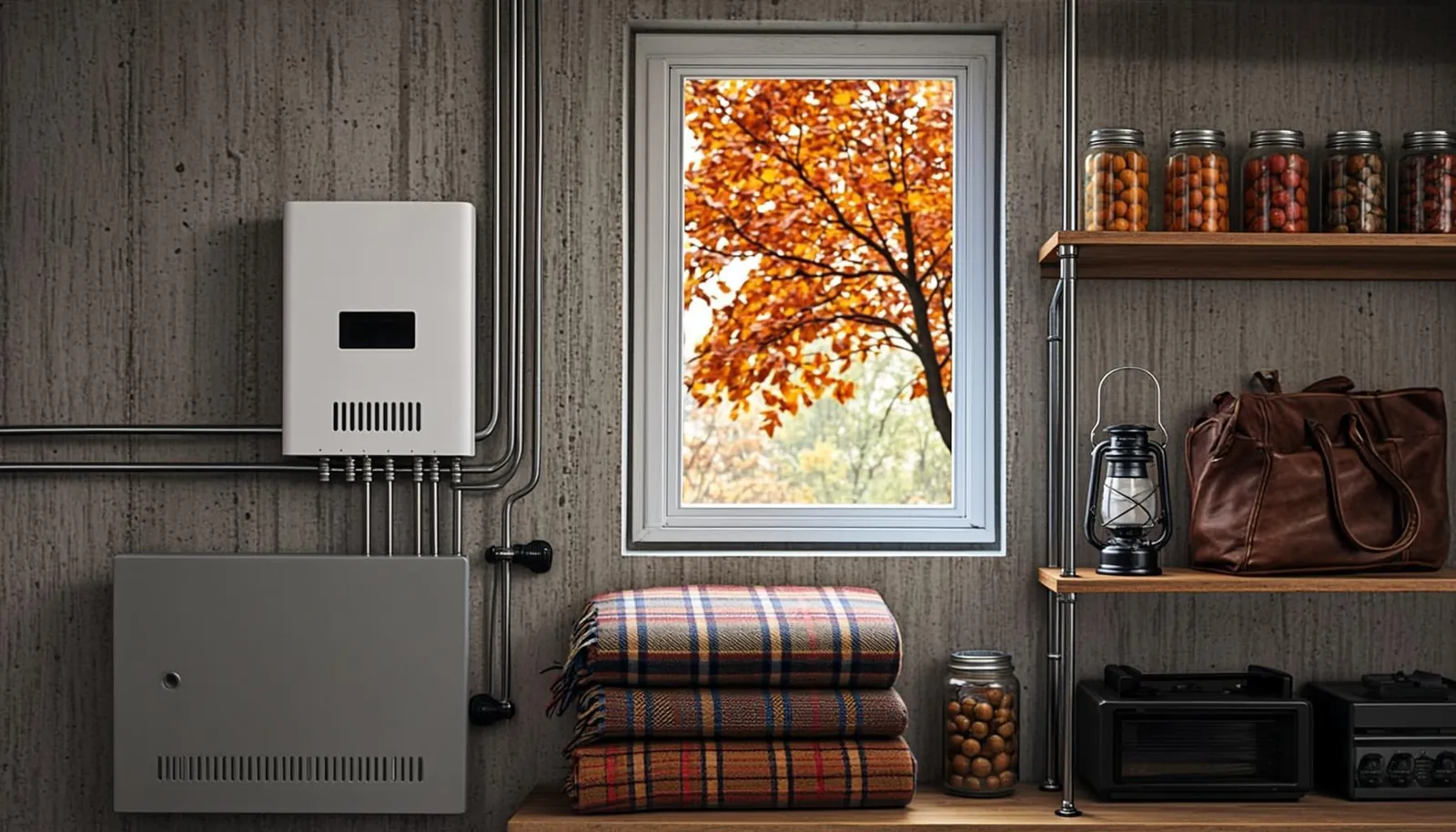
On April 5, 2023, 1,125,000 Hydro-Québec customers lost power at the same time, and it took until April 11 for 99% of affected homes to be reconnected. Enough to make anyone dream of a home battery. In Quebec, the picture has just changed: since October 1, 2026, Rénoclimat pays up to $4,000 for a fixed battery and up to $1,000 to have a backup power source connected.
A battery doesn't solve everything. In very cold weather, heating can account for up to 80% of a household's electricity use, according to Hydro-Québec, and heating is what would drain a battery fastest. On Rate D, a battery won't lower your bill by a cent. Here is what it really does, what Rénoclimat requires, what it earns you on Rate Flex D and how to choose one. Amounts are those in effect in mid-October 2026, before taxes.
What is a fixed home battery?
For Rénoclimat, a fixed battery is a set of one or more batteries and one or more inverters, permanently connected to the electrical panel. The inverter converts the battery's direct current into alternating current for your appliances and manages exchanges with the grid, which the system stays connected to.
Hydro-Québec classifies this equipment as self-generation, under two headings: storage, to keep energy for later use, and backup power, meaning an inverter, battery or generator that takes over automatically during an outage. The bidirectional charging station (V2G), which draws on an electric vehicle's battery, belongs to the same family. A fixed battery therefore plays two roles:
- During an outage: the home is isolated from the grid and the inverter powers circuits chosen in advance, called critical loads. This islanded mode is only allowed for your own loads.
- Day to day: it charges at one time and discharges at another, for example during Rate Flex D peak events, or it stores the output of solar panels.
These uses are governed by Hydro-Québec's E.12-07 standard, which also applies to storage systems and electric vehicles.
Fixed battery, portable power station or generator: how they compare
Hydro-Québec distinguishes two families of backup power. Temporary systems, like mobile generators or portable batteries (portable power stations), aren't connected to the panel: you plug your devices into them with suitable extension cords. Permanent systems, like a stationary generator with a transfer switch or a battery system, power the home directly and must be installed by a member of the Corporation des maîtres électriciens du Québec (CMEQ), the province's master electricians' corporation.
| Fixed battery | Portable power station | Generator | |
|---|---|---|---|
| Connection | Permanently to the panel, through an inverter | None: devices plug into it with extension cords | Portable: devices plugged in with extension cords. Stationary: to the panel, through a transfer switch |
| Installation | Master electrician, with Hydro-Québec's authorization | None, but never an improvised connection | Stationary: master electrician. Portable: never into a wall outlet or the panel |
| During an outage | Can take over automatically | You plug devices in one by one | A stationary unit can take over automatically |
| Carbon monoxide | No combustion | No combustion | Produces it: always outdoors, away from doors, windows and air intakes |
| Flex D and solar | Can cover peak events or store solar output | Only for the devices plugged into it | — |
| Rénoclimat grant | Up to $4,000 | Excluded | Purchase excluded; connection by a master electrician: up to $1,000 |
Only the fixed battery qualifies for the $4,000: Rénoclimat excludes portable batteries. For a portable power station, Hydro-Québec calls for heavy-duty extension cords certified for outdoor use with a sufficient current rating, never a male-to-male adaptor, and following the manufacturer's instructions. It also groups portable batteries with generators among the devices to be used outdoors, away from openings.
Power outages in Quebec: when they last for days
Three major outages documented by Hydro-Québec follow the same pattern: most customers get power back within a day or two, while the last ones wait much longer.
| Event | At the peak | Power restored |
|---|---|---|
| Ice storm, January 5 to 10, 1998 | 1,393,000 customers without power on January 10 | Still 380,000 customers without power on January 13 and 62,000 on January 27; last customer reconnected on February 6 |
| Derecho, May 21, 2022 (gusts of 150 km/h) | 554,649 customers affected on May 21 at 8 p.m. | 85% restored 72 hours after the peak, 95% after 125 hours |
| Freezing rain and high winds, April 5, 2023 | 1,125,000 customers at once, 1,310,000 in all | 44% restored after 24 hours, 77% after 48 hours, 99% on the morning of April 11 |
In 2022, when 95% of customers had been reconnected, more than five days after the storm, about one affected home in twenty was still in the dark. In 2023, nearly one affected home in four was still waiting 48 hours after the worst of it. In 1998, the last customer got power back 32 days after the ice storm began.
Hydro-Québec attributes 40 to 70% of outages to vegetation, which was behind 90% of the damage from the derecho. The Outaouais appears in all three reports, and Montérégie, hard hit in 1998, was affected again in 2023: our directory lists home battery installers in the Outaouais and Montérégie.
How long should you be able to hold out? After the April 2023 storm, Hydro-Québec reminded customers that the Quebec government recommends an emergency kit for three days. That's a good starting target, knowing that the longest outages go well beyond it.
Rénoclimat: up to $4,000 for a fixed battery
The new version of Rénoclimat, run by Quebec's environment department (MELCCFP), covers work done from October 1, 2026, and is scheduled to end on March 31, 2029, or sooner if the budget runs out. Its two new outage-related measures each come with their own conditions.
Technical requirements
According to the participant guide, the system must:
- include one or more batteries and one or more inverters permanently connected to the electrical panel;
- have a capacity of at least 5 kWh;
- produce a true sine wave, with a continuous output of at least 1.2 kW and a surge capacity of at least 2.5 kW;
- not be isolated from the grid, so it can power the home at the same time as the electricity distributor;
- comply with Hydro-Québec's E.12-07 standard.
Excluded: portable batteries, electric vehicles and the master electrician's fees. The $4,000 therefore covers the purchase of the system.
Who qualifies
The owner, if the dwelling is their principal residence (the home they live in for most of the year), or if it is a duplex, a triplex or a building with four or more units. Secondary residences, like cottages, are excluded from both new measures. The dwelling must also:
- have no more than three storeys above ground and a footprint of no more than 600 m², and be residential over more than half of its floor area;
- have been built and lived in for at least five years when you apply, which rules out new homes;
- be habitable year-round, with heating able to maintain 21°C, and sit on permanent foundations;
- be connected to the Hydro-Québec grid or to a municipal or co-operative system.
The work must be done by a contractor registered with the Registraire des entreprises, holding the Régie du bâtiment du Québec (RBQ) licences that exactly match the work, and not listed in the Register of enterprises ineligible for public contracts (RENA). The contractor fills out and signs the work compliance certification form. Do-it-yourself work is not eligible.
How much you'll get
The grant is the lower of two amounts: what you paid the contractor for eligible expenses, before taxes, or the set maximum. If the battery and inverter cost you more than $4,000 before taxes, you get $4,000; otherwise, you get the amount you paid. Across all energy efficiency measures, assistance is capped at $21,500 per house and $31,000 for a duplex, a triplex or a multi-unit residential building.
Connecting a backup power source: up to $1,000
This measure pays the fees of a master electrician holding an RBQ 16.0 licence to connect the backup source to a transfer switch, install that switch and connect it to the panel. Buying the source itself, a generator for example, and buying the switch are not covered. Secondary residences are excluded.
Can a battery qualify for both measures, $4,000 for the system and $1,000 for the electrician? The guide doesn't say clearly. It excludes from the second measure the purchase of an inverter able to act as a transfer switch, which suggests the case was anticipated, without confirming it. Ask Rénoclimat (1-866-266-0008) before counting on $5,000.
Deadlines, portal and stacking
You must apply no later than 12 months after the work is completed, and before March 31, 2029, through an online portal that was still under development in mid-October 2026; Quebec says it will open this fall. You can do the work now: keep your property assessment roll, detailed invoices, the compliance form and photos of the work.
Stacking is prohibited with any other assistance from departments, agencies and Crown corporations of the governments of Quebec and Canada, tax credits included, or from a municipal body. The department may check the work for up to 12 months after payment.
What about LogisVert? Storage is excluded
Hydro-Québec's LogisVert program subsidizes solar panels ($1,000 per installed kilowatt, up to 40% of the purchase and installation cost), but not batteries: version 1.10 of its participant's guide, dated September 15, 2026, lists storage equipment among the ineligible items.
Rate Flex D: what a battery can really save you
Rate Flex D is Hydro-Québec's dynamic pricing offer. In winter, a kWh costs less than on Rate D almost all the time, but much more during peak demand events. Prices since April 1, 2026:
- Winter, outside events: 4.886¢ per kWh up to 40 kWh per day of the consumption period, then 9.103¢ (versus 7.065¢ and 11.142¢ on Rate D);
- During a peak event: 46.463¢ per kWh;
- Summer, April to November: Rate D prices;
- System access charge: 46.154¢ per day, as on Rate D.
Events happen from December 1 to March 31, between 6 and 10 a.m. or between 4 and 8 p.m., except on certain days over the holidays and at Easter. Each lasts 4 hours, with at most two events a day, at least 6 hours apart, and 120 hours per winter, or 30 events. Notice arrives before 3 p.m. the day before. In winter 2025–2026, there were 20.
The math, kWh by kWh
A battery doesn't create energy: it shifts your consumption. Each kWh it supplies during an event saves you 46.463¢, but it has to be recharged off-peak: at 9.103¢ if your consumption is already past the first tier (more than 40 kWh per day on average on your bill), or at 4.886¢ otherwise. The net gain:
- 46.463¢ − 9.103¢ = 37.36¢ per kWh shifted;
- 46.463¢ − 4.886¢ = 41.58¢ per kWh shifted.
Three limits cap the savings. Capacity: a battery that delivers 10 kWh shifts no more than that per event. Power: over 4 hours, a 1.2 kW inverter, Rénoclimat's minimum, delivers at most 4.8 kWh (1.2 kW × 4 h); for 10 kWh, you need at least 2.5 kW continuous (10 ÷ 4). And your consumption: the house must use at least that much electricity during the event.
What it adds up to over a winter
The table assumes the battery empties completely at every event, gives back all the energy it stored and that 2026 prices don't change: these are ceilings. The formula: kWh per event × number of events × gain per kWh.
| kWh delivered per event | 20 events (winter 2025–2026) | 30 events (maximum) |
|---|---|---|
| 5 kWh | $37 to $42 | $56 to $62 |
| 10 kWh | $75 to $83 | $112 to $125 |
| 15 kWh | $112 to $125 | $168 to $187 |
Example: 10 kWh × 20 events = 200 kWh; 200 kWh × 37.36¢ = $74.72 for the winter, or about $750 to $830 over 10 winters at constant prices. For Rate Flex D alone to pay for a battery, its cost after the Rénoclimat grant would have to stay below those cumulative savings: compare with your quotes.
For reference, Hydro-Québec estimates that its roughly 140,000 Rate Flex D customers saved an average of $90 without smart devices and $150 with automated smart thermostats in winter 2025–2026, before taxes. A good share of the savings comes from simple habits, with no battery: see how to save energy in winter.
What about Rate D or the Winter Credit Option?
On Rate D, the price per kWh doesn't change with the time of day: a battery saves you nothing. The Winter Credit Option pays 58.490¢ per kWh curtailed during events, but it is reserved for contracts that already had it on March 31, 2026, and can't be combined with Rate Flex D. Before you sign up for Rate Flex D, note that if you opt out before completing a full winter, you can't come back that winter or the next.
Batteries and solar panels: net metering changes the math
With Hydro-Québec's net metering option, the electricity your panels feed into the grid builds up in a surplus bank that reduces the kWh billed on your following bills. The bank is reset to zero every 24 months, on March 31 of even-numbered years unless you choose another date, and the remaining balance is then paid at 4.730¢ per kWh. The grid already acts as your reservoir: keeping your surplus in a battery instead of feeding it into the grid does not lower your bill any further.
Another catch: Rate Flex D and the Winter Credit Option are both off-limits to customers on net metering. Hydro-Québec also allows, under certain conditions, self-generation without compensation, where surplus fed into the grid is not credited; a battery then keeps your output for you and can also cover Rate Flex D peaks. Have your installer run the numbers for both scenarios.
For outages, the pairing makes sense: the E.12-07 standard allows the installation to be used as backup power for your own loads and, if the system is designed for it, the panels can recharge the battery during a long outage. Don't count on it too much in winter, though: that's the season when output falls short of the home's needs, Hydro-Québec points out.
LogisVert pays for the panels, Rénoclimat for the battery. Since the Rénoclimat guide prohibits stacking without addressing this specific case, ask for separate invoices and have your eligibility confirmed. The rest is in our guide to solar panels in Quebec, along with the solar calculator and the directory of solar installers. For an overview of storage technologies, see solar energy capture and storage.
How to size your battery: kWh, kW and essential loads
Capacity, in kilowatt-hours (kWh), tells you how much energy the battery holds in reserve. The inverter's power, in kilowatts (kW), tells you how many devices it can run at the same time. Energy (kWh) = power (kW) × time (h): a 5 kWh battery, Rénoclimat's minimum, runs down in just over 4 hours at 1.2 kW (5 ÷ 1.2 = 4.2 h), but lasts 10 hours if your devices draw 0.5 kW on average. Surge capacity is the power the inverter can deliver for a brief moment, when a device starts up.
- List your essential loads: refrigerator, freezer, sump or well pump, a few lights, Internet modem, chargers, medical equipment. If you heat with wood, gas or oil, check whether your appliance needs electricity to run.
- Note the power of each one, in watts, on its nameplate or in the manual, and how many hours a day it runs.
- Calculate the energy per day: watts ÷ 1,000 × hours = kWh, then add it all up.
- Multiply by the days of autonomy you want, for example the three days of the emergency kit.
- Check the power: the inverter must continuously supply everything running at the same time and handle start-ups.
A fictional example, to redo with your own figures: 6 kWh per day × 3 days = 18 kWh. A 10 kWh battery would cover about a day and a half (10 ÷ 6 = 1.7 days), unless you shorten the list.
The trap is heating. Since it can account for up to 80% of consumption in very cold weather, running baseboard heaters or a heat pump for days would take a capacity out of all proportion to that of essential loads. Keep the battery for those loads and plan another way to keep the house warm. If you add a generator, Hydro-Québec's standard requires it to have its own switching device with a mechanical interlock: the battery's inverter can't be used to connect it. To run the numbers with your own devices, try our home battery calculator.
Safety and installation: a job for a master electrician
Hydro-Québec is clear: never connect self-generation equipment yourself, because a non-compliant installation can cause a fire, serious injury or death. The best-known danger, backfeeding, happens when a system without a transfer device sends power back into the grid during an outage: crews working on the lines risk electrocution.
A fixed battery is therefore installed by a master electrician who is a CMEQ member, and who must also hold a valid RBQ 16.0 licence for Rénoclimat's connection measure. The steps with Hydro-Québec:
- You hire the electrical contractor. You must own the equipment and the site, and operate the installation.
- The contractor submits the application, with a single-line diagram signed by a master electrician or an engineer and the inverter's certificates.
- Hydro-Québec analyzes the grid's hosting capacity and may put the application on hold where self-generation is already dense. Most projects pay no connection fees.
- Hydro-Québec issues conditional acceptance: wait for it before buying.
- After installation, the master electrician performs the compliance tests and sends a signed verification report.
- Hydro-Québec issues final authorization. Until then, the installation stays padlocked in the open position.
The E.12-07 standard also requires:
- an inverter certified to UL 1741-SB and compliant with the IEEE 2030.5 communication protocol; even a firmware update requires Hydro-Québec's written approval;
- a telecommunications link at your expense, wired inside the installation (no wireless), through which Hydro-Québec can change the inverter's settings, or limit or stop production at any time, without notice;
- permanent warning labels at the meter and at the disconnect point;
- for backup mode, a device that fully isolates the home from the grid: a mechanically interlocked device, a double-throw switch or a certified transfer switch, depending on the configuration.
A battery eventually wears out: when it's time to replace it, ask the installer how it will be recovered. For household and small batteries, see where to recycle old batteries.
Choosing a home battery installer
Our directory of home battery installers groups businesses by region, with a form to request quotes. Before you sign, check:
- Licences: a master electrician who is a CMEQ member, a valid RBQ 16.0 licence, and a business registered with the Registraire des entreprises and not on the RENA. Our guide to checking a contractor explains where to look.
- Paperwork: who submits the application to Hydro-Québec, and a commitment to order the equipment only after conditional acceptance.
- Spec sheet: capacity in kWh, continuous and surge power, true sine wave, UL 1741-SB and IEEE 2030.5 certificates, compliance with the E.12-07 standard.
- Invoice: itemized, with the system, the electrician's fees and the switch listed separately, plus the signed compliance form.
- Backup plan: which circuits will be powered during an outage, for how long, and whether a generator can be added later.
- Several quotes, for comparable systems.
Planning a heat pump too? Our heat pump guide covers LogisVert. And to go into your quotes with a clear idea of the capacity you need, start with the calculator.
Sources
- Guide du participant, Rénoclimat, édition 2026 (participant guide, in effect October 1, 2026; in French), Ministère de l'Environnement, de la Lutte contre les changements climatiques, de la Faune et des Parcs, 2026.
- Aide financière Rénoclimat pour améliorer la performance énergétique d'une habitation et l'adapter aux inondations (Rénoclimat financial assistance; in French), Gouvernement du Québec, 2026 (page updated October 13, 2026).
- Electricity Rates Effective April 1, 2026, Hydro-Québec, 2026.
- Rate Flex D: Save up to 20% on your electricity bill, Hydro-Québec, accessed October 2026.
- Collective efforts – Overview, winter 2025–2026, Hydro-Québec, 2026.
- Norme E.12-07 (requirements for connecting distributed generation of 100 kW or less using certified inverters to Hydro-Québec's low-voltage distribution system; in French), Hydro-Québec, 2025.
- Participant's guide for residential customers, LogisVert Efficient Homes Program, version 1.10, Hydro-Québec, 2026.
- Connection of self-generation equipment, Hydro-Québec, accessed October 2026.
- Backup power supply: Three key rules for safe use, Hydro-Québec, accessed October 2026.
- The January Ice Storm: timeline of January 1998, Hydro-Québec, accessed October 2026.
- Bilan des pannes causées par le derecho du 21 mai 2022 (outage report for the May 21, 2022 derecho; in French), Hydro-Québec, 2022.
- Verglas d'avril 2023 : Hydro-Québec à l'œuvre pour accroître la résilience du réseau (April 2023 ice storm report; in French), Hydro-Québec, 2023.
Frequently asked questions
What grant is available for a home battery in Quebec?
Since October 1, 2026, Rénoclimat pays up to $4,000 for a fixed battery permanently connected to the electrical panel: at least 5 kWh, a true sine wave inverter with at least 1.2 kW continuous output and 2.5 kW surge capacity, not isolated from the grid and compliant with Hydro-Québec's E.12-07 standard. The home must be a principal residence (or a duplex, a triplex or a multi-unit building) and the contractor must hold the right licences. LogisVert, for its part, excludes storage equipment.
Is a portable power station or an electric vehicle eligible for Rénoclimat?
No. The participant guide excludes portable batteries and electric vehicles. Only a fixed system, permanently connected to the panel and meeting the technical requirements, qualifies for the $4,000 grant. The master electrician's fees are also excluded from this measure.
How much can a battery save on Rate Flex D?
Each kWh the battery supplies during a peak event avoids 46.463¢, minus the cost of recharging off-peak (9.103¢ or 4.886¢): 37 to 42¢ net. In winter 2025–2026, there were 20 events: a battery delivering 10 kWh per event would have saved at most $75 to $83. On Rate D, it saves nothing, since the price doesn't vary with the time of day.
Can you combine solar panels, net metering and Rate Flex D?
No. Rate Flex D and the Winter Credit Option require that you not be signed up for a net metering option. With net metering, your surplus is credited in kWh on your following bills: a battery therefore doesn't lower the bill any further, but it can serve as backup power during an outage.
Who can install a fixed home battery?
A master electrician who is a member of the Corporation des maîtres électriciens du Québec (CMEQ). For Rénoclimat's connection measure, they must also hold a valid RBQ 16.0 licence. The contractor submits the application to Hydro-Québec, and the installation can only be connected to the grid after final authorization. Never connect a battery or a generator yourself.
Do you offer this service?
Readers of this page are looking for this kind of pro (home battery installer). Join our recommended partners.
Become a partner