Clementines vs mandarins: the difference, the season and how to use the whole fruit
A clementine is a mandarin, but not every mandarin is a clementine. Here is how to find your way around the box, where these little imported citrus fruits come from and how to enjoy them right down to the peel, without wasting a thing.
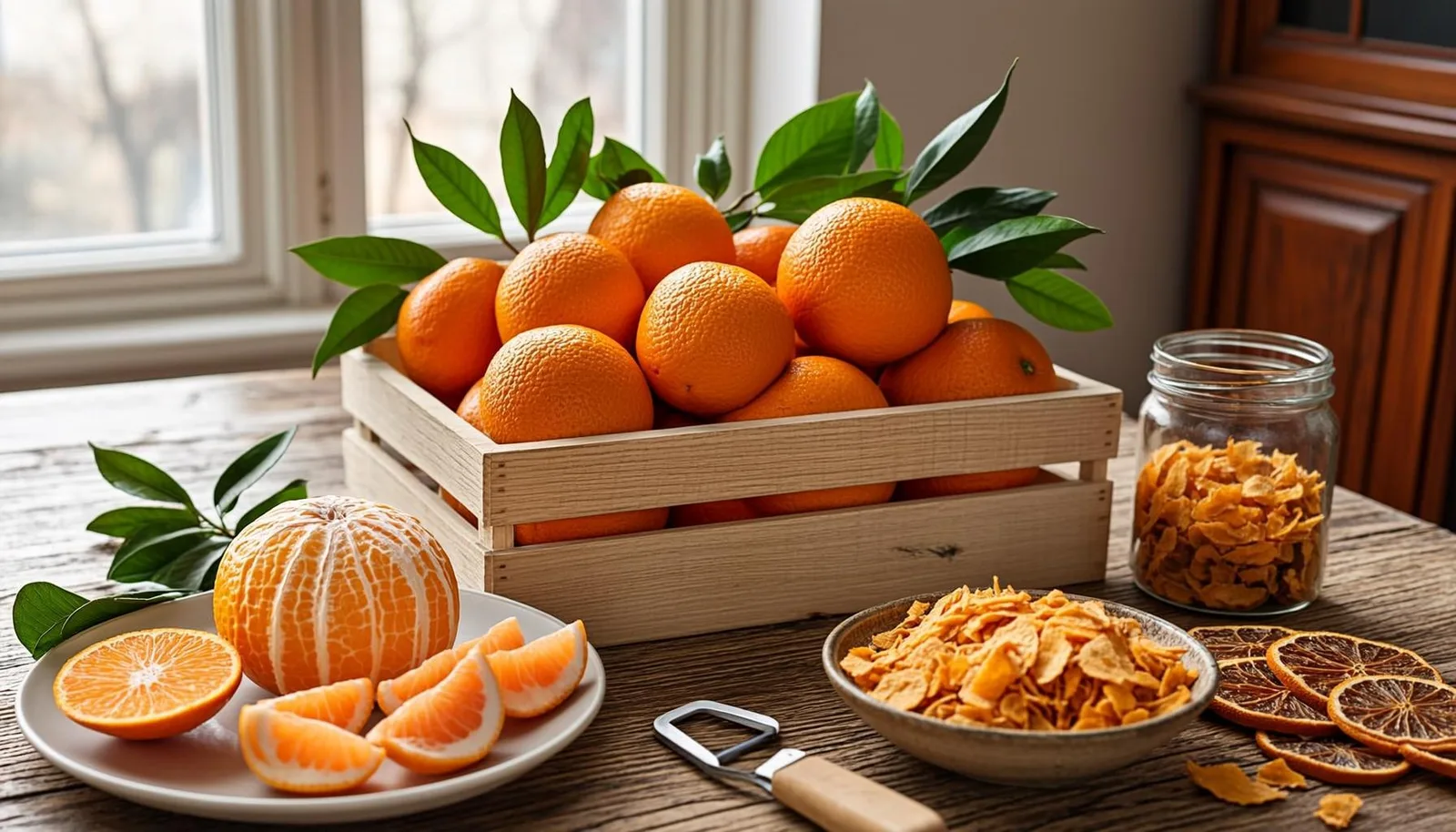
In December, the box of clementines settles in on the kitchen counter. You peel one in passing, then another, until the day you find two shrivelled fruits at the bottom and a third one covered in mould. Yet this little citrus fruit comes from far away: Canada is not among the producing countries, but it imported about 205,000 tonnes of mandarins in 2024-2025, according to the United States Department of Agriculture. All the more reason to choose it well, store it well and waste none of it, peel included.
Here is what really sets clementines, mandarins, satsumas and tangerines apart, what the box holds depending on the month, how to sort and store it, then what to do with the zest and peels, all the way to decorating the tree. For the rest of the meal, our guide to traditional Quebec holiday recipes walks you through the réveillon menu, dish by dish.
Clementine, mandarin, satsuma, tangerine: who's who?
The word that covers all the others is "mandarin." Mandarins make up the largest and most varied group of citrus, which botanists call Citrus reticulata, explains a publication from University of California Cooperative Extension. Tracy Kahn, curator of the Citrus Variety Collection at the University of California, Riverside, sums it up: clementines and satsumas are mandarins, among many others. The reference text quoted on the same page describes fruit that is usually smaller than an orange, somewhat flattened, with a peel and segments that come apart easily.
The clementine was selected in the early 20th century in Oran, Algeria, by a French missionary. It was believed to be a hybrid, and a genetic map published in 2012 in the journal BMC Genomics confirmed it: it comes from a cross between a so-called Mediterranean mandarin and a sweet orange. The satsuma, for its part, was developed mainly in Japan. It is the most cold-hardy of the mandarins, and its sweet, slightly flattened fruit is seedless and easy to peel. As for the tangerine, it is not a botanical category. The word is used mostly, for convenience or as a marketing term, for mandarins of a reddish-orange colour, such as Dancy, and it probably comes from the port of Tangiers, in Morocco.
At a glance:
| Name | What it is | Distinguishing features |
|---|---|---|
| Mandarin | The large group (Citrus reticulata), the largest and most varied group of citrus | Fruit usually smaller than an orange, somewhat flattened; peel and segments that come apart easily |
| Clementine | A mandarin descended from a Mediterranean mandarin and a sweet orange, selected in Algeria | Rounder and a deeper orange than the satsuma; usually seedless, unless a pollinator tree grows nearby |
| Satsuma | A group of mandarins developed mainly in Japan | Sweet, seedless, easy to peel; the most cold-hardy of the mandarins |
| Tangerine | A common name with no botanical standing | Used mostly for reddish-orange mandarins, such as Dancy |
| Brand-name "mandarins" in a box | A brand name, not a variety | Depending on the season, clementines or other mandarins, including hybrids |
What's in the box, and where it comes from
On a box, the word "mandarins" or a brand name does not always tell you which variety you are buying. Tracy Kahn gives the example of a well-known brand under which clementines are generally packed before Christmas, then W. Murcott and Tango mandarins after the holidays. She adds that many fruits sold as mandarins or tangerines are actually mandarin hybrids. In short, the January box is not necessarily the December box: if you are set on clementines, read the label.
So where do they come from? Not from here. In its January 2026 report on world citrus markets, the United States Department of Agriculture (USDA) does not list Canada among mandarin producers, but among the major importers: 177,000 tonnes in 2023-2024, 205,000 tonnes in 2024-2025 and about 220,000 tonnes forecast for 2025-2026. In its table, only Russia, the European Union, the United States, Vietnam and the United Kingdom import more. On the production side, China dwarfs everyone else, with 27.1 of the 38.4 million tonnes forecast worldwide, far ahead of the European Union, Turkey, Morocco, South Africa and the United States, where the crop comes mostly from California.
The report does not say where the mandarins sold in Canada come from, but it describes the calendar of the main suppliers of the neighbouring U.S. market. California harvests from November to May, and Morocco ships mainly from November to April. From May to October, Chile and Peru, in the Southern Hemisphere, take over. So you can find mandarins almost all year round, but the big Northern Hemisphere season falls right in the middle of the holidays. To find out where yours come from, look for the country of origin on the box.
The conclusion is obvious: a fruit that has travelled that far deserves to be eaten down to the last segment. Buy what your household will actually eat rather than a second box on special, and for the rest of the year, make room for local fruit. Our tips for buying fewer imported products show where the effort counts the most.
Choosing and storing: counter, fridge and sorting the box
At the store, Sauve ta bouffe, a project of Les AmiEs de la Terre de Québec, gives simple guidelines in its fact sheet on oranges and clementines: a firm, heavy fruit with smooth skin and no soft spots. Also inspect the box or mesh bag: if there is a mouldy fruit at the bottom, pick another one.
At home, it all depends on how long you need them to last. According to the same fact sheet, oranges and clementines keep for about a week at room temperature and about a month in the fridge. It recommends a cool place, away from heat and humidity, with the fruit not piled up and kept away from fruits and vegetables that give off ethylene. A small bonus: Sauve ta bouffe notes that an orange kept at room temperature is juicier. If you plan to juice citrus, take it out of the fridge a little ahead of time.
The box: sort it as soon as you get home
The real trap is the box itself. In the question-and-answer section of the University of California, Davis postharvest centre, Mary Lu Arpaia points out that the green and blue moulds of citrus get in through wounds in the peel, which is why careful handling matters. She adds that dumping mouldy fruit releases millions of spores into the air. Her advice, intended for distributors, adapts well to the kitchen:
- Open the box as soon as you get home and take the fruit out one by one, rather than tipping it all out at once. Check the underside of each one.
- Remove mouldy fruit away from the others, without shaking it over the box, and put it in a closed bag or container before taking it out of the kitchen.
- Rinse and dry well any sound fruit that was touching a mouldy one, then inspect it again.
- Eat those first: that fruit should be used up without delay.
Do another check from time to time, especially if the box stays on the counter: a fruit removed in time protects its neighbours.
Zest, dried peel and slices for the tree
A clementine is more than its segments. Before you peel it, think of the zest. For oranges, Sauve ta bouffe recommends using zest only from organic, untreated fruit, and freezing it if you do not plan to use it soon. It can then go into muffins, a sorbet or a sauce: our homemade cranberry sauce, for example, calls for orange zest and juice. Even large pieces of peel can be frozen: let them dry for an hour or two in the open air, on paper, then put them in the freezer, where they keep for about four months.
Dried strips of peel
For zest that keeps in the pantry, Colorado State University describes a method designed for thick-skinned oranges. Choose fruit with no mould and no colour added to the skin, then scrub it under cool running water. Remove only the thin coloured layer, 1.5 to 3 mm thick, leaving behind the white part, which is bitter. The guide then suggests a 10-minute dip in an ascorbic acid solution, draining well, then drying in a single layer at 60°C, in the oven or a dehydrator, for 8 to 12 hours, until the strips are crisp. In dry, tightly closed jars stored in a cool, dry, dark place, dried fruit keeps for 6 to 12 months. Drop a strip into a hot mulled cider, with or without alcohol, and you're all set.
Slices to decorate the tree
Dried orange or clementine slices, threaded on a string, make a fragrant garland that will end up in the compost rather than the garbage. We found no official method for these decorative slices, but the Colorado State University drying guide gives useful benchmarks: an oven at 60°C, the slices in a single layer, turned every 3 to 4 hours, and a final hour with the oven off and the door wide open. The same guide points out that thin slices dry faster than thick pieces or whole fruit. A whole slice, with its juicy flesh, will therefore take longer than the 8 to 12 hours given for thin strips of peel. Let one cool before you judge, because warm fruit feels softer than it really is. These slices are no longer for eating: at the end of the holidays, into the compost they go. And if you are still undecided about the tree itself, our comparison of a real or artificial Christmas tree looks at the greener option in Quebec.
Peels in the compost, no question
There are always peels left over, and they belong in the compost. The guide Le compostage facilité, produced with support from RECYC-QUÉBEC and available on its website, even lists orange and grapefruit peels among the materials a household already has in abundance to feed its compost. For citrus, it gives only two instructions: cut the peels up well to help them break down, and bury them in the pile, because, like all fruit, they are sugary and attract flies.
The same goes for your garland of dried slices after the holidays, once the string is removed. If your municipality collects food scraps, check its rules for the brown bin. Our article on composting food scraps will help you manage your kitchen bin. Just keep the order of priorities in mind: what can be eaten goes to the kitchen first (segments, juice and zest), and the compost takes the rest.
True or false: 4 myths about clementines
"Clementines never have seeds." FALSE. They are usually seedless, but only when no pollinator tree grows nearby, University of California Cooperative Extension explains. A clementine with seeds is therefore not a fake clementine: its flowers were pollinated by another variety.
"The clementine is a cross between a mandarin and an orange." TRUE. Its genetic map, published in 2012, confirmed that it descends from a Mediterranean mandarin and a sweet orange. It is still classified among the mandarins.
"Clementines keep just as well on the counter as in the fridge." FALSE. Sauve ta bouffe gives about a week at room temperature, compared with about a month in the fridge. The counter is for the ones you will eat this week.
"Citrus peels can't be composted." FALSE. The home composting guide distributed by RECYC-QUÉBEC includes them. Just cut them up well and bury them in the pile so they don't attract flies.
Free gift: get The Quebec Recipe Advent Calendar, 24 recipes ready in 30 minutes or less with local ingredients, one a day until Christmas Eve. The same page gathers all our holiday recipes and guides.
Sources
- Is there a difference between Mandarins and Clementines?, Tracy L. Kahn, Postharvest Research and Extension Center, University of California, Davis, 2012.
- A Mandarin by Any Other Name, Cindy Fake, University of California Cooperative Extension, Placer and Nevada Counties, 2004.
- A reference genetic map of C. clementina hort. ex Tan.; citrus evolution inferences from comparative mapping, P. Ollitrault et al., BMC Genomics, 2012.
- Citrus: World Markets and Trade, Foreign Agricultural Service, United States Department of Agriculture (USDA), January 2026.
- Orange et Clémentine (oranges and clementines; in French), Sauve ta bouffe, Les AmiEs de la Terre de Québec, 2025.
- How can I best work handle boxed citrus with fruit that have some mold?, Mary Lu Arpaia, Postharvest Research and Extension Center, University of California, Davis, 2012.
- Le compostage facilité : guide sur le compostage domestique (home composting made easy; in French), Josée Duplessis (ed.), NOVA Envirocom, with a grant from RECYC-QUÉBEC, 2006.
- Drying Fruits, P. Kendall and J. Sofos, Colorado State University Extension, 1994 (revised in 2025).
Frequently asked questions
What is the difference between a clementine and a mandarin?
Mandarin is the large group; the clementine is one of its varieties. Selected in Algeria in the early 20th century, it comes from a cross between a Mediterranean mandarin and a sweet orange, as a genetic map published in 2012 confirmed.
Should clementines be kept in the fridge?
Yes, if you want them to last. According to Sauve ta bouffe, oranges and clementines keep for about a month in the fridge, compared with about a week at room temperature.
What should I do if a clementine goes mouldy in the box?
Remove it away from the other fruit, without shaking it over the box: dumping mouldy citrus releases millions of spores, the University of California, Davis points out. Put it in a closed bag, rinse and dry well the fruit that was touching it, then eat those first.
Can clementine zest be frozen?
Yes. Sauve ta bouffe advises freezing zest if you do not plan to use it soon. Large pieces of peel can also be frozen after drying for an hour or two in the open air on paper, and they keep for about four months. For zest, choose organic, untreated fruit.
Is a tangerine a mandarin?
Yes. The word tangerine has no botanical standing: it is used mostly for mandarins of a reddish-orange colour, such as Dancy. It probably comes from the port of Tangiers, in Morocco.