Traditional Quebec holiday recipes: the réveillon menu, dish by dish
Tourtière, meatball stew, turkey with cranberries, doughnuts, Yule log: the Quebec réveillon menu has a long history, and almost all of it can be made ahead. Here is where each dish comes from, the recipe that goes with it, a make-ahead calendar and the rules for a réveillon without waste or food poisoning.
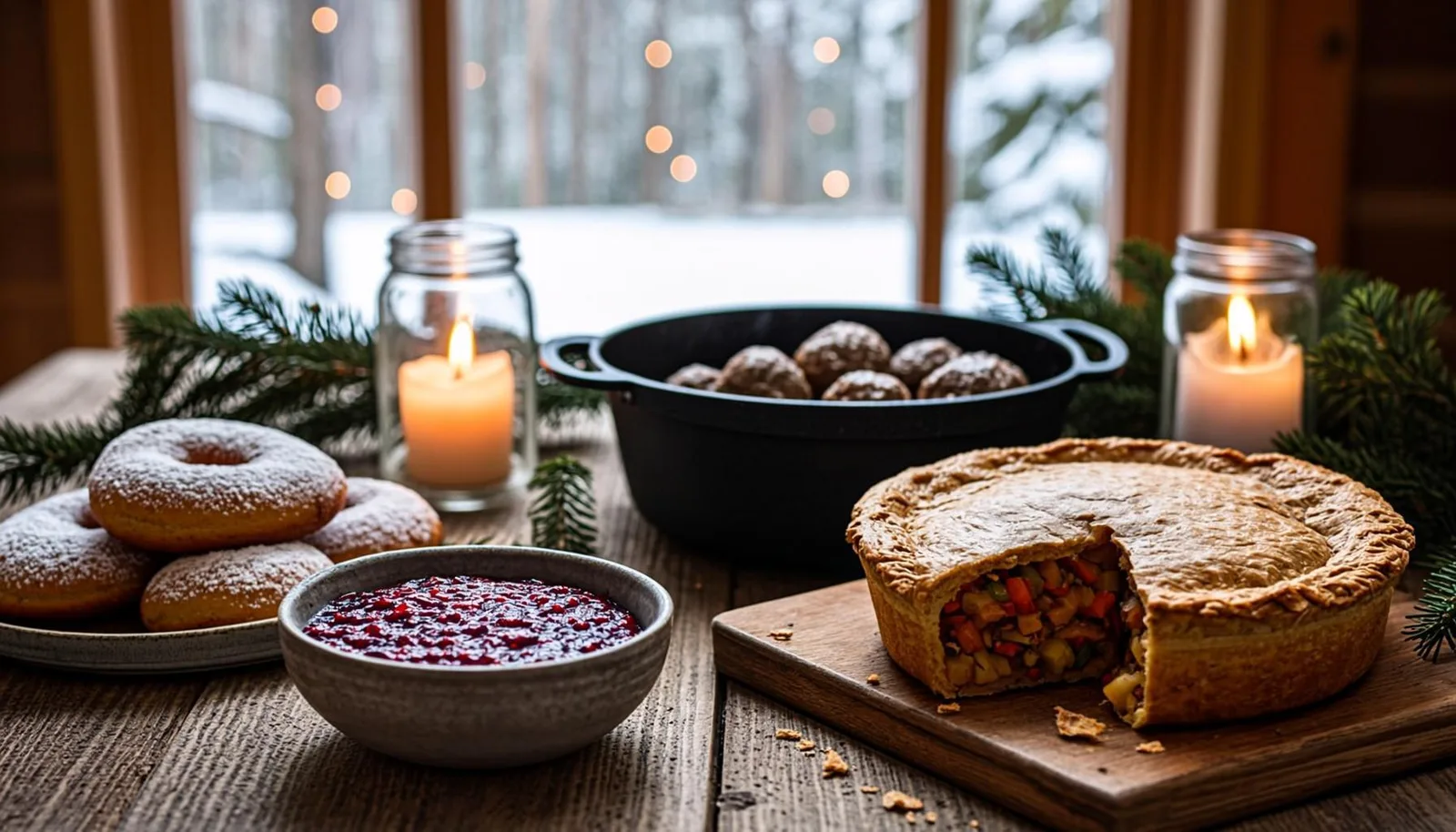
In Quebec, the réveillon is no ordinary supper. In 1976, the holiday supplement of the newspaper L'Union put it bluntly: the réveillon had to outdo every other meal of the year. Tourtière, stew, turkey, doughnuts, Yule log: every family has its own recipes, but the same dishes come back from one generation to the next, and most of them can be made ahead.
Here is where the réveillon comes from, what each of its dishes has to tell, and how to organize it without wearing yourself out or wasting food: a make-ahead calendar, guidelines for quantities and leftovers, and the food safety rules that really matter. Each dish links to its detailed recipe, and each key ingredient to its guide.
The réveillon: where the big Christmas night comes from
For the Government of Canada's Translation Bureau, réveillon refers to the meal eaten late in the evening, or in the middle of the night, at Christmas as well as on New Year's. By extension, the word covers the whole party, with its meal and activities. It comes from réveil, the French word for waking up. In the early days of New France, Christmas was first and foremost a religious holiday, The Canadian Encyclopedia points out: in 1645, French colonists were already attending a midnight mass in a church in Québec City. The meal eaten after coming home from mass then became part of family tradition.
In the 19th century, according to an article by the Ontario broadcaster TVO, a good French-Canadian Catholic was practically expected to stay up for midnight mass. Afterwards, the family ate and celebrated until dawn, around tourtière, meatball stew and pigs' feet. To fill the table, women cooked for weeks in advance. As late as 1976, the L'Union supplement described the same night: the children are woken around 11 p.m., the whole family goes to midnight mass, and the réveillon is eaten around 2 a.m. On the menu: tourtière or pâté à la viande, turkey, vegetables and potatoes, then a fruitcake or a bûche de Noël (Yule log).
And New Year's Day? According to archivist Michel Prévost of the University of Ottawa, French Canadians saw Christmas primarily as a religious holiday; TVO adds that it was rather on New Year's Day that the extended family gathered to exchange gifts. On the morning of January 1, the father also blessed his children, a custom that has since been lost, notes The Canadian Encyclopedia. New Year's Eve, for its part, remains a party spent with family or friends.
Then habits changed. Again according to Michel Prévost, church attendance plummeted in the 1960s and 1970s, in the wake of the Quiet Revolution, and masses were moved earlier: 11 p.m., 10 p.m., then 9 p.m. In 2020, he observed that there are almost no midnight masses left. The réveillon followed: according to The Canadian Encyclopedia, it is now eaten before mass on Christmas Eve, or even on Christmas Day. The menu, however, has kept its pillars. The Encyclopedia still lists turkey, cranberries, tourtières, homemade pickles and the bûche.
Tourtière (or pâté à la viande), queen of the table
No réveillon without tourtière. The Canadian Encyclopedia presents it as the dish served at the réveillon after midnight mass, and it is nothing new: La cuisinière canadienne, published in 1840 and likely the very first French-language cookbook printed in the country, already offered several versions. Pork, mutton, veal, potatoes or chicken were simmered and spiced, then enclosed in a solid crust. According to culinary historian Elizabeth Driver, quoted by the Encyclopedia, the meat was traditionally cut into small pieces with a knife; today, many cooks use ground meat. And in the early days of the colony, lard was probably the main fat, suggests Nathalie Cooke, also quoted.
In most of Quebec, tourtière and pâté à la viande are the same dish. The Office québécois de la langue française (OQLF) defines it as a pie filled with ground pork, seasoned with spices and sometimes bound. Beef or veal can join or replace the pork. The meat is first precooked in a little water with onion, salt, pepper and savory or sage; once it has cooled, mashed potatoes or breadcrumbs are sometimes added, then the filling goes into the crust and the pie into the oven.
Our traditional pâté à la viande follows this logic, with an all-butter pie crust you can master and freeze ahead. And if someone at your table doesn't eat meat, the vegetarian tourtière with lentils and mushrooms deserves its place right beside it.
Lac-Saint-Jean tourtière and cipaille: different dishes
In Saguenay–Lac-Saint-Jean, Charlevoix and their immediate surroundings, the word tourtière is not the usual synonym for pâté à la viande, the OQLF specifies. The Canadian Encyclopedia describes the tourtière prepared along the shores of the Saguenay and Lac Saint-Jean as a pie built in several layers, with cubed meats and vegetables. The Translation Bureau compares it to cipaille, with only two layers of pastry, and notes that it is also called tourtière du Lac-Saint-Jean.
Cipaille, for its part, is a big pie baked in a deep dish: several layers of meats, potato chunks, onions and seasonings, separated by layers of pastry, often six layers in all. The Translation Bureau calls it a traditional holiday dish in French Canada. According to the OQLF, it traditionally mixes game with other meats.
True or false: three common beliefs about tourtière
"The word tourtière comes from the tourte, the bird." FALSE. The idea is persistent, and not absurd: at the beginning of the 19th century, North America had billions of passenger pigeons (tourtes in French), and they were hunted, notably on Île d'Orléans, and baked into pies. But The Canadian Encyclopedia files this explanation among the myths. The name more likely comes from the shallow pie dish, the tourtière, still used in France to bake and serve tourtes (pies). The word tourte itself is said to come from a Latin slang expression, tortus panis, a round loaf of bread.
"Pâté à la viande and tourtière are the same thing." TRUE, except in Saguenay–Lac-Saint-Jean and Charlevoix. For the OQLF as for the Translation Bureau, the two words are synonyms in everyday use. In those regions, however, tourtière is the big layered pie described above. And Acadians in the Maritimes simply call their version pâté à viande, notes The Canadian Encyclopedia.
"Cipaille is named for its six crusts (six-pâtes)." FALSE. The spelling six-pâtes does exist, and the Translation Bureau explains it by the six rows of pastry the dish can have. But according to the OQLF, cipaille, cipâte and their variants are Quebec French words adapted from the English sea-pie. On the origin of the dish itself, the sources differ: the Translation Bureau suggests it may have been brought to America by English sailors around the middle of the 18th century, while the OQLF presents it as a dish of Quebec origin.
Meatball stew (and pigs' feet)
The second classic of Christmas night: ragoût, or stew. In its list of common dishes at réveillons of the past, TVO mentions, right after tourtière, ragoût de boulettes, meatballs in brown gravy, and pigs' feet cooked slowly until very tender.
Our old-fashioned meatball stew with toasted flour explains step by step how to toast the flour and build the sauce. Good news for your planning: like tourtière, it is a cooked dish you can freeze weeks ahead (see the calendar below). On the safety side, its meatballs are made of ground meat, which must reach 71°C (160°F) in the centre according to Health Canada, just like tourtière filling: a thermometer settles the question.
If your family recipe for stew or tourtière calls for cinnamon, cloves or nutmeg, our holiday spice guide helps you choose them and keep them fragrant from one year to the next.
Turkey and cranberries (atocas)
Turkey was already on the réveillon menu described by L'Union in 1976, between the tourtière and the vegetables, and it still opens The Canadian Encyclopedia's list, followed by cranberries. The Quebec government notes that the cranberry used to be called atoca. And it is the local choice par excellence: Quebec produces more cranberries than any other province, ranks 2nd or 3rd in the world depending on the year, behind Wisconsin and Massachusetts, and 1st in the world for organic cranberries, with 34 certified organic cranberry farms. Nearly 8 out of 10 growers are in Centre-du-Québec, and the harvest takes place every fall by flooding the fields.
Our guide to Quebec cranberries: season, storage and freezing explains how to stock up in the fall so you have them on hand in December, and our homemade cranberry sauce can be made calmly the day before.
For the turkey itself, two decisions are made early: fresh or frozen, and what size. Our guide fresh or frozen turkey: size and thawing helps you decide. If it is frozen, it thaws in the fridge, never on the counter: the Quebec government allows about 24 hours for a 3 kg turkey, plus one day for each additional 2 kg. A 7 kg turkey therefore needs about three days. On the big day, don't rinse it before cooking, the Quebec government also advises, because this can cause contamination problems. Time per kilo gives an estimate, but the thermometer has the final word: 82°C (180°F) in the thickest part for a whole bird, according to Health Canada and the Quebec government. The whole method is in our recipe for roast turkey: cooking time per kilo and safe internal temperature.
The sweets: doughnuts, Yule log, sucre à la crème and cookies
At réveillons of the past, TVO reports, a much-loved dessert was homemade doughnuts served with jam. In Canada, the Translation Bureau points out, a beigne is a ring-shaped pastry made of fried dough; elsewhere in the French-speaking world, people say beignet, a word that here refers to a food coated in batter and fried, sweet or savoury. Our recipe for old-fashioned Quebec holiday doughnuts revives that tradition.
The bûche, for its part, is the Christmas dessert par excellence for The Canadian Encyclopedia, and it was already on the 1976 réveillon menu. It is a rolled cake shaped like a log, the Translation Bureau explains; originally, the word referred to a large log burned at Christmas. Our chocolate maple Yule log combines the classic roll with a truly local flavour.
Sucre à la crème, finally, is made with maple sugar or brown sugar and cream, and served in small squares, according to the Translation Bureau. So that it sets every time, our traditional sucre à la crème relies on a thermometer rather than luck. And if you want to replace some of the sugar with maple syrup in your holiday desserts, our guide to replacing sugar with maple syrup helps you make the swap without ruining your recipe.
To keep the kids busy during the holidays, the ginger molasses Christmas cut-out cookies are cut with cookie cutters and decorated as a family. If you add a cheese board between the turkey and the Yule log, our guide to putting together a Quebec cheese board helps you choose local cheeses. And for a fresh touch at the end of the evening, a bowl of clementines does the trick: our guide clementines or mandarins explains the difference, the season and how to waste none of them.
To drink: eggnog and hot cider, with or without alcohol
Health Canada counts eggnog and cider among the foods served at many holiday meals and parties, along with turkey, tourtière, cheese and baked goods. For eggnog, one nuance matters. Store-bought eggnog is pasteurized. Homemade is another story.
"Homemade eggnog made with raw eggs is perfectly safe." FALSE. Raw eggs can contain Salmonella bacteria, Health Canada reminds us. For homemade eggnog, you need to use pasteurized egg and dairy products, or heat the egg and milk mixture to at least 71°C (160°F). Our homemade eggnog is cooked for exactly that reason, and it is served alcohol-free, to the whole family.
Hot mulled cider, for its part, warms your hands after a walk in the snow. Health Canada advises checking the label to make sure the juice or cider is pasteurized; if it is not, or if in doubt, bring it to a boil. Our recipe for hot mulled cider, with or without alcohol includes an alcohol-free version that suits everyone, kids and drivers included. That is the one we suggest putting at the centre of the table.
What to make when: the réveillon calendar
Cooks of the past got started weeks ahead, and the 1976 supplement noted that preparations began weeks, even months, before Christmas. Today, the freezer does part of the work. Health Canada gives 2 to 3 months in the freezer, at -18°C, for cooked dishes containing eggs, meat and vegetables, and 4 to 6 months for meat broth, stock and gravy: a tourtière or stew made three or four weeks before the réveillon is well within those limits. Here is a typical calendar. Freezing techniques and dish-by-dish times are in our make-ahead holiday dishes freezer calendar.
| When | What to make | Key guideline |
|---|---|---|
| 3 to 4 weeks ahead | Pie crust, tourtières, meatballs and stew, broth: cook, cool quickly and freeze in portions. | Cooked dishes: 2 to 3 months in the freezer; meat broth and gravy: 4 to 6 months (Health Canada). |
| The week before | Ginger cookies and sucre à la crème; shopping list based on the number of guests; depending on its size, the frozen turkey moves to the fridge. | Thawing in the fridge: about 24 h for 3 kg, plus one day per additional 2 kg, or about 3 days for 7 kg (Quebec government). |
| The day before | Tourtières and stew move from the freezer to the fridge; cranberry sauce; Yule log assembled; table set. | Thaw in the fridge, not on the counter, and never stuff the turkey the day before (Quebec government). |
| On the day | Turkey in the oven and stuffing cooked separately; tourtières and stew reheated; eggnog cooked and chilled; hot cider. | Whole poultry: 82°C; stuffing and reheated leftovers: 74°C; homemade eggnog: 71°C (Health Canada). |
One last tip: label each container with the name of the dish and the date, and stick a list on the freezer door. Nothing will be forgotten at the bottom until March.
A réveillon without waste
The simplest way to throw nothing out is not to cook for thirty when you are hosting twelve. Our guide to holiday food quantities per guest gives dish-by-dish guidelines. And an extra tourtière in the freezer is a January supper ready to go.
For leftovers, the instructions are simple. Health Canada asks you to put them in shallow containers, uncovered, so they cool quickly, to store the turkey separately from the stuffing and gravy, then to eat refrigerated leftovers within 2 or 3 days or freeze them right away. Sources don't quite agree on that time frame: the Quebec government and Health Canada's leftovers infographic go up to 3 or 4 days. Aim for the shorter one. In the freezer, cooked turkey keeps 1 to 3 months without gravy and 6 months with gravy according to the Quebec government; Health Canada gives 4 to 6 months for cooked poultry. When it's time to eat, reheat solid leftovers, such as turkey and potatoes, to 74°C (165°F).
To go further, our article Holiday leftovers: how long in the fridge and freezer reviews each dish, and our 7 leftover turkey recipes so nothing goes to waste turn the day after the party into weeknight suppers.
To buy your ingredients straight from local producers, our guide to public markets and Christmas markets in Quebec lists the 2026 holiday market dates, region by region.
Food safety: turkey, the buffet and the 2-hour rule
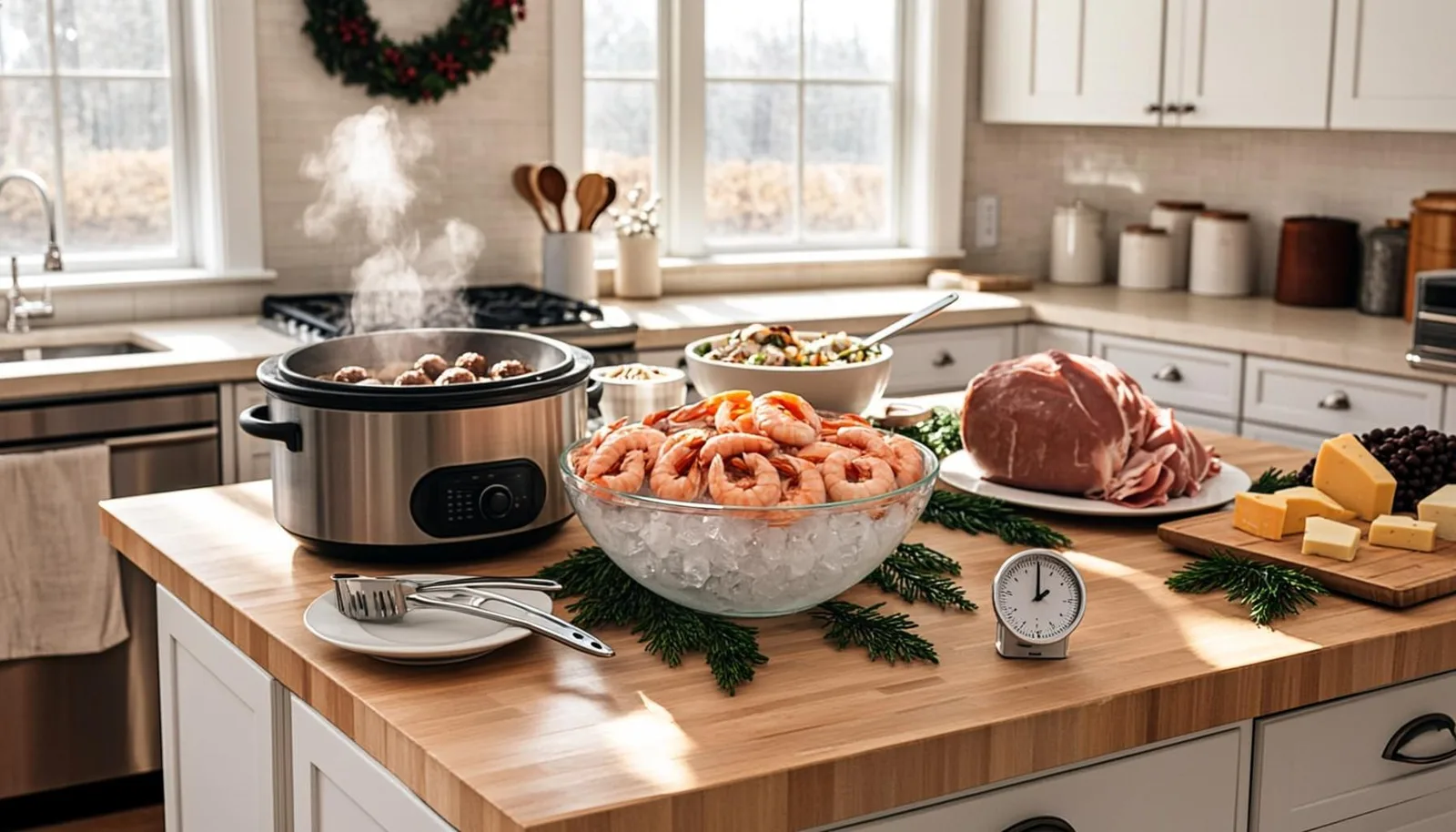
A réveillon runs late, and that is where the risk hides: in the dishes left on the table while everyone chats. Health Canada asks you to throw out any perishable food left at room temperature for more than 2 hours, and to keep hot foods at 60°C or above and cold foods at 4°C or below. The Quebec government explains why: after more than 2 hours at room temperature, bacteria can multiply. It advises serving small quantities at a time, keeping hot dishes in chafing dishes or slow cookers, and setting cold dishes on crushed ice. All the tips for a safe buffet are in our article on the 2-hour rule and the right buffet temperatures.
For cooking, keep these Health Canada numbers near your thermometer:
- 82°C (180°F) for whole poultry, measured in the thickest part;
- 74°C (165°F) for stuffing, casseroles, leftovers and egg dishes;
- 71°C (160°F) for ground pork, beef and veal, so tourtière filling and meatballs, and for the egg and milk mixture of homemade eggnog.
The Quebec government adds 74°C (165°F) for breasts cooked on their own. As for stuffing, Health Canada and the Quebec government recommend cooking it separately. If you insist on stuffing your turkey, do it loosely, just before it goes into the oven, and remove all the stuffing as soon as it is cooked. Never the day before: according to the Quebec government, that promotes microbial growth. With a thermometer and an eye on the clock, your réveillon can last until dawn, just like in the old days.
Free gift: get The Quebec Recipe Advent Calendar, 24 recipes ready in 30 minutes or less with local ingredients, one a day until Christmas Eve. The same page gathers all our holiday recipes and guides.
Sources
- Tourtière, Sasha Chapman, The Canadian Encyclopedia, Historica Canada, 2014 (last edited 2015).
- Christmas in Canada, James H. Marsh, updated by Maude-Emmanuelle Lambert, The Canadian Encyclopedia, Historica Canada, 2011 (last edited 2015).
- Pâté à la viande (Grand dictionnaire terminologique entry; in French), Office québécois de la langue française, 2010.
- Cipaille (Grand dictionnaire terminologique entry; in French), Office québécois de la langue française, 2010.
- Cipaille, tourtière, pâté à la viande (in French), Clés de la rédaction, Translation Bureau, Public Services and Procurement Canada, 2025.
- Temps des Fêtes : vocabulaire thématique (holiday season vocabulary; in French), Clés de la rédaction, Translation Bureau, Public Services and Procurement Canada, 2025.
- Why French-Canadians kick off Christmas with an all-night feast, Daniel Kitts, TVO Today, 2020.
- L'Union, holiday supplement, December 21, 1976, page 2 (in French), text by Mary Jo Zucchero, digital collections of Bibliothèque et Archives nationales du Québec (BAnQ).
- Culture de la canneberge (cranberry growing in Quebec; in French), Gouvernement du Québec, 2026.
- Holiday food safety, Health Canada, 2017.
- Turkey and holiday meals, Gouvernement du Québec, 2024.
- Storing leftovers (infographic), Health Canada, 2024.
Frequently asked questions
What is traditionally eaten at a Quebec réveillon?
Tourtière, or pâté à la viande, is the signature dish. At 19th-century réveillons, families also served meatball stew (ragoût de boulettes), pigs' feet and homemade doughnuts, according to TVO. Today, The Canadian Encyclopedia lists turkey, cranberries, tourtières, homemade pickles and the bûche de Noël (Yule log).
Are tourtière and pâté à la viande the same thing?
Yes, in most of Quebec: the OQLF and the federal Translation Bureau treat them as synonyms. But in Saguenay–Lac-Saint-Jean, Charlevoix and the surrounding areas, a tourtière is a big layered pie filled with cubed meats and vegetables, different from the ground pork meat pie.
Where does the word tourtière come from?
According to The Canadian Encyclopedia, the name most likely comes from the shallow pie dish called a tourtière, still used in France to bake and serve tourtes (pies). The idea that it comes from the tourte, the bird, is a persistent myth.
Which réveillon dishes can be made ahead?
Tourtières, meatball stew, pie crust and broth can be made 3 to 4 weeks ahead and frozen: Health Canada gives 2 to 3 months in the freezer for cooked dishes. A frozen turkey moves to the fridge a few days ahead, allowing about 24 hours for 3 kg plus one more day for each additional 2 kg.
Is homemade eggnog safe?
Yes, if it is made with pasteurized egg and dairy products, or if the egg and milk mixture is heated to at least 71°C (160°F), as Health Canada recommends. Raw eggs can contain Salmonella bacteria. Store-bought eggnog is already pasteurized.