Elderberry syrup: what Health Canada's monograph says
Elderberry syrup has become a pharmacy and farmers' market staple as soon as cold season starts. Health Canada has a monograph on elder, but it does not say quite what labels suggest. Here is what it allows, what the studies say, and the precautions to take, especially if you make your own syrup.
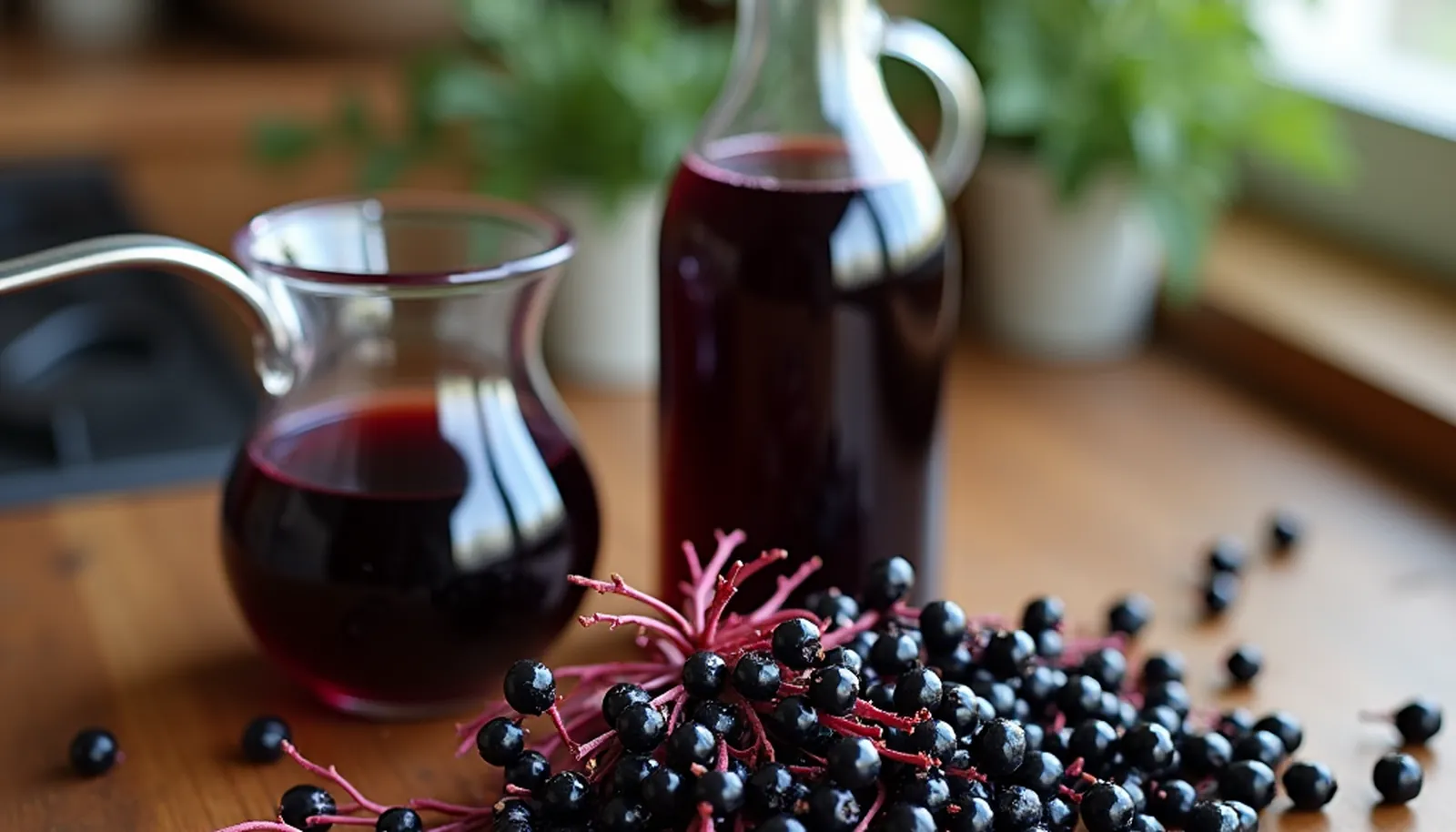
Deep purple bottles, labels promising to "support immunity", homemade recipes circulating on social media: elderberry syrup is everywhere from October on. It also has the advantage of coming from a local plant, since Canadian elder grows along ditches and fields throughout southern Quebec.
But what does Health Canada really say about elder? And what do studies show? This article is part of our guide to herbal remedies for colds and flu.
This article is for information only and does not replace the advice of a health professional.
What is a monograph?
In Canada, natural health products must obtain a product licence from Health Canada. To simplify things, the agency publishes monographs: documents that set out, for a given plant, the parts that can be used, the doses, the permitted uses and the mandatory warnings. A manufacturer that follows the monograph can obtain its licence more easily.
Once the product is authorized, its label carries an eight-digit licence number preceded by the letters NPN. To learn how to read all this, see our article on natural health product labels.
What the elder monograph covers
Health Canada's elder monograph, in its December 2025 version, covers two subspecies:
- European black elder (Sambucus nigra subsp. nigra);
- Canadian elder (Sambucus nigra subsp. canadensis), the one that grows here.
The permitted parts are the dried flower and the dried fruit, taken by mouth. Foods and food-like forms are excluded: the monograph covers health products, not jam.
Permitted uses
For adults, the monograph allows the following uses, all in Herbal Medicine:
- as a diaphoretic, meaning to promote sweating, to help relieve fever associated with colds or flu;
- to help relieve cold and flu symptoms;
- for the flower: to help relieve sinus and hay fever congestion;
- for the fruit: to help relieve joint pain, for example from arthritis, and as a source of antioxidants;
- as a diuretic, and as an "alterative" that helps eliminate waste.
For children aged 2 to 11 and adolescents, the uses are more limited: fever associated with colds or flu, relief of cold and flu symptoms, and, for the flower only, sinus and hay fever congestion. Joint pain, diuretic and antioxidant uses are not provided for them.
The key term is Herbal Medicine. In the monograph, traditional-use claims are worded with this term, for example "Used in Herbal Medicine to…". This means the claim is based on the plant's traditional use, not on clinical trials that would have demonstrated its effectiveness. It is a nuance packaging does not always make obvious.
Doses
The monograph sets daily doses by form and age. A few examples for adults 18 and over:
| Form | Dose per day, adult |
|---|---|
| Dried flower, as an infusion | 6 to 15 g |
| Dried flower, powder or extract | 1.5 to 15 g |
| Dried fruit, powder, extract, decoction or infusion | 1.3 to 18 g |
For children, doses are calculated as fractions of the adult dose, and the permitted forms are limited: before age 3, only liquids, such as solutions or suspensions. No use is provided for before age 2.
Mandatory warnings
Every product licensed under the monograph must display certain warnings:
- ask a health care practitioner before use if you are pregnant or breastfeeding;
- for cold, flu, fever or congestion uses: consult if symptoms persist or worsen;
- stop use if hypersensitivity or allergy occurs;
- a diuretic effect may occur.
The monograph lists no mandatory contraindications. If you take medications, your pharmacist remains the right person to check for possible interactions.
What the studies say
The monograph says what is allowed on the label. To know whether elderberry works, you have to look at clinical trials. The best available synthesis is the systematic review by Wieland and colleagues, published in 2021 in BMC Complementary Medicine and Therapies.
Its authors found only 5 clinical trials on elderberry and viral respiratory infections:
- Prevention: a single trial, in 312 adults. Elderberry may not reduce the risk of catching a cold (8% vs. 11%, low certainty).
- Duration of the cold: in those who caught one anyway, the cold might last about two days less.
- Severity: the cold might be less severe.
- Flu: 3 small trials, 151 participants in all. Elderberry might shorten the illness, but the estimate is very uncertain.
- Safety: no serious adverse events reported, but adverse events were poorly reported.
The authors rate the certainty of evidence as moderate to very low, because of small trials and risks of bias, and call for larger studies. The National Center for Complementary and Integrative Health (NCCIH), a U.S. public agency, sums it up the same way: some preliminary research suggests elderberry may relieve flu and cold symptoms, but few studies have examined it.
Elderberry does not replace the vaccine
With the flu, caution is called for. According to Québec.ca, most healthy people recover on their own in 5 to 8 days, but it can lead to complications. The best way to protect yourself from these complications is vaccination.
Elderberry syrup can be part of comfort care at home, but it replaces neither the vaccine nor a medical visit. If the fever persists, if breathing becomes difficult or if the skin changes colour, see a doctor. If in doubt, 811, option 1, puts you in touch with an Info-Santé nurse.
Homemade syrup: beware of raw berries
Making your own elderberry syrup with berries you picked yourself is tempting. It is possible, but you need to know about one danger. According to the NCCIH, raw or unripe berries, leaves and stems of elder contain compounds that can cause nausea, vomiting and severe diarrhea. Cooking destroys these compounds.
A few basic rules for a safer homemade syrup:
- Identify the plant correctly. Canadian elder has large flat clusters of small purple-black berries. Quebec also has red elder, with cone-shaped clusters of red berries: that is not the one used for syrup. If in doubt, do not pick.
- Only fully ripe berries, an even purple-black. Discard green ones.
- Remove all the stems. A fork run through the cluster detaches the berries easily.
- Always cook. The berries must simmer in water before being strained and sweetened. Never raw berries in a smoothie or a cold infusion.
- No honey before age 1. If your syrup contains honey, it is off-limits to babies, because of the risk of infant botulism.
Also keep in mind that a homemade syrup is not a licensed product: its concentration is unknown, and the monograph's doses do not apply directly. In the kitchen, elderberry is above all a tasty fruit, like other wild berries that must be cooked, such as mountain ash berries.
In short
Health Canada allows licensed elder products to say they help relieve cold and flu symptoms, in Herbal Medicine, so based on traditional use. The few clinical studies suggest a cold might be slightly shorter, with low certainty. That is not nothing, but it is far from the promises on some labels.
If you take it, choose a product with an NPN, follow the dose, and see a doctor if symptoms persist or worsen. If you make it yourself, always cook the berries. And if you give it to a child, remember that the monograph does not provide for any use before age 2. To compare with other remedies, from honey to echinacea, see our guide to cold remedies.
Sources
- Natural Health Product: Elder (Sambucus), Health Canada, 2025.
- Elderberry for prevention and treatment of viral respiratory illnesses: a systematic review, L. S. Wieland et al., BMC Complementary Medicine and Therapies, 2021.
- European Elder, National Center for Complementary and Integrative Health, 2024.
- Product Licensing, Health Canada.
- Information about the flu (influenza), Government of Quebec.
- Infant botulism, Health Canada.
Frequently asked questions
Is elderberry syrup recognized by Health Canada?
Health Canada has published an elder monograph, updated in December 2025. It allows products made from dried flowers or fruit to be licensed, in Herbal Medicine, to help relieve cold and flu symptoms and the fever that comes with them. These claims are based on traditional use. A licensed product has an NPN.
Does elderberry really shorten a cold?
Maybe. According to a 2021 systematic review, in adults who caught a cold, elderberry might shorten the illness by about two days and make it less severe. But there were only 5 clinical trials, and the certainty of evidence ranges from moderate to very low.
Are raw elderberries toxic?
Yes. According to the NCCIH, raw or unripe berries, leaves and stems contain compounds that can cause nausea, vomiting and severe diarrhea. Cooking destroys these compounds. Use only ripe, well-cooked berries, and remove the stems.
Can you give elderberry syrup to a child?
Health Canada's monograph provides for uses from age 2, not before, with doses reduced by age. Health Canada advises consulting a health professional before giving a natural health product to a child. If the syrup contains honey, never before age 1.
Is elder allowed during pregnancy?
Health Canada's monograph requires a statement to ask a health care practitioner before using an elder product if you are pregnant or breastfeeding.