Replacing your plastic containers without throwing everything out: the logical order
Emptying the container cupboard into the blue bin in one go is the reflex many of us have, and it is the least ecological option. There is a logical order: first what gets heated and what is damaged, then the rest, as it wears out. Here is how to move to glass and stainless steel without wasting anything.
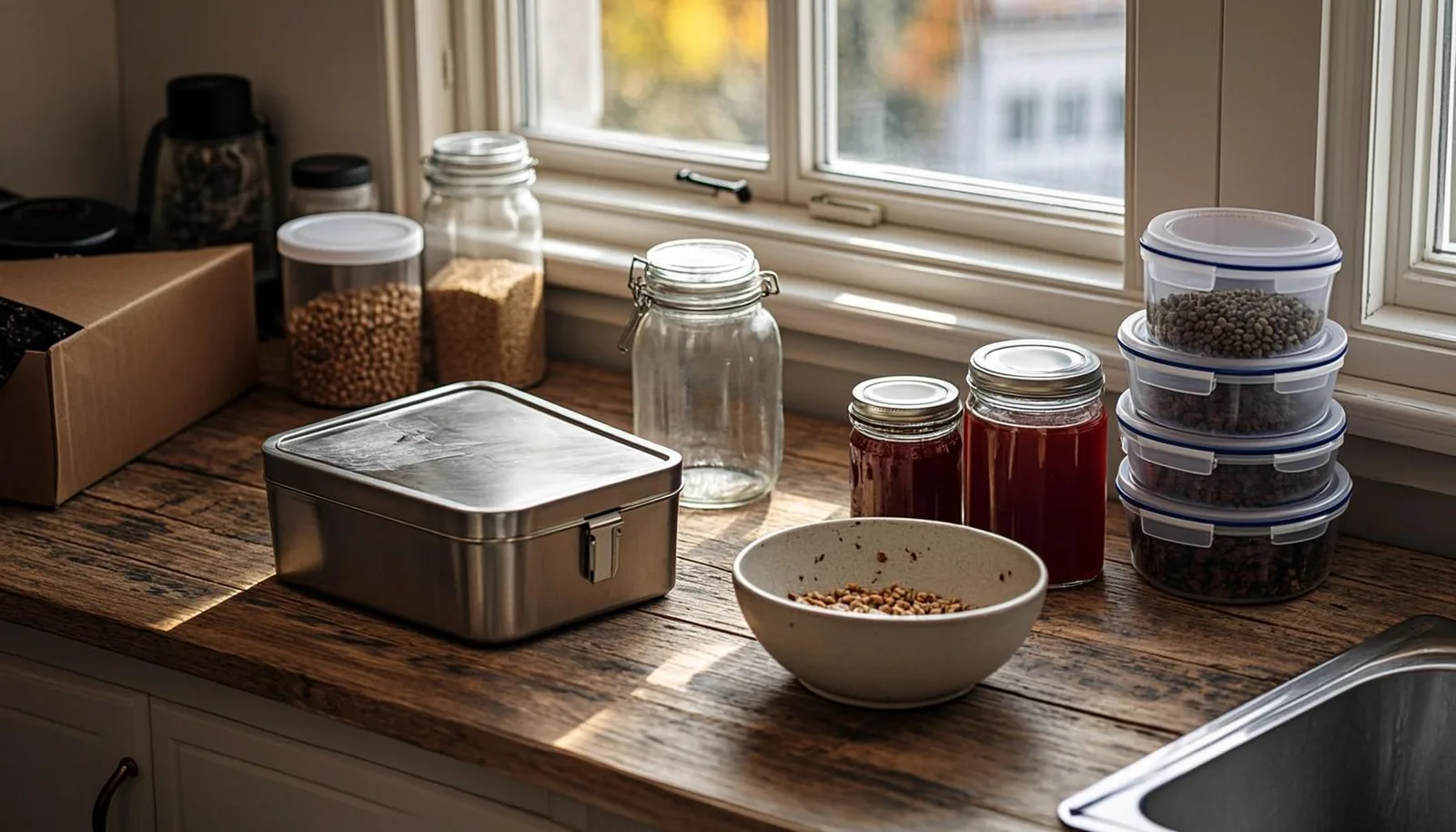
You have read two or three articles about bisphenols and microplastics, and your container cupboard is giving you a funny look. The temptation is to pull everything out, fill the blue bin and go buy a complete glass set. That is understandable, but it is the option that creates the most waste all at once, and it does not necessarily address what matters most for your health.
The right approach is a step-by-step replacement. You start with what gets heated and what is damaged, because that is where authorities and specialists focus their advice. The rest can keep serving, in the kitchen or elsewhere, until the end of its life. To understand what Health Canada really says about the risk, first read our pillar article on microwaving plastic and bisphenols. Here, we move on to action.
Why not throw everything out at once
In Quebec, RECYC-QUÉBEC promotes the 3RV-E hierarchy: reduce at the source first, then reuse, then recycle, recover, and dispose only as a last resort. A plastic container in good condition that you keep using for cold food is already in the "reuse" box. Throwing it out to replace it with a new one, even glass, skips two steps of that hierarchy: one more object gets made, and a container that could still serve goes to recycling.
On the health side, the picture is not alarming. According to Health Canada's 2008 risk assessment, most Canadians are exposed to bisphenol A (BPA) at low to very low levels that do not pose a health risk. The department also concludes that exposure from food packaging does not pose a risk, including for infants. The potential concern was mainly about babies, which led to the ban on polycarbonate baby bottles containing BPA in Canada. Health Canada says, however, that it continues to monitor exposure and review new research, and it is gathering information on the broader family of bisphenols.
In other words, there is no rush to empty your cupboards. There are, on the other hand, simple steps that follow official advice, and that is where you begin.
Priority 1: what goes in the microwave
Heat is the point that comes up in every recommendation. Health Canada advises using only glass or food-grade plastic containers labelled microwave safe, and only plastic wrap labelled for that use. Harvard Health adds that fatty foods, such as meats and cheeses, show more migration of plasticizers into food.
So take a look at what you actually reheat. The candidates to replace first:
- Margarine, yogurt, cream cheese or whipped topping tubs. They are designed for cold food. Clemson University and Harvard Health list them among the containers not to microwave, unless labelled otherwise.
- Takeout containers. Harvard Health says most are not made for the microwave, and that trays labelled for microwave use are meant for one-time use only.
- Freezer bags and grocery bags. Neither should be used for reheating.
- The plastic "leftovers" container that goes in the microwave every lunchtime, especially if it has no microwave-safe label.
The good news is that this change does not require buying much. Transferring leftovers to a ceramic plate or bowl before reheating them costs nothing. To cover food, Harvard Health suggests wax paper, parchment paper, a white paper towel or a domed lid; if you use plastic wrap, it should not touch the food. Also remember to leave an opening for steam.
Not sure whether a ceramic or glass dish is suitable? Clemson University offers a simple test: put the empty dish in the microwave with a cup of water in a glass measuring cup, and heat for 1 minute on high. If the dish stays cool, it is suitable; if it becomes warm or hot, do not use it in the microwave. Also avoid ceramics with metallic trim.
Priority 2: damaged, stained or smelly containers
Second sort: the condition of the container. Health Canada recommends avoiding plastics that are visibly damaged, stained or have an unpleasant smell. Harvard Health says much the same about the microwave: old, scratched or cracked containers, and those that have been microwaved many times, may release more plasticizers into food.
In practice, take these out of food use:
- containers that are cracked, warped or have become cloudy and rough;
- those permanently stained by tomato sauce or curry;
- those that keep a smell even after washing;
- old hard, clear containers marked "PC" or "polycarbonate". Health Canada says these markings mean the container may contain BPA. The number 7 in the triangle can correspond to polycarbonate, but the PC marking is more precise; when in doubt, the department suggests contacting the manufacturer. To sort out all those numbers, see our article on what the numbers in the triangle mean.
If you still have old baby bottles or hard plastic children's dishes from another era, now is also the time to take a close look at them. We cover it in baby bottles and children's dishes: is BPA still a risk in Canada?
What can stay: plastic in good condition, for cold food
Once those two sorts are done, you probably have a good stack of containers in good condition left. Those can keep serving. For storing food, Health Canada names three options: stainless steel, glass and food-grade plastic. An intact plastic container used for cold or dry food (cut vegetables, snacks, flour, leftovers you will transfer before reheating) remains a reasonable use under that advice.
The practical rule: you do not buy again as long as what you have works. When a container breaks, gets stained or loses its lid, you replace it with glass or stainless steel. The transition happens on its own over a few years, with no big purchase and no big recycling bag. That is exactly the logic of our 30-day plan to cut down on plastic: reduce what comes in before getting rid of what is already there.
A second life outside the kitchen
A container retired from food use is not waste. RECYC-QUÉBEC presents reuse as the second path to favour, right after source reduction, and it includes finding other uses for an object. A few ideas that have proven themselves in many homes:
- Workshop and garage: screws, nails, wall anchors, fuses, small bike parts.
- Desk and crafts: pencils, elastics, buttons, beads, kids' paint.
- Garden: seedling pots (poke a few holes in the bottom), saucers under pots, a container for carrying harvested seeds.
- Bathroom and medicine cabinet: hair elastics, bandages, small accessories.
- Car and camping: emergency kit, dry matches, clothespins.
Just one warning: do not put household products in them. Health Canada asks that household chemicals be kept in their original, tightly closed containers. An old yogurt tub full of cleaner, in a home with children, is a mix-up you do not want to risk. And when a container is truly finished, it goes in the blue bin: in Quebec City, the city asks that plastic containers and packaging be emptied and lightly rinsed before they go in. Note that in the same city, containers labelled biodegradable or compostable go in the garbage. Rules vary from one municipality to another; RECYC-QUÉBEC's « Ça va où? » app gives you yours.
What to replace them with: glass, stainless steel, ceramic
When it is time to replace, each material has its strengths. None is perfect for everything, and it is fine to have a little of each.
| Material | Best for | Microwave | Watch out for |
|---|---|---|---|
| Glass | Leftovers, prepared meals, storage in the fridge and freezer | Yes, if labelled for that use | Thermal shock; discard if chipped or cracked |
| Stainless steel | Cold lunches, snacks, dry food storage | No, unless the oven manufacturer allows it | Opaque (you can't see what's inside); nickel allergy |
| Ceramic | Reheating, serving | Yes, without metallic trim (cup-of-water test if in doubt) | Not practical for carrying a lunch |
| Food-grade plastic | Cold or dry food, light transport | Only if labelled microwave safe | Replace if damaged, stained or smelly |
Glass: the most versatile, as long as you spare it the shocks
Glass is the best replacement for containers that go in the microwave. Its weakness is thermal shock: a sudden temperature change can make it crack, or even shatter. Iowa State University, drawing on precautions published by Consumer Reports, recommends not moving a dish directly from the freezer to the oven or vice versa, setting a hot dish on a dry towel or trivet rather than a cold or wet counter, and discarding glass that is chipped, cracked or scratched. Borosilicate glass handles temperature swings better than tempered soda-lime glass, which, on the other hand, holds up better when dropped. The simplest approach is to follow your container manufacturer's instructions.
And before buying, look in your recycling bin: sauce, pickle or jam jars make excellent containers for the fridge and pantry. We explain how to use them safely, including in the freezer, in reusing glass jars.
Stainless steel: light, unbreakable, but not for reheating
Stainless steel is unbeatable for kids' lunches, snacks and transport: it does not break and it is light. However, like other metal containers, it does not go in the microwave unless the oven manufacturer expressly allows it. If someone in your home is allergic to nickel, first read our article on stainless steel and nickel.
A simple four-week plan
So you don't get lost, here is a way to spread it all over a month, without buying everything at once.
- Week 1: change the habit before the object. Everything that gets reheated goes on a ceramic or glass plate or bowl. Cost: zero.
- Week 2: sort the cupboard. Remove containers that are damaged, stained, smelly or marked PC. Set aside those that can have a second life outside the kitchen.
- Week 3: replace only what is really missing for lunches and leftovers to reheat. Collect jars, and look to your municipality's reuse organizations and second-hand stores before buying new.
- Week 4: reduce what comes in. Fewer takeout meals in trays, your own containers at the grocery store when possible, and a list of what you will replace when the rest wears out.
If your goal is also to limit plastic particles in your daily life, these steps overlap with the ones we describe in how to limit microplastics in your daily life. There is no rush: a well-chosen glass container will last for years, and every plastic container used to the end, in the right place, is one less piece of waste.
Sources
- Bisphenol A (BPA), Health Canada, 2020.
- Microwaving food in plastic: Dangerous or not?, Harvard Health Publishing, 2017.
- Microwave Food Safety, Clemson Cooperative Extension, Home & Garden Information Center, 2026.
- Glass Kitchenware Cautions, Iowa State University Extension (AnswerLine), 2019, reviewed in 2024.
- Mieux consommer : la hiérarchie des 3RV-E (in French), RECYC-QUÉBEC.
- Réemployer (in French), RECYC-QUÉBEC.
- Récupération (in French), Ville de Québec, 2026.
- Household chemical safety, Health Canada, 2026.
Frequently asked questions
Should I throw out all my plastic containers?
No. Health Canada accepts food-grade plastic containers for storing food. Replace first the ones you heat in the microwave without them being designed for it, and the ones that are damaged, stained or smell bad. The others can be used until the end of their life.
Can a margarine or yogurt tub go in the microwave?
No, unless it is labelled microwave safe. These containers are designed for cold food. Harvard Health and Clemson University advise transferring food to a glass or ceramic dish before reheating it.
Can a stainless steel container go in the microwave?
As a rule, no: metal containers do not go in the microwave unless the oven manufacturer allows it. Stainless steel is perfect for cold lunches, storage and snacks; to reheat, transfer the food to glass or ceramic.
Can a glass dish go from the freezer to the oven?
Avoid it. A sudden temperature change can make glass crack or shatter. Iowa State University recommends not going directly from the freezer to the oven, unless the manufacturer says so for that specific product.
Where do plastic containers go at the end of their life in Quebec?
Plastic containers and packaging go in the recycling bin, emptied and lightly rinsed. In Quebec City, containers labelled compostable or biodegradable go in the garbage. When in doubt, RECYC-QUÉBEC's « Ça va où? » app gives your municipality's rule.