Fall root vegetables: carrots, parsnips, beets and celeriac, from the field to the cold room
In October, root vegetables come out of the ground by the crateful, and they are what lets us eat local until spring. On one condition: keep them cold, humid and away from apples. Here is how to choose, store and cook carrots, parsnips, beets and celeriac, greens and peels included.
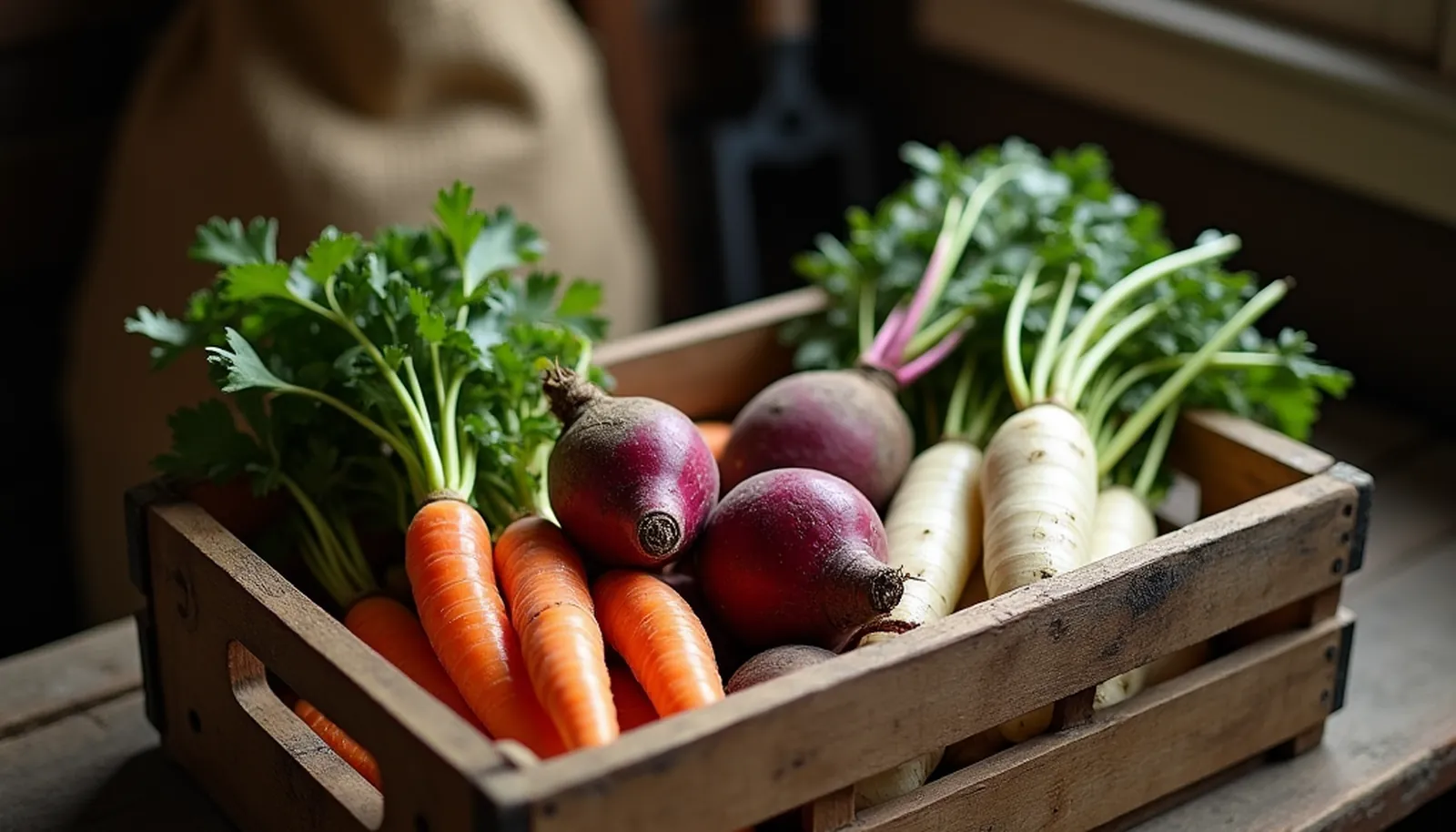
In October, Quebec's fields empty out one forkful at a time: carrots, parsnips, beets and celeriac go from the ground into crates, then into cold rooms. They are what lets us eat local in the middle of February. The MAPAQ's sector diagnostic of the fresh vegetable industry makes the point: if Quebec's supply lasts a good part of the year, it is mostly thanks to so-called "storage" vegetables, such as root vegetables, cabbages and winter squash. In 2024, carrots alone ranked third among Quebec's fresh vegetables by sales value, at about $58 million, behind lettuces and dry onions. Quebec then accounted for 40% of Canadian carrot sales.
Stored well, these roots last for months. Stored badly, they go soft, sprout or turn bitter well before Christmas. This guide covers the four big roots of fall: how to choose them, get them ready for winter, store them (in the fridge, in a cold room, in sand or even in the garden) and cook them without wasting anything. To go further, we have prepared five companion pieces: 6 ways to eat carrot and beet greens, oven-baked vegetable peel chips, maple and thyme roasted parsnips, pickled beets canned the safe way and our verdict on storing roots in sand.
Four roots, four personalities
Carrots are the easiest to live with: raw, grated, roasted or in a soup, they go with everything. The green you sometimes see on the shoulder is no sign of freshness: according to the Postharvest Research and Extension Center at the University of California, Davis (UC Davis), it comes from exposure to light while the root was growing, and it counts as a quality defect.
Parsnips look like big cream-coloured carrots, and their sweet flavour has to be earned: they need to get cold. According to Montana State University, their flavour is not fully developed until the roots have spent two to four weeks at temperatures close to freezing. Growers use the same principle in storage: a parsnip dug early in the fall gets sweeter after two or three weeks in the cold, note the universities of Massachusetts and New Hampshire. Half a cup of parsnip provides about 55 calories, and it is a good source of vitamin C, folate, potassium and magnesium, Montana State University adds.
Red beets are still the most popular, but the Mangez Québec fact sheet points out that there are also yellow and white beets, handy when you do not want to dye the whole dish, and the chioggia, with pink flesh striped with white. A 125 ml (½ cup) serving of raw beet provides about 30 calories and 80 µg of folate, or 20% of the daily value. The leaves are eaten like spinach, raw or cooked.
Celeriac is the underdog of the bunch, with its look of an earthy, hairy ball. Under the rough skin, though, the flesh is delicate and flavourful. It is in fact a variety of celery from the Mediterranean region, notes Équiterre, which counts it among the great winter vegetables because it keeps easily. Local celeriac is available from September to March.
Turnips, rutabagas and Jerusalem artichokes round out the winter vegetable team. The Jerusalem artichoke even has its own guide: how to choose, prepare and store Jerusalem artichokes.
Choosing them at the market
For beets, the Mangez Québec fact sheet gives precise pointers: choose them firm, with smooth, even skin and no bruises. If they still have their leaves, the leaves should not be wilted. Small beets are more tender and cook faster. Most are harvested when they measure 3 to 8 cm; bigger ones become fibrous and less flavourful.
For carrots, UC Davis links quality to a firm, straight root that tapers evenly to the tip, bright orange, with no cracks and no green shoulders. For parsnips, aim for small or medium, firm roots: big ones often hide a woody core that has to be removed before cooking, explains Montana State University. And for celeriac, avoid soft or wrinkled roots: water loss is the main cause of deterioration for this vegetable, according to the storage manual of the World Food Logistics Organization (WFLO).
Do not snub forked carrots or lumpy beets, though: their shape changes nothing about their taste. We explain what ugly vegetables are and where to find them in Quebec.
Buying them in bunches, with their greens? Cut the tops off as soon as you get home. In its guide to storing vegetables and fruits, Health Canada recommends removing the leaves from carrots and beets before refrigerating them, since the leaves spoil faster. Do not throw those leaves away, though: they can be cooked, and we suggest 6 ways to eat them.
The golden rule: cold, humid and away from apples
All four roots want the same thing: cold, ideally around 0°C, and plenty of humidity, from 90 to 100% relative humidity depending on the vegetable, according to the storage conditions table from the universities of Massachusetts and New Hampshire. Those are root cellar conditions, a far cry from a heated kitchen.
Humidity keeps the roots from drying out. For carrots, humidity of 98 to 100% prevents them from drying and losing their crunch, explains UC Davis. For celeriac, the water loss that makes it wrinkle is the main cause of deterioration, according to the WFLO.
Cold slows everything down. At 0°C, a mature carrot keeps 7 to 9 months in commercial storage; between 3 and 5°C, it lasts more like 3 to 5 months with little decay, according to UC Davis. Celeriac goes from 6 to 8 months at 0°C to about 4 months at around 4 or 5°C, according to the WFLO. And from 7°C, roots start growing new leaves again and turn woody, warns Washington State University (WSU).
Careful, though: cold does not mean frozen. Carrots risk damage from -1.2°C (UC Davis). Beets without their leaves freeze at about -0.9°C (Mangez Québec), and so does celeriac (WFLO). Parsnips are the toughest: they tolerate freezing, but they are damaged by successive freezing and thawing, according to WSU.
Finally, keep them away from fruit. Apples, pears, peaches, plums, cantaloupes and tomatoes give off a lot of ethylene in storage, a gas that speeds up ripening. Carrots and parsnips are very sensitive to it: they turn bitter, according to the universities of Massachusetts and New Hampshire. It takes very little: 0.5 ppm of ethylene is enough to make a carrot noticeably bitter in two weeks, according to UC Davis. Celeriac, for its part, gets tough if exposed for a long time (WFLO). So apples need their own corner: see how to store apples all winter.
| Vegetable | Ideal conditions | Commercial storage | Home root cellar | Freezing | Ethylene (apples, pears) |
|---|---|---|---|---|---|
| Carrot, tops removed | 0°C, 98 to 100% humidity | 5 to 9 months | 4 to 5 months | damaged from -1.2°C | very sensitive: bitter taste |
| Parsnip | 0°C, 90 to 95% humidity | 2 to 6 months | 2 to 4 months | tolerates freezing, not freeze-thaw cycles | very sensitive: bitter taste |
| Beet, tops removed | 0°C, 95% humidity | 4 to 6 months | 1 to 3 months | freezes at about -0.9°C | not very sensitive |
| Celeriac | 0°C, 95 to 99% humidity | 6 to 8 months | about 4 months if the room stays at 4 or 5°C | freezes at about -0.9°C | slightly sensitive: the root gets tough |
This table combines several sources: the universities of Massachusetts and New Hampshire for carrots, parsnips and beets, the WFLO for celeriac, WSU for durations in a home root cellar, and UC Davis, Mangez Québec and the WFLO for freezing. Commercial storage durations assume temperature and humidity controlled to a tee; at home, go by the home root cellar column.
Getting the harvest ready for winter
Whether you are harvesting your own garden or buying a crate at the farm stand, the same steps apply. Harvest in dry weather, in dry soil: wet produce is much more prone to disease, WSU points out. MOFGA, the Maine Organic Farmers and Gardeners Association, advises digging carrots before the ground freezes and harvesting beets just before they are fully mature, when nights drop to around -1°C. Parsnips can wait; more on that below.
Do not wash the roots you want to keep for a long time. Shake off the soil, remove clumps by hand and leave them as they are: Health Canada advises keeping most vegetables unwashed until you prepare them, and the Mangez Québec fact sheet recommends not wetting beets. The Massachusetts researchers add that carrots bruised during washing can turn bitter.
Cut off the tops, leaving a short piece of stem, about 1.25 cm (½ in.) above the crown, as WSU recommends. For beets kept in the fridge, Mangez Québec suggests leaving 4 to 5 cm of stem instead. The sources differ a little, but none cuts flush with the root. For celeriac, trim the long rootlets carefully, without cutting too close to the bulb, MOFGA advises.
Then sort them. Intact roots go into winter storage; those nicked by the fork get eaten first, as MOFGA recommends for parsnips. It is a good rule for all roots: a wound opens the door to rot.
Finally, do not rush to take the crates downstairs. To avoid mould, MOFGA advises waiting until temperatures have dropped to 4°C (40°F) or below before packing vegetables in damp sand, sawdust or leaves. Use the time to put your garden to bed before the frosts.
Where to keep them: fridge, cold room, sand or garden
In the fridge, for a few weeks
The refrigerator is still the simplest solution for a bunch or two. Health Canada advises keeping fruit and vegetables in two separate drawers, with vegetables going in the high-humidity drawer. Put the roots in a plastic bag with a few holes in it: WSU suggests four holes of about 6 mm. Unwashed beets keep 2 to 4 weeks there, sometimes longer, according to Mangez Québec. Parsnips last about three weeks or more in a perforated bag, away from strong-smelling foods like green onions and leeks, according to Montana State University.
In a cold room or root cellar, for the winter
For a whole harvest, you need a cold, humid space: the cold room under the front steps, a root cellar or a corner of an unheated basement. WSU recommends the lowest part of the basement, usually the coldest and most humid. Put in a thermometer and, if you can, a hygrometer: what you are aiming for are the values in the table. Keep turnips and rutabagas apart, because they give off odours: WSU even advises storing them outside the house. The needs of each vegetable and how to set up a root cellar are explained in our article on the benefits of a natural root cellar.
In sand, grandma's method
A cold room is not always humid enough. Hence the old method of burying roots in damp sand. WSU suggests layers of damp sand, peat or sphagnum moss, and MOFGA a bucket of damp sand topped with a lid set on loosely. Does it really work, and under what conditions? We sorted the true from the false in storing root vegetables in sand: myth or fact.
In the garden, under mulch
Parsnips are the winter champions: many gardeners leave them in the garden and harvest them in spring, notes Montana State University. MOFGA advises leaving them uncovered until the ground freezes, then covering them with mulch until harvest, in spring; their flavour improves with frost. Carrots, for their part, can stay in the ground under a mulch of straw or hay until late fall and early winter, according to MOFGA.
In the freezer, for the extras
Roots freeze well, as long as you prepare them. For carrots, the National Center for Home Food Preservation (NCHFP) at the University of Georgia advises peeling them, cutting them into slices, cubes or sticks and blanching them for 2 minutes in boiling water (5 minutes for small whole carrots), then cooling them quickly and packing them with 1.25 cm (½ in.) of headspace. Beets are frozen once cooked and cut, for up to 12 months, according to Mangez Québec. For parsnips, the method is explained in our maple roasted parsnip recipe. In general, Health Canada says many frozen vegetables keep for up to 12 months.
In the kitchen: the right move for each root
Carrots need almost nothing. If you peel them, keep the peels: they make excellent oven-baked chips.
Parsnips should be scrubbed well to remove soil and sand; peeling is optional. Remove the woody core from big parsnips, then cut them into 0.5 to 1.25 cm (¼ to ½ in.) pieces for roasting or boiling. According to Montana State University, they cook in 12 to 15 minutes in water or steam, or in 12 to 15 minutes in a skillet, and they can even be grated raw in place of cabbage in a slaw. Ginger, nutmeg and cinnamon suit them well, and so does maple: try our maple and thyme roasted parsnips.
A word of caution for gardeners: wear gloves and long sleeves to dig and strip your parsnips. Wild parsnip, an invasive plant, is a parsnip that escaped from gardens, and its sap can cause severe burns by making skin more sensitive to sunlight, warns the Government of Ontario. To be safe, treat the foliage of garden parsnips with the same respect, and leave it for the compost.
Beets should be scrubbed just before cooking, without peeling: the skin comes off once the beet is cooked, under cold water, and gloves will save you from pink hands, Mangez Québec advises. Raw, beets can be grated or sliced on a mandoline. Be careful, though: the same fact sheet reports that food poisoning has been linked to eating raw red beets that had been stored. To eat beets raw, it therefore recommends choosing yellow, white or chioggia beets, or red ones that still have their leaves, which means they were harvested recently. To keep part of the harvest in the pantry, make our pickled beets, canned using a tested method.
Celeriac is peeled, then grated raw into a salad with lemon juice, or cooked into a purée with potatoes, for 20 to 30 minutes. Two tips from Équiterre: to soften its bitterness when you eat it raw, blanch it for 1 minute in salted boiling water, and do not overcook it, because it becomes bland and sticky.
Nothing goes to waste: greens, peels and imperfect roots
Root vegetables are perfect for cooking without waste. Beet leaves are eaten like spinach, and carrot tops make a very good pesto: we suggest six ways to use them in carrot and beet greens: 6 ways to eat them. Peels, scrubbed well, become crispy chips. Extra beets get pickled. Misshapen or slightly soft roots end up in soup, purée or the oven.
For the rest of your anti-waste habits, from meal planning to fridge leftovers, see our tips for cooking without waste. What is truly left over, such as rootlets, tough stems, damaged parts and parsnip leaves, goes into the compost: see how to compost food scraps.
Your root calendar, from October to April
- October: the month for harvesting and sorting. Dig in dry weather, cut off the tops, set aside damaged roots. It is also when growers fill their storage: after October, Quebec beets are stored, then sold as demand calls for them, according to Mangez Québec.
- November: move the crates to the root cellar once the temperature has dropped to 4°C or below, and dig the last carrots kept under mulch.
- December to February: check your stores every week or two, remove anything that softens or moulds, and eat the roots in order of how long they keep at home: beets first (1 to 3 months), then parsnips (2 to 4 months) and carrots (4 to 5 months), according to WSU.
- March and April: the end of the season for local celeriac, which runs from September to March, and time to dig the parsnips left in the garden.
With a good root cellar, a few perforated bags and a little discipline, an October harvest can feed the household for a good part of the winter. Happy harvesting!
Sources
- Portrait-diagnostic sectoriel de l'industrie des légumes frais au Québec 2018-2024 (sector diagnostic of the fresh vegetable industry; in French), Ministère de l'Agriculture, des Pêcheries et de l'Alimentation du Québec (MAPAQ).
- Storing vegetables and fruits, Canada's food guide, Health Canada, 2026.
- Optimal Storage Conditions and Ethylene Sensitivity of Fall Storage Crops, A. Brown, A. Cavanagh, R. Hazzard (University of Massachusetts) and B. Sideman (University of New Hampshire), updated 2018.
- Carrot (produce fact sheet), Trevor V. Suslow, Jeffrey Mitchell and Marita Cantwell, Postharvest Research and Extension Center, University of California, Davis, 2002.
- Celeriac (Celery Root), Commodity Storage Manual, World Food Logistics Organization (WFLO), 2008.
- Storing Vegetables and Fruits at Home (EB1326E), Val Hillers, Washington State University Extension, 2013.
- Betterave du Québec (beet fact sheet; in French), Mangez Québec, 2020.
- Parsnips, Montana State University Extension, 2014.
- Céleri-rave local (celeriac recipe sheet; in French), Julie Strecko, nutritionist, Équiterre, 2022.
- Freezing Carrots, National Center for Home Food Preservation, University of Georgia.
- Storing Garden Vegetables (Fact Sheet #15), Eric Sideman and Cheryl Wixson, Maine Organic Farmers and Gardeners Association (MOFGA), 2010.
- Wild Parsnip, Government of Ontario, 2013.
Frequently asked questions
Why did my carrots turn bitter?
The most likely culprit is ethylene, a gas given off by apples, pears, tomatoes and other fruit. According to the University of California, Davis, as little as 0.5 ppm of ethylene is enough to make a carrot bitter in two weeks. Keep carrots and parsnips away from fruit, in another bin or another room.
Should I wash root vegetables before storing them?
No. Health Canada advises keeping most vegetables unwashed until you prepare them, and the Mangez Québec fact sheet recommends not wetting stored beets. Just remove clumps of soil by hand and wash the roots right before cooking.
How long do beets keep in the fridge?
From 2 to 4 weeks, sometimes longer, in the crisper drawer, unwashed and with about 4 to 5 cm of stem left on, according to the Mangez Québec fact sheet. In a cold, humid root cellar, count on 1 to 3 months.
Can parsnips stay in the garden all winter?
Yes, it is even a tradition. Many gardeners leave them in the ground and harvest them in spring, notes Montana State University, and MOFGA advises covering them with mulch. Parsnips tolerate freezing; what they handle poorly is repeated freezing and thawing, according to Washington State University.
Does celeriac keep as long as carrots?
Almost. At 0°C and with humidity close to saturation, it keeps 6 to 8 months, according to the WFLO storage manual, compared with 7 to 9 months for a mature carrot, according to the University of California, Davis. But at 4 or 5°C, celeriac only lasts about 4 months.