Storing root vegetables in sand: myth or fact
Burying carrots in a crate of sand is a grandma's method that comes back every fall. It works, but not for the reasons people think, and not just any old way. Here is what storage guides say, eight common beliefs put to the test and the method that works.
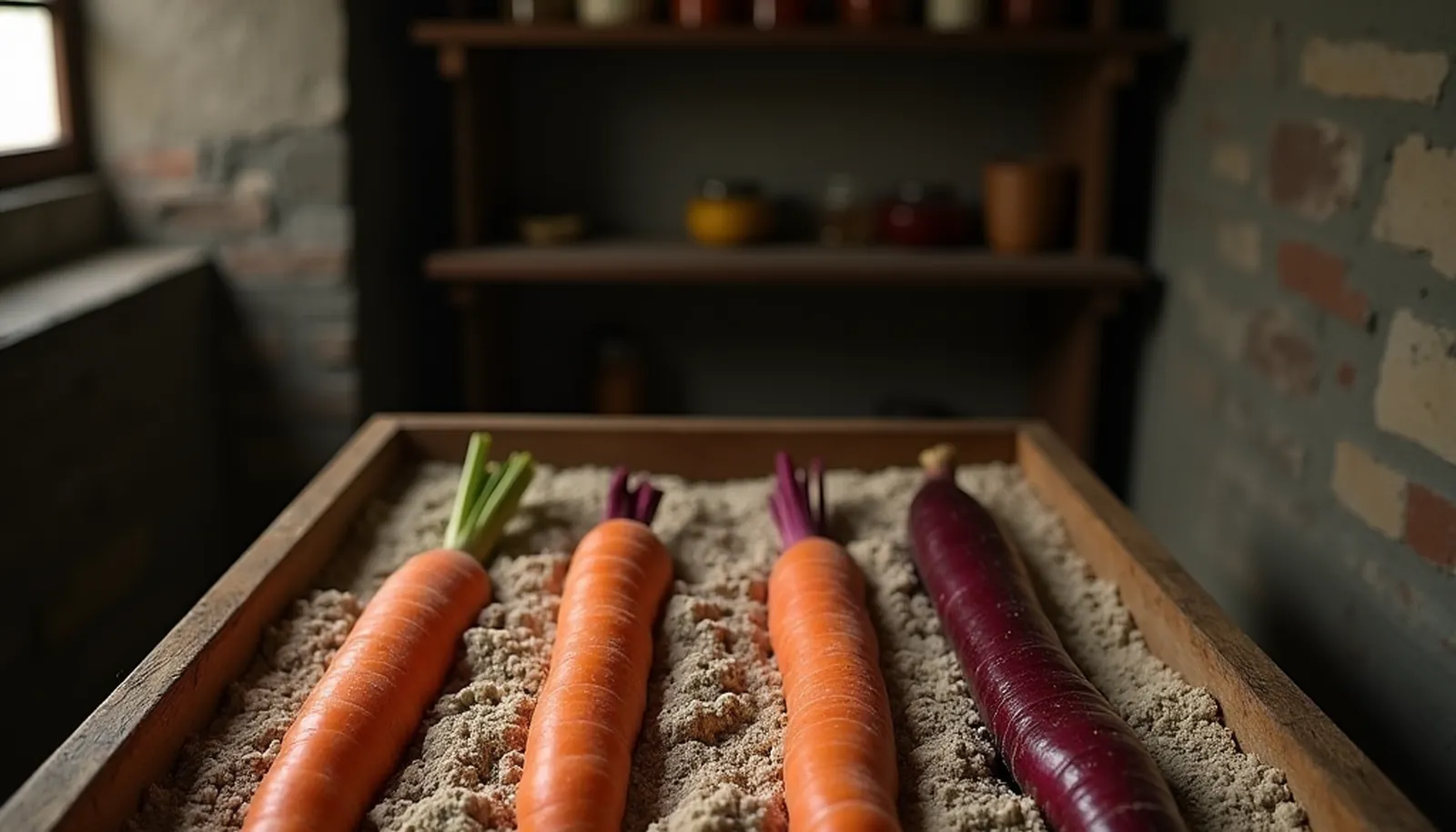
Every fall, the same picture comes back: a wooden crate full of sand at the back of the root cellar, from which grandma pulled crunchy carrots in the middle of February. Fond memory or tall tale? Good news: the method has its place in serious storage guides, from Britain's Royal Horticultural Society to American university extension services. But sand works no miracles, and used badly, it can even encourage rot.
Here is what sand really does, eight common beliefs put to the test, the method step by step and the signs that should worry you. For the other ways to keep your roots, from the fridge to the garden, see our guide to fall root vegetables.
The verdict: true, on three conditions
Sand preserves nothing on its own. Its role is to keep humidity around the roots so they do not dry out. The Royal Horticultural Society (RHS) says it clearly: for roots that lose their moisture, such as carrots, celeriac, rutabagas and beets, layers of damp sand in a box, kept in a dark, frost-free place, keep them from shrivelling. That matters, because a carrot wilts when relative humidity drops below 95%, according to Iowa State University.
What really preserves them is the cold. So the three conditions for success are:
- a cold place, ideally between 0 and 2°C for carrots according to Iowa State University, without ever freezing;
- clean, barely damp sand, never soaked;
- healthy roots, unwashed, with their tops cut off.
Without the cold, damp sand will prevent neither sprouting nor rot.
8 common beliefs about sand, true or false
1. "Sand keeps carrots crunchy all winter": mostly true
That is its real job: by keeping humidity around the roots, it keeps them from going soft. The University of California, Davis, points out that humidity of 98 to 100% keeps carrots from drying out and losing their crunch. But "all winter" depends on the temperature: at 0°C, a mature carrot keeps 7 to 9 months in commercial storage, and between 3 and 5°C, more like 3 to 5 months, according to the same source.
2. "With sand, you don't need a cold room": false
Sand cools nothing. Iowa State University warns that carrots risk sprouting or rotting from about 4°C, and Washington State University (WSU), that at 7°C roots start making new leaves and turn woody. So a crate of sand in a heated basement will work no miracles. You need a cold corner, and the ideal is still a cold room or root cellar: see the benefits of a natural root cellar.
3. "You have to wash the vegetables well before burying them": false
North Dakota State University (NDSU) is clear: do not wash roots before storing them. Remove the soil gently, without scraping the skin, and wash only before eating. The RHS also advises simply shaking off the loose soil. Only one source we consulted is an exception: Iowa State University advises carefully washing celeriac to remove the soil. For carrots and beets, none of the sources we consulted advises washing them.
4. "You cut the tops flush with the root": false
You should cut off the tops, but leave a short piece of stem. Sources vary on the length: 6 mm (¼ in.) for NDSU, 1.25 cm (½ in.) for WSU, 1.25 to 2.5 cm (½ to 1 in.) for Iowa State University. NDSU explains the trade-off: a stem that is too long encourages rot, one that is too short dries out the root. And the cut tops do not have to go to the compost: we suggest 6 ways to eat them.
5. "Any sand will do, and the wetter the better": false
Use clean sand, such as play sand or builder's sand. The Farmers' Almanac advises against beach sand, because of the salt. As for moisture, the sand should be barely damp, not wet: the guides talk about "damp" or "moist" sand (WSU, MOFGA), and the Farmers' Almanac specifies that it should be very slightly so. Too much water encourages disease: wet produce is much more susceptible, WSU points out. And to avoid mould, MOFGA, the Maine Organic Farmers and Gardeners Association, advises waiting until temperatures have dropped to 4°C (40°F) or below before packing roots in damp sand or sawdust.
6. "Sawdust, peat or leaves work too": true
There is nothing magical about sand. Iowa State University suggests sand or sawdust for large amounts of carrots, WSU layers of damp sand, peat or sphagnum moss, and MOFGA leaves, sawdust or moss. MOFGA even recommends damp sawdust for parsnips, and sawdust, moss or sand for turnips and rutabagas, the latter shrivelling easily.
7. "You can store apples in the same room": false
Not next to the carrots, at least. The Canadian Food Inspection Agency (CFIA) recommends not storing carrots with products that give off ethylene, such as apples, avocados, bananas, pears or tomatoes: they can develop a bitter or even petroleum-like taste. MOFGA also warns about apples, whose ethylene makes other vegetables rot, and advises keeping them in closed containers. Sand changes nothing. Apples have their own rules: see how to store apples all winter.
8. "Parsnips absolutely have to come in before winter": false
Parsnips are the exception. They can spend the winter in the garden: Iowa State University advises covering them with several centimetres of straw to prevent cold damage, then harvesting them in spring, before the plant starts growing again, because their quality drops quickly after that. MOFGA adds that their flavour improves with frost. To get the bed ready, see how to put your garden to bed before the frosts.
The method, step by step
- Harvest in dry weather, when the soil is dry, before a hard freeze: NDSU recommends harvesting beets and carrots before a killing frost of -2°C (28°F).
- Sort: only healthy roots go into the sand. The RHS advises discarding or quickly eating damaged ones.
- Prepare them: shake off the soil without washing or scraping, then cut off the tops, leaving a short piece of stem.
- Prepare the container: a wooden crate or a bin, as the RHS suggests, or a bucket topped with a lid set on loosely, as MOFGA suggests for carrots and beets.
- Dampen the sand just enough that it feels cool to the touch, with no puddles or mud.
- Build the layers: about 5 cm (2 in.) of sand on the bottom, a layer of roots lying down and not touching, then 5 cm of sand, and so on, finishing with about ten centimetres of sand, as the Farmers' Almanac describes.
- Place the container in the coldest, most humid spot that does not freeze, once temperatures have dropped to 4°C or below.
- Keep an eye on it: remove any soft or spotted root as soon as you see it, and moisten the sand a little if it dries out, advises the Farmers' Almanac.
Where to put the crate, in a house or an apartment
NDSU suggests an unheated garage, a cold mudroom or a cool corner of the basement. WSU recommends the lowest part of the basement, usually the coldest and most humid. In a garage, watch the thermometer: carrots are damaged from -1.2°C, according to UC Davis. Bring the crate in or cover it well during deep cold spells, and avoid places where the temperature keeps going up and down.
In an apartment, without a cold room, sand is not the right solution. For small amounts of carrots, Iowa State University advises perforated plastic bags in the refrigerator instead. The crate of sand is meant for big harvests and houses with a truly cold corner.
Signs that things are going wrong
| What you see | Likely cause | What to do |
|---|---|---|
| New leaves, woody roots | Too warm: 4°C and above, according to Iowa State; 7°C, according to WSU | Find a colder corner; eat these roots first |
| Soft, shrivelled roots | Too dry: humidity below 95%, according to Iowa State | Lightly moisten the sand; make sure the roots are well covered |
| Mould, rot | Too wet, too warm, or wounded roots | Remove affected roots; let the sand dry a little; wait for the cold before storing |
| Bitter taste | Ethylene from apples, pears, tomatoes or bananas, according to the CFIA | Move the fruit away; keep the carrots in another room |
| A water-soaked ring under the skin that turns black within 2 or 3 days | Freezing: carrots are damaged from -1.2°C, according to UC Davis | Eat or discard the affected roots quickly; protect the crate from the cold |
One last thing: the RHS notes that rodents, such as mice and voles, can go after stored root vegetables. Keep the crate out of their reach, or cover it with fine mesh.
Sources
- Root vegetables: storing, Royal Horticultural Society.
- Storing Winter Storage Vegetables, Aaron Steil, Iowa State University Extension, 2025.
- Storing Your Harvest, Tom Kalb, North Dakota State University Extension.
- Storing Vegetables and Fruits at Home (EB1326E), Val Hillers, Washington State University Extension, 2013.
- Storing Garden Vegetables (Fact Sheet #15), Eric Sideman and Cheryl Wixson, Maine Organic Farmers and Gardeners Association (MOFGA), 2010.
- Carrot (produce fact sheet), Trevor V. Suslow, Jeffrey Mitchell and Marita Cantwell, Postharvest Research and Extension Center, University of California, Davis, 2002.
- Natural toxins in fresh fruit and vegetables, Canadian Food Inspection Agency, 2019.
- How to Store Root Vegetables in Sand (Without a Root Cellar), Deborah Tukua, Farmers' Almanac, 2026.
Frequently asked questions
What sand should I use to store carrots?
Clean sand, such as play sand or builder's sand, and not beach sand, which contains salt, advises the Farmers' Almanac. It should be barely damp, never soaked. Damp sawdust, peat or sphagnum moss also work, according to university guides.
Should I wash carrots before putting them in sand?
No. North Dakota State University recommends not washing roots before storage, removing soil gently without scraping them and washing them only before eating.
How long do carrots keep in sand?
It all depends on the temperature. In a very humid spot at 0 to 2°C, Iowa State University counts 4 to 6 months for carrots and 1 to 3 months for beets. From about 4°C, carrots risk sprouting or rotting, with or without sand.
Can I keep the crate of sand in the garage?
In an unheated garage, yes, North Dakota State University suggests it, but only as long as it does not freeze: carrots are damaged from -1.2°C, according to the University of California, Davis. Put in a thermometer and bring the crate inside at the first deep cold.
Does sand keep carrots from turning bitter?
No. Bitterness comes mostly from ethylene, a gas given off by apples, pears, tomatoes, bananas or avocados. The Canadian Food Inspection Agency recommends not storing carrots with these fruits, sand or no sand.