What the numbers in the triangle under your containers mean
The little number in the triangle under your yogurt tub is not a recycling symbol: it tells you what kind of plastic the item is made of. Here is what codes 1 to 7 mean, what really goes in the bin in Quebec since curbside recycling was modernized, and what that number does, or does not, tell you about your health.
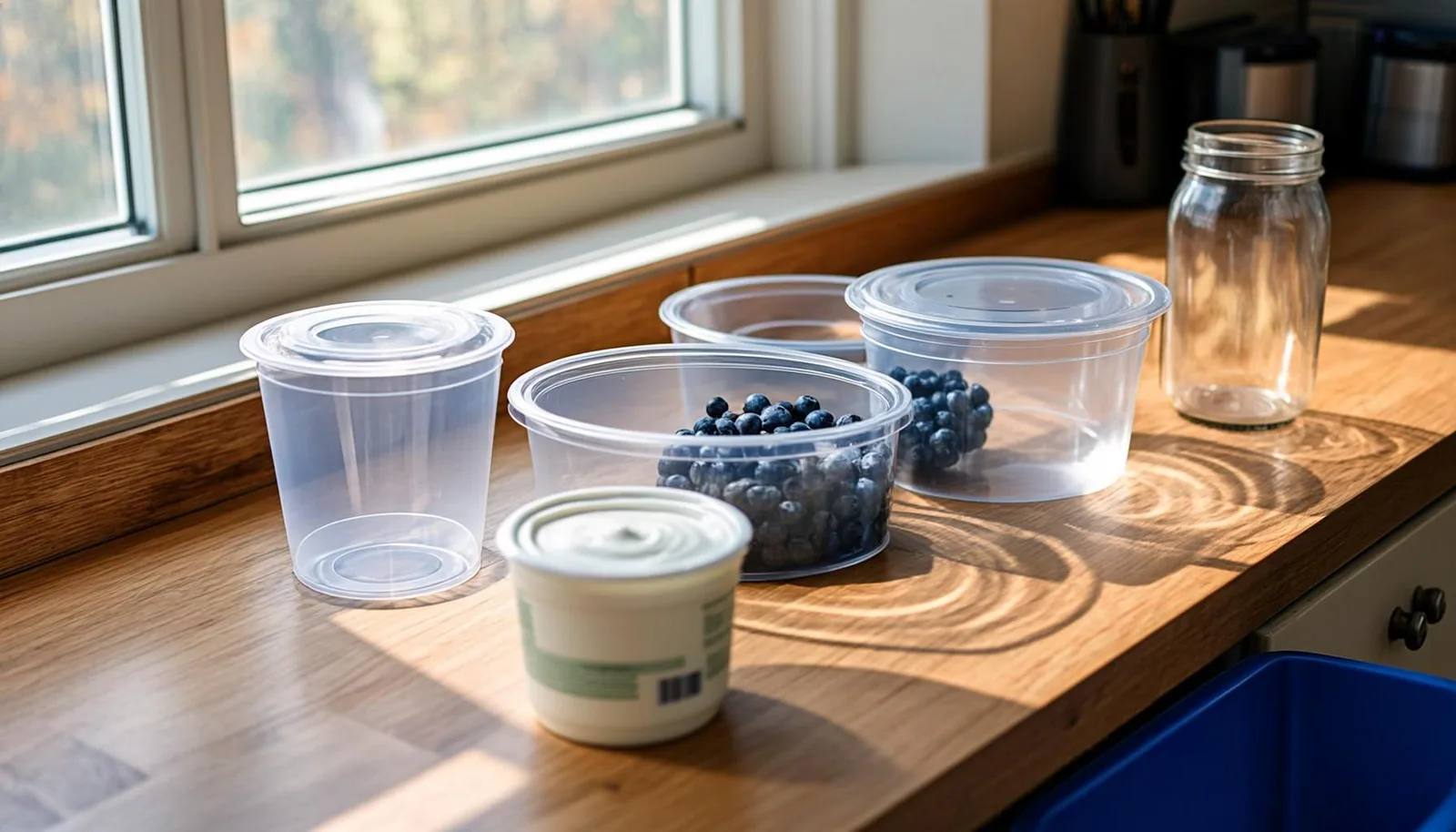
Flip over a yogurt tub, a strawberry clamshell or a bottle of dish soap: you will almost always find a little triangle with a number from 1 to 7, sometimes followed by letters like PET, PP or PS. Lots of people see it as a green light for the blue bin. Others use it to decide what can go in the microwave. Either way, we ask it to say more than it does.
This number is a resin identification code: it names the family of plastic, and that is all. Here is how to read it, what it changes at the recycling bin in Quebec since 2025, and what it can teach you, modestly, about the containers you heat.
A number that names the plastic, not its fate
The system was born in the United States. According to the ASTM D7611 standard, it is based on a coding system developed in 1988 by the Society of the Plastics Industry, the American plastics industry association. The goal was simple: show what resin an item is made of, to help with sorting. University of Illinois Extension makes the same point: these codes were created solely to identify the type of resin.
The current standard is even clearer. It states in black and white that these codes are not "recycle codes." Carrying a code does not mean an item is recycled, and the standard even forbids placing the word "recyclable" or any other environmental claim close to the symbol. The code can be an aid to recycling, but it promises nothing.
The problem was the design. For years, the number sat inside the three chasing arrows, the same logo we associate with recycling. The public ended up believing that anything marked with those arrows went in the bin. So in 2013, ASTM International approved a change: the number now sits inside a solid triangle, with no arrows, precisely to separate the code from the recycling message. You will keep seeing both versions for a long time, since the standard only applies to new moulds: manufacturers are not required to change existing ones.
From 1 to 7: which plastic is behind each number
The seven codes cover six common resins plus a catch-all category. The examples in the table come from RECYC-QUÉBEC's fact sheet on PET and from University of Illinois Extension; the last column sums up Quebec's modernized collection guidelines, detailed further down.
| Code | Resin | Example items | In the bin in Quebec? |
|---|---|---|---|
| 1 | PET (polyethylene terephthalate) | Water bottles, peanut butter jars, egg cartons, mushroom or berry clamshells | Yes (deposit beverage bottles go back for the deposit) |
| 2 | HDPE (high-density polyethylene) | Household cleaner bottles, some food containers | Yes |
| 3 | PVC (polyvinyl chloride) | Detergent and shampoo bottles, toys | Yes for containers; no for toys |
| 4 | LDPE (low-density polyethylene) | Thin bags, film | Packaging bags and film: yes in Montreal; garbage bags: no |
| 5 | PP (polypropylene) | Straws, cups, some food containers | Yes |
| 6 | PS (polystyrene) | Foam takeout containers and disposable cups | Food-grade polystyrene: yes; protective foam that crumbles: no |
| 7 | Other (polycarbonate, bio-based plastics, etc.) | Eyeglass lenses, polycarbonate containers, compostable PLA | Packaging: yes; compostable or PLA: no |
University of Illinois Extension sums up a useful trend: generally, the higher the number, the harder the plastic is to recycle. It adds, though, that programs vary from town to town, and that is exactly what happens in Quebec, where the rules are broader than in many American cities. Number 6, for example, is described there as generally not accepted by recycling facilities, whereas here food-grade polystyrene goes in the bin.
Number 7, a category of its own
Number 7 does not designate a specific resin: it means "other." It includes both rigid, clear polycarbonate and bio-based plastics such as PLA (polylactic acid). RECYC-QUÉBEC's fact sheet on PET explains why PLA bothers recyclers: it looks like PET, clumps during drying and moulding, and turns recycled resin yellow and cloudy. It is one of the reasons compostable plastics are refused in the bin.
In Quebec since 2025: the number matters less than what the item is
Curbside recycling in Quebec has changed hands. The extended producer responsibility regulation, in force since July 2022, puts the management of containers, packaging and printed paper in the hands of the companies that put them on the market, and they now pay for collection instead of municipalities. Éco Entreprises Québec (ÉEQ), the body designated to represent them, runs the modernized collection, which aims to standardize practices across Quebec. The concrete result for you: a simpler list of accepted materials.
Vaudreuil-Dorion's FAQ on modernized collection puts it simply: plastics numbered 1 to 7, those with no number and food-grade polystyrene can now go in the blue bin. Montreal, for its part, accepts yogurt tubs of all sizes, foam meat and fish trays, takeout food packaging, and packaging bags and film.
So the real question is no longer "which number?" but "is it a container, packaging or printed paper?" The same FAQ specifies that toys, pots and pans, dishes, outdoor furniture and garden hoses do not go in the bin, even if they are made of numbered plastic: they belong at the ecocentre instead. Our guide to recycling properly in Quebec covers the other materials.
When guidelines differ
Municipal guidelines do not always say exactly the same thing. Vaudreuil-Dorion specifically accepts plastics with no number, while Montreal's page does not mention them. Caps are another example: Montreal asks you to leave plastic caps on plastic bottles, while Quebec City keeps only caps under 5 cm in circumference on the container and asks you to remove the others. When in doubt, Quebec City points to RECYC-QUÉBEC's Ça va où? tool, which gives the detailed list of materials.
Bin traps: compostables, foam and deposits
Three mistakes come up often, and the number in the triangle does not help you avoid them.
- Compostable or biodegradable plastics. Montreal refuses those marked PLA, and Quebec City sends compostable containers and packaging to the garbage. So no blue bin for them. Our article on compostable versus conventional plastic explains why.
- Protective foam. The blocks that cushion a TV and break apart into little beads are refused in both Montreal and Quebec City, even though a polystyrene meat tray is accepted.
- Deposit bottles. In Montreal, ready-to-drink plastic beverage containers from 100 ml to 2 L go back for the deposit, not in the bin. The number 1 under the bottle changes nothing.
For the rest, preparation is simple: empty and lightly rinse, do not nest one package inside another (take the bag out of the cereal box, for example) and, as Quebec City asks, put materials loose in the bin.
One detail is a reminder that not everything is up to you: according to RECYC-QUÉBEC, black PET is not detected by current optical sorters, and a PVC sleeve around a PET bottle can send it into the wrong stream. The sorting centre does its best with what manufacturers put on the market.
The number and your health: what it says, and mostly what it does not
This is where the most stubborn shortcuts circulate: "5 is microwave-safe," "3, 6 and 7 are toxic." The resin identification code was not designed for that, and none of the sources consulted treats it as a safety scale.
There is one useful exception. Health Canada explains that bisphenol A (BPA) is used to make polycarbonate, a hard, clear plastic, and that a container marked with a 7 together with the letters PC or the word polycarbonate may contain BPA. If you are not sure, it suggests contacting the manufacturer. A 7 on its own, on the other hand, does not mean polycarbonate: it could be any other plastic.
That signal also needs perspective. According to Health Canada's 2008 risk assessment, most Canadians' exposure to BPA is low to very low and does not pose a health risk; exposure from food packaging does not either, infants included. Infants still justified extra measures: in Canada, it is illegal to manufacture, import, advertise or sell polycarbonate baby bottles that contain BPA. To dig deeper into bisphenols and heat, read our feature Microwaving plastic: what Health Canada really says about bisphenols.
For the microwave, the number is not what counts; the use label is. Health Canada recommends using glass or food-grade plastic containers labelled for the microwave, along with plastic wrap made for that purpose. It also advises avoiding plastics that are visibly damaged, stained or smell bad, and replacing them. A 5 with no microwave label is therefore not a green light, and a clearly labelled container does not need a particular number to be used according to the manufacturer's directions.
Reading a container in 10 seconds
When you flip a container over, here is the order of questions that avoids most mistakes:
- Is it a container, packaging or printed paper? If so, it probably goes in the bin. If it is an object (toy, dishes, hose), take it to the ecocentre or find it a second life, whatever its number.
- Is it compostable, biodegradable or marked PLA? Then no blue bin: follow your town's guideline, often the garbage.
- Is it a deposit beverage bottle? Bring it back to a return point.
- Do you want to heat it? Look for the manufacturer's microwave label, not the number. A 7 with PC signals polycarbonate.
- Is it scratched, stained or warped? Keep it for non-food use or replace it gradually, without throwing everything out at once.
And if you notice your bin overflowing with numbered tubs, it may be worth using fewer at the source: our plan to cut down on plastic starts with an audit of your garbage.
Sources
- ASTM D7611/D7611M-21, Standard Practice for Coding Plastic Manufactured Articles for Resin Identification, ASTM International, 2021.
- ASTM Shifts from Chasing Arrows Plastic Resin Label, Allan Gerlat, Waste360, 2013.
- Understanding recycling: Resin identification codes, University of Illinois Extension, 2025.
- Fiche informative : contenants et emballages de plastique PET no 1 (in French), RECYC-QUÉBEC and Éco Entreprises Québec, 2018.
- FAQ : collecte modernisée des matières recyclables (in French), Ville de Vaudreuil-Dorion, 2025.
- Quoi mettre dans le bac des matières recyclables (in French), Ville de Montréal, 2025.
- Récupération : matières recyclables (in French), Ville de Québec, 2026.
- Bisphenol A (BPA), Health Canada, 2020.
Frequently asked questions
Does the triangle with a number mean the container is recyclable?
No. The standard behind the code, ASTM D7611, states that these are not "recycle codes": the number only identifies the resin. That is why the arrows were replaced with a solid triangle in 2013.
In Quebec, which plastic numbers go in the bin?
With the modernized collection of 2025, plastic containers and packaging numbered 1 to 7 are accepted, including food-grade polystyrene. Compostable plastics, protective foam that crumbles into beads and items that are not packaging, such as toys, do not belong there.
Where does plastic with no number go?
It depends on your town's guidelines. Vaudreuil-Dorion's FAQ on modernized collection accepts plastic packaging with no number, but not every town spells it out that clearly. When in doubt, check RECYC-QUÉBEC's Ça va où? tool or your municipality's website.
Does number 5 mean a container can go in the microwave?
No. The number tells you the resin, not the use. Health Canada recommends using glass or food-grade plastic containers labelled as microwave-safe.
Should I throw out all my number 7 containers?
No. Number 7 groups all "other" plastics. According to Health Canada, it is a 7 together with the letters PC or the word polycarbonate that signals a container may contain BPA, and most Canadians' exposure was judged to be low. Replace damaged or stained ones first.