Quebec cheese board for the holidays: how to build one without waste
Three or four well-chosen Quebec cheeses, the right amounts and a few storage habits: that is all it takes for a holiday cheese board that does not end up as forgotten scraps at the back of the fridge. Here are the guidelines, the precautions for more vulnerable guests and four common beliefs, settled.
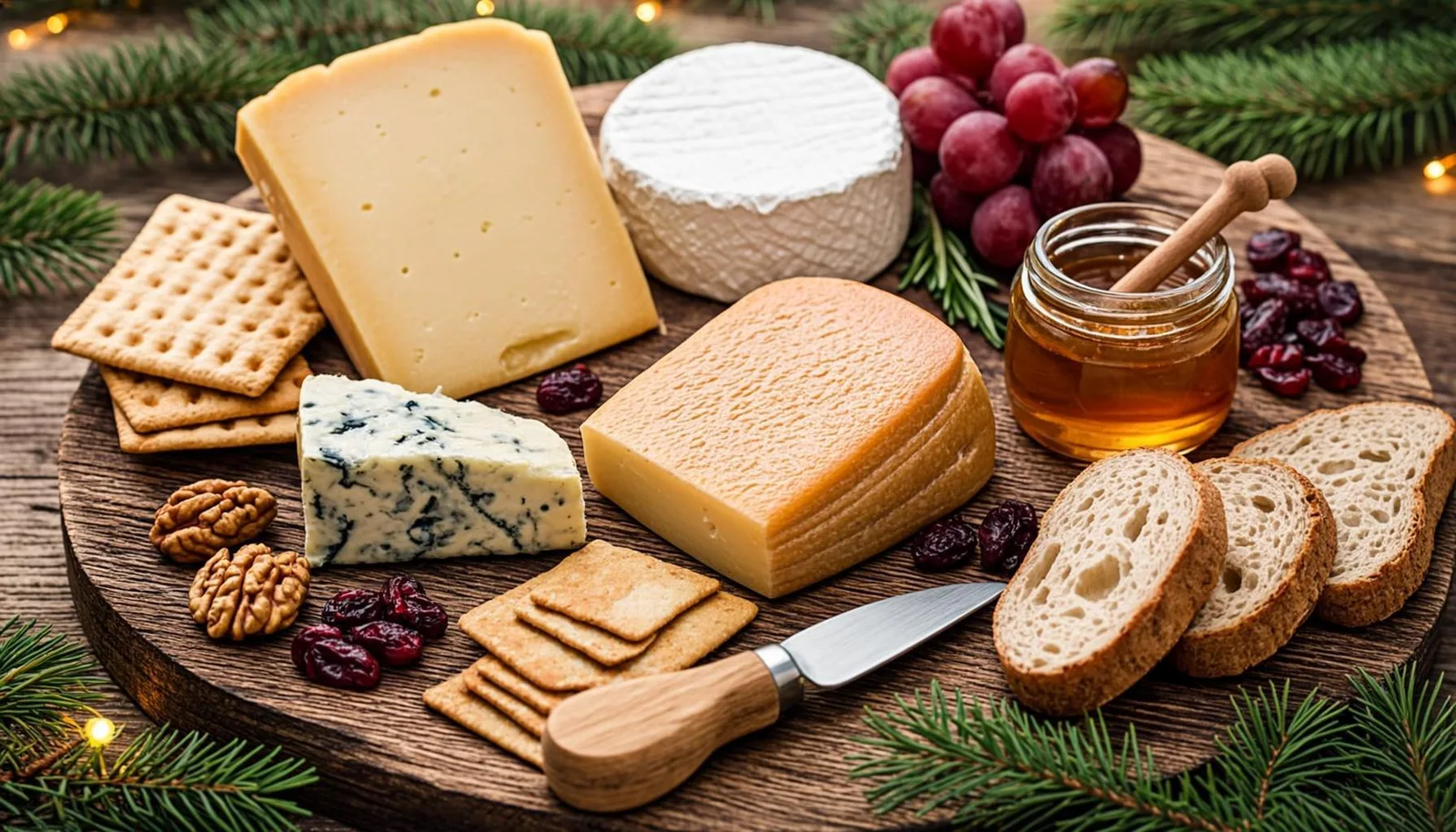
Whether you serve it with drinks before dinner, instead of dessert or as a light meal, the cheese board is the holiday dish that takes the least cooking. The trap is abundance: seven cheeses for eight guests, half of them cut into cubes, and opened pieces lingering in the fridge until February.
Here is how to work out the amounts, choose the cheese families (with examples of award-winning Quebec cheeses), serve safely, protect more vulnerable guests and give leftovers a second life. This guide goes with our traditional réveillon menu, dish by dish.
How much cheese per person, and how many kinds
Dairy Farmers of Canada gives three guidelines depending on when the cheese is served: 45 to 60 g per person at the end of a meal, 90 to 100 g as an appetizer, and 250 g if cheese is the meal, with only crackers and fruit. Here is what that means for a full table.
| When it is served | Per person | For 8 guests | For 12 guests |
|---|---|---|---|
| At the end of the meal | 45 to 60 g | 360 to 480 g | 540 to 720 g |
| As an appetizer | 90 to 100 g | 720 to 800 g | 1.08 to 1.2 kg |
| As the meal (cheese, crackers and fruit) | 250 g | 2 kg | 3 kg |
As for the number of cheeses, the same organization suggests 2 to 5 varieties. From a zero-waste point of view, the logic is simple: every extra kind means one more small leftover. Three or four cheeses from different families are enough to create contrast. When the board follows a big meal, aim for the low end of the range: you can always bring another piece out of the fridge. For the rest of the menu, see our guide to holiday food quantities per guest.
The families to bring together, with local examples
For a balanced board, think in textures rather than brands. Dairy Farmers of Canada suggests choosing from hard, soft, washed-rind, semi-firm and blue-veined cheeses. The glossary of Fromages d'ici, the cheese brand of Les Producteurs de lait du Québec (Quebec's milk producers), explains what sets them apart: soft cheese ripens from the surface under a bloomy rind grown from a sprayed penicillium culture, firm and hard cheeses ripen throughout and gain flavour over time, and blue cheese is pierced with needles that let air in and bring out its bluish mould.
Fromages d'ici, which focuses on cow's milk cheeses, lists more than 1,000 cheeses, more than 90 cheese makers in 14 regions and 32,000 tonnes of fine cheese a year. To spot reliable picks, there is Sélection Caseus, created in 1998 and run by MAPAQ (Quebec's agriculture, fisheries and food ministry) and the Institut de technologie agroalimentaire du Québec: it is the only competition devoted to cheeses made in Quebec. In 2026, 205 cow, goat and sheep milk cheeses were judged; the 63 finalists, from 28 cheese makers, are ranked on October 28, 2026. Take a look at the list of winners before you do your holiday shopping.
Here are recent examples, family by family. These are not buying recommendations: any good cheese from the same family will do. The last column comes from MAPAQ's Thermoguide+.
| Family | What sets it apart | Sélection Caseus winners | In the fridge, once opened |
|---|---|---|---|
| Soft, bloomy rind | Downy, edible white rind; ripened from the surface | Laliberté (Centre-du-Québec) and Le Petit Normand (Lanaudière), 2025 winners | 3 weeks |
| Washed rind | Rind washed during ripening, copper or beige tones; soft to firm | L'Origine de Charlevoix (Capitale-Nationale), Le 14 Arpents and La Belle-Mère (Saguenay–Lac-Saint-Jean), 2025 winners | 3 weeks (soft), 1 month (semi-firm) |
| Firm or hard | Ripened throughout, low moisture, flavour that intensifies with age | Alfred Le Fermier Grand Cru (Estrie), Caseus Argent (silver) 2025; Louis Cyr 2 ans (Chaudière-Appalaches), Caseus Bronze 2025 | 5 weeks (firm), 10 months (hard) |
| Blue-veined | Bluish mould that develops throughout the cheese | Rébellion 1837 (Outaouais), 2025 winner | 1 month |
| Goat or sheep | Comes with bloomy, washed or natural rinds, like cow's milk cheese | Taliah, sheep (Centre-du-Québec), Caseus Or (gold) 2025; Grey Owl, bloomy-rind goat (Bas-Saint-Laurent), Caseus Or 2024 | Depends on texture |
That last column is a zero-waste tool. If you are worried about leftovers, give more room to firm and hard cheeses, which keep for weeks or even months, and buy soft cheeses in smaller amounts. For other local products, see our tips for eating more local food in Quebec.
On the day: temper, order, don't let it linger
Cheese that is too cold has little taste: the Fromages d'ici glossary notes that flavours are more intense at room temperature. Dairy Farmers of Canada advises taking cheese out of the fridge at least 45 minutes before serving. MAPAQ specifies that firm or hard cheeses can be tempered for 45 to 60 minutes before cutting, but that for a cheese board, it is better to bring out only small amounts at a time, to limit how long they sit out of the fridge. That matters even more for soft and blue cheeses, which its Thermoguide+ classifies as perishable foods.
It is also your best ally against waste: a piece that stayed in the fridge keeps, unlike cheese that spent the evening on the table. Keep cheeses in wedges or chunks rather than cubes, cut as you go and refill the board as needed. For soft cheeses, MAPAQ advises leaving the rind on portions that will not be eaten: it acts as a protective layer. If your board is part of a buffet that lasts all evening, review our holiday buffet food safety rules.
For the tasting order, Dairy Farmers of Canada recommends starting with mild cheeses and moving toward the strongest, saving the blue for last. Arrange them on the board in that order, clockwise, with one knife per cheese. For accompaniments, it suggests nuts, a variety of breads, fresh fruit (apples, grapes, figs), dried fruit, chutneys or jams, and plain, unsalted crackers so the cheese stays in the spotlight; fig jam goes particularly well with blue cheese. The local version: slices of Quebec apples and our homemade cranberry sauce, which can be made ahead.
Raw milk, pregnancy and Listeria: who should be careful
According to Fromages d'ici, raw milk has not been heated above 40°C, thermized milk has been heated briefly (59 to 65°C for 15 to 20 seconds), and pasteurized milk, used for most Canadian cheeses, has been heated to at least 63°C for 30 minutes or to 72°C for 15 seconds.
In Quebec, raw milk itself cannot be sold, but raw milk cheese can. Quebec's food regulation (Règlement sur les aliments) exempts from pasteurization any cheese ripened for at least 60 days at 2°C or more. Since 2008, it has also allowed soft and semi-firm raw milk cheeses ripened for a shorter time, under strict conditions: milk free of pathogens and processed within 24 hours of milking, monthly testing for Listeria monocytogenes in both the milk and the cheeses, and a monthly veterinary check of the herd. The same regulation requires the words "fait de lait cru" (made from raw milk) on the main panel of the label; for thermized milk, a mention of unpasteurized milk appears in the ingredient list. At the counter, ask for this information if the packaging does not show it.
These rules do not remove all risk. Health Canada considers pregnant people, people aged 60 and over, children aged 5 and under and people with a weakened immune system to be at greater risk of food poisoning. For them, its fact sheet updated in September 2026 recommends avoiding:
- all uncooked cheese made from unpasteurized milk, raw milk included;
- even when pasteurized, uncooked soft cheeses (Brie, Camembert, feta), semi-soft cheeses such as Havarti (pâte demi-ferme in Quebec) and blue-veined cheeses (Gorgonzola, Roquefort).
Still on the menu: pasteurized hard cheeses (Parmesan, Romano) and firm cheeses (Cheddar, Colby, Swiss, cheese curds), cottage cheese, cream cheese and processed cheese. And above all, any cheese that is well cooked, au gratin or in a sauce: MAPAQ gives the target, 74°C. One discrepancy to know about: MAPAQ notes that raw milk hard cheeses such as Parmesan carry less risk because of their long ripening, while Health Canada says to avoid all uncooked cheese made from unpasteurized milk. For someone at risk, follow the more cautious advice. If you are hosting a pregnant friend or a grandparent, put at least two pasteurized firm cheeses on the board, label each cheese and plan a gratin for the soft cheeses.
After the party: wrap, freeze, cook the leftovers
MAPAQ recommends storing semi-firm, firm and hard cheeses in an airtight container or in their original packaging, tightly resealed, so they do not dry out or make the whole fridge smell. For soft cheeses, especially washed-rind ones, it is the opposite: no plastic wrap, which keeps them from breathing. Put them back in the cheese shop's paper, or in waxed paper covered with aluminum foil. Beeswax wraps are often recommended for cheese; none of the official sources consulted mentions them. For firm cheeses, a tightly closed glass container follows the advice with nothing to throw away.
For fridge storage times at 4°C, see the table above; fresh, unripened cheeses keep for 1 to 2 weeks. Write the opening date on the package.
In the freezer, all cheeses can go in, but their texture changes (see the common beliefs below): save them for cooking and freeze them in portions. MAPAQ recommends freezer bags or containers with as much air removed as possible, a label with the name and date, and a temperature of -18°C or lower. Thaw in the fridge, only the amount you need; hard cheeses also keep longer than many other foods once thawed.
To cook the leftovers, firm and washed-rind cheeses melt into a potato or squash gratin, a cheese sauce for pasta or cauliflower, a homemade fondue, a quiche or a croque-monsieur. Soft cheeses slip into an omelette or a savoury tart. The natural rinds of hard cheeses, too dry to bite into, can flavour a simmering soup; remove them before serving. For the rest of the table, see how to host a zero-waste meal.
Four common beliefs about cheese, settled
- "Cheese can't be frozen." FALSE. According to MAPAQ, all cheeses can be frozen. The price is texture: firm cheeses become crumbly, and soft and fresh cheeses, which are moister, change more. Perfect for cooking, less so for the board.
- "You don't eat the rind." FALSE, most of the time. The Fromages d'ici glossary states that the rind is edible most of the time. The white down on Brie or Camembert comes from edible, harmless moulds, just like the veins of a blue cheese, MAPAQ explains. The exceptions: wax or paraffin coatings, which are not always edible. For the rest, it is a matter of taste.
- "A mouldy Cheddar can be saved by cutting around the spot." TRUE. For semi-firm, firm or hard cheese, MAPAQ allows you to cut away at least 2.5 cm around the mould, then rewrap the rest in new wrapping. Careful: this is false for Brie, blue cheese or fresh cheese. Unusual mould can spread throughout, so throw it out.
- "If you're pregnant, the cheese board is off limits." FALSE. Health Canada recommends avoiding certain uncooked cheeses, not all of them. Pasteurized Cheddar, Swiss, Parmesan and cheese curds, cottage cheese and cream cheese stay on the menu, as does any well-cooked cheese.
Free gift: get The Quebec Recipe Advent Calendar, 24 recipes ready in 30 minutes or less with local ingredients, one a day until Christmas Eve. The same page gathers all our holiday recipes and guides.
Sources
- How to make a cheese plate, Dairy Farmers of Canada.
- Thermoguide+ : fiches sur les fromages, le lait et la crème, et les aliments congelés (food storage guide: cheese, milk and cream, frozen foods; in French), Ministère de l'Agriculture, des Pêcheries et de l'Alimentation du Québec (MAPAQ).
- Safer food choices for people at greater risk of food poisoning, Health Canada, 2026.
- Règlement modifiant le Règlement sur les aliments et modifiant d'autres dispositions réglementaires, décret 741-2008 (amendments to Quebec's food regulation; in French), Gazette officielle du Québec, 2008.
- 26e concours Sélection Caseus : 63 fromages québécois accèdent à la finale (26th Sélection Caseus: 63 Quebec cheeses reach the final; in French), Office of the Minister of Agriculture, Fisheries and Food, Gouvernement du Québec, 2026.
- Lauréats antérieurs (past winners; in French), Sélection Caseus (MAPAQ and Institut de technologie agroalimentaire du Québec).
- Lexique du fromager (cheese glossary; in French), Fromages d'ici, Les Producteurs de lait du Québec.
- Notre engagement (our commitment; in French), Fromages d'ici, Les Producteurs de lait du Québec.
Frequently asked questions
How much cheese should I plan per person for the holidays?
Dairy Farmers of Canada suggests 45 to 60 g per person at the end of a meal, 90 to 100 g as an appetizer and 250 g when cheese is the meal, served with crackers and fruit.
How long before serving should cheese come out of the fridge?
At least 45 minutes, according to Dairy Farmers of Canada. MAPAQ says 45 to 60 minutes for firm or hard cheeses, and advises bringing out only small amounts at a time, especially for soft and blue cheeses.
How long does opened cheese keep?
In the fridge at 4°C, MAPAQ's Thermoguide+ gives 3 weeks for a soft cheese, 1 month for a blue or semi-firm cheese, 5 weeks for a firm cheese and 10 months for a hard cheese. Fresh, unripened cheeses keep for 1 to 2 weeks.
Can a pregnant guest eat cheese at the réveillon?
Yes, with the right choices. Health Canada considers pasteurized hard or firm cheeses (Parmesan, Cheddar, Swiss, cheese curds), cottage cheese, cream cheese and any well-cooked cheese to be safer. Uncooked soft, semi-soft and blue-veined cheeses, and any uncooked cheese made from unpasteurized milk, should be avoided.
Is raw milk cheese allowed in Quebec?
Yes. A cheese ripened for at least 60 days at 2°C or more can be made from raw milk and, since 2008, Quebec has also allowed soft and semi-firm raw milk cheeses ripened for a shorter time, under strict conditions. The label must say "fait de lait cru" (made from raw milk).