A holiday buffet without food poisoning: the 2-hour rule and the right temperatures
At a holiday réveillon, the buffet often stays open all evening. Yet Health Canada is clear: perishable food should not sit at room temperature for more than 2 hours. Here is how to keep hot food hot and cold food cold, protect guests who are more vulnerable or have allergies, and put leftovers away in time.
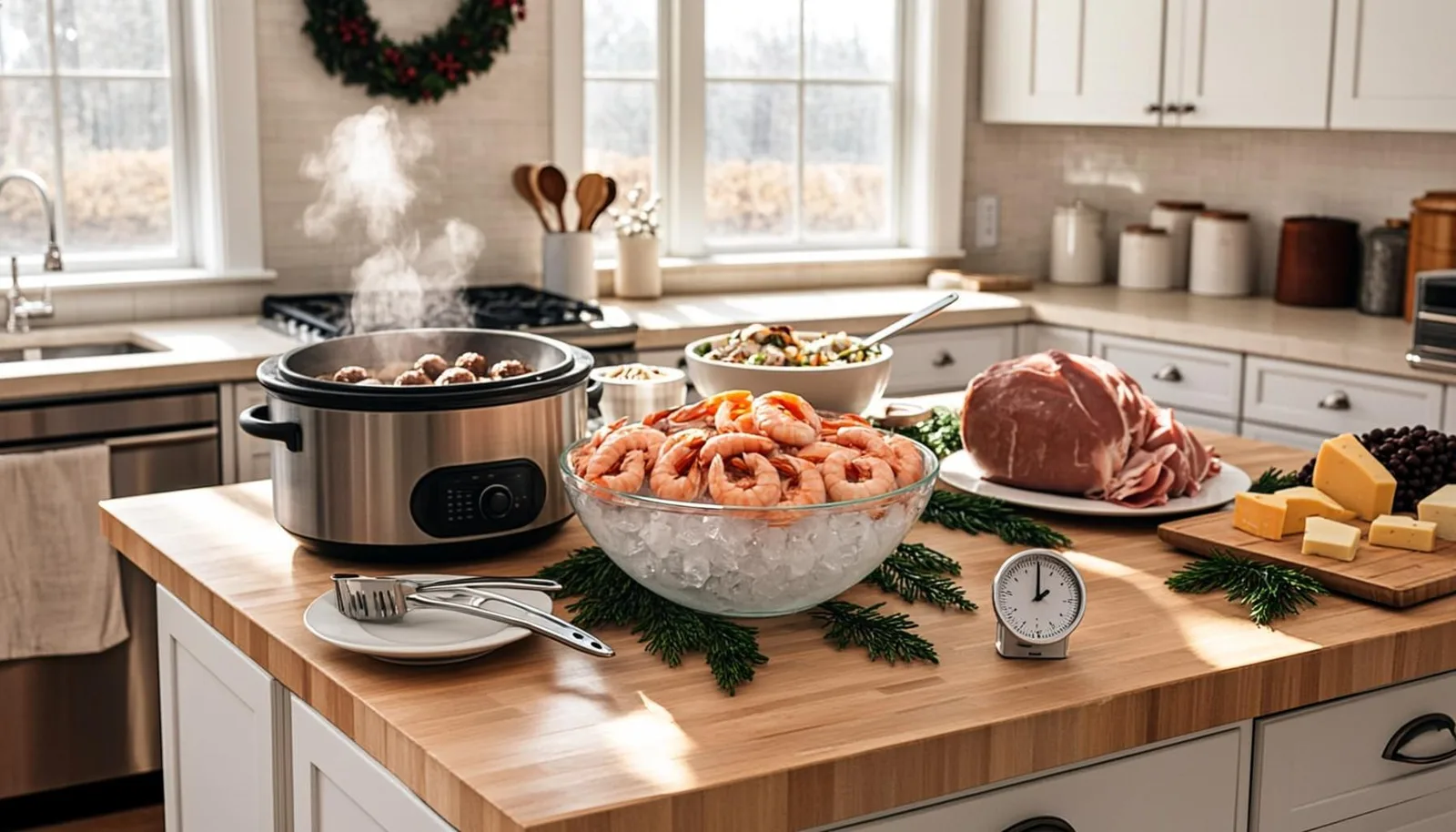
At a holiday réveillon, a buffet has one big advantage: everyone eats at their own pace, and the host can finally sit down. Its downside is that the dishes stay on the table for hours, and at room temperature bacteria multiply quickly, the Quebec government reminds us. A few simple rules are enough to keep your buffet safe, from the first canapé to the last square of sucre à la crème. To plan the menu itself, see our guide to traditional Quebec holiday recipes, dish by dish.
The 2-hour rule and the danger zone
Perishable food must stay cold, at 4°C or lower, or hot, at 60°C or higher. In between is the "danger zone": bacteria multiply rapidly there and can produce dangerous toxins, explains the Quebec government. Health Canada gives the same benchmarks and a clear limit: perishable food left at room temperature for more than 2 hours should be thrown out.
The detail people forget is when the clock starts. The U.S. Department of Agriculture (USDA) counts the 2 hours from the end of cooking, or from the moment the dish leaves an appliance that was keeping it hot. Resting and carving the roast turkey, like appetizers that drag on, are part of the count. The benchmarks to post on the fridge door:
| Benchmark | Temperature or time | Source |
|---|---|---|
| Hot dishes on the buffet | 60°C (140°F) or higher | Health Canada, Quebec government |
| Cold dishes on the buffet | 4°C (40°F) or lower | Health Canada, Quebec government |
| Maximum time at room temperature | 2 hours, then throw it out | Health Canada |
| When the clock starts | End of cooking, or when the dish leaves the oven, slow cooker or chafing dish | USDA |
| Above 32°C (90°F) | 1 hour | USDA |
| Leftovers into the fridge | Within 2 hours, at 4°C or lower | USDA, Quebec government |
| Refrigerated leftovers | 2 or 3 days, otherwise freeze them | Health Canada |
| Homemade eggnog | Mixture heated to at least 71°C (160°F) | Health Canada |
| Egg dishes, shellfish, reheated leftovers | 74°C (165°F) | Health Canada |
Keep hot food hot and cold food cold
On a buffet, no dish should sit "at room temperature" by default. Health Canada recommends chafing dishes or slow cookers for hot food, and serving platters set on crushed ice for cold food. The USDA adds warming trays and suggests nesting serving dishes in larger bowls of ice.
- Serve small dishes. The USDA advises small serving trays that are replaced often. The rest waits somewhere hot, at 60°C or higher, or in the fridge.
- Replace, do not top up. Health Canada asks you not to add new food to a serving dish that is already in use, and to bring out a clean platter every time you restock. Otherwise, there is no way to know how long the bites at the bottom have been sitting there.
- One utensil per dish. Health Canada recommends a serving spoon or tongs for each dish, a habit that also helps with allergies.
- Keep a thermometer handy. Health Canada recommends a digital instant-read food thermometer. In the centre of a slow cooker, it tells you whether the dish is staying at 60°C or higher.
- Write down the time. A small card next to each cold dish with the time it came out of the fridge, and you know when to take it away.
For a potluck, think about transport: Health Canada suggests insulated containers with hot packs (or foil and heavy towels) for hot food, and a cooler with ice or freezer packs for cold food. Small dishes have another advantage: less food out on the table means less food thrown away. To get the amounts right at the grocery store, see our guide to holiday food quantities per guest.
Dishes to watch and more vulnerable guests
Cheese, seafood, turkey, fresh produce, raw flour: several holiday staples can carry germs such as Salmonella, E. coli or Listeria, Health Canada reminds us. On a buffet, three families of dishes call for extra care.
Dishes that are handled a lot and served cold. According to the Bad Bug Book from the U.S. Food and Drug Administration (FDA), Staphylococcus aureus food poisoning often involves meat, poultry, egg products, salads (egg, potato, macaroni…), sandwich fillings, dairy products and cream-filled pastries, especially when these foods were handled a lot and then kept for a long time slightly above fridge temperature. Staphylococci are found in the nose, throat or on the skin of half or more of healthy people: wash your hands well before assembling platters.
Rice and other starchy foods. The vomiting form of Bacillus cereus food poisoning is mostly associated with rice, but also with potatoes, pasta and cheese products, according to the FDA. The rice dish cooling down at the end of the table deserves as much attention as the turkey.
Raw eggs and raw seafood. Raw eggs can carry Salmonella. Store-bought eggnog is pasteurized; homemade eggnog is made with pasteurized eggs and milk, or with a mixture heated to at least 71°C, like our homemade cooked eggnog. Raw oysters and sushi, for their part, can contain bacteria, parasites or viruses.
Pregnant women, young children, older adults: plan safe choices
Health Canada considers people who are pregnant, adults 60 and over, children 5 and under and people with a weakened immune system to be at greater risk. Its information sheet on safer food choices covers several buffet classics:
- Deli meats: avoid non-dried deli meats sold refrigerated (ham, turkey breast, roast beef, bologna), unless they are heated until steaming. Dried and salted deli meats, like some salami, are a safer choice.
- Pâtés and meat spreads: avoid those sold refrigerated (cretons, for example); canned ones are fine.
- Smoked fish and seafood: avoid those sold refrigerated (smoked salmon, for example), unless they are cooked in a hot dish.
- Raw fish and seafood: avoid raw oysters, tartare and sushi; shellfish cooked to 74°C is a safer choice.
- Cheese: unless it is cooked, avoid cheese made from unpasteurized milk, as well as soft (Brie, Camembert), semi-soft (Havarti) and blue-veined (Roquefort) cheeses, even when pasteurized. Pasteurized hard or firm cheeses (Parmesan, Cheddar, cheese curds), cottage cheese and cream cheese are fine, as is any cheese cooked au gratin and served hot and bubbling. Feta, however, is one of the soft cheeses to avoid.
- Egg dishes: avoid homemade mayonnaise made with raw eggs; quiche cooked to 74°C is a safer choice.
No need to ban the Brie: just put safe options right next to it, and label them clearly. Our guide to putting together a Quebec cheese board will help you plan both.
Allergies: a buffet with no traps
Health Canada lists 11 priority food allergens: eggs, milk, mustard, peanuts, crustaceans and molluscs, fish, sesame seeds, soy, sulphites, tree nuts, and wheat and triticale. A buffet almost always includes several of them, and self-service multiplies the contact between dishes. Allergies Québec suggests a few habits for hosts:
- Read every ingredient list and keep the packaging so the person with allergies can check. Avoid products labelled "may contain."
- Identify the dishes that contain allergens ahead of time. On a buffet, a small card in front of each dish ("contains: nuts, milk") informs everyone.
- Use a clean utensil for each ingredient in the kitchen and for each dish when serving.
- Prepare the allergen-free dish first and serve the person with allergies first, before the others dig in.
- Keep dishes containing allergens out of reach of children with allergies.
And do not count on cooking: heat does not destroy allergens, Allergies Québec points out.
After the party: put leftovers away and watch for symptoms
At the end of the evening, sort things out with your watch in hand. Anything that spent more than 2 hours at room temperature gets thrown out, even if it looks perfect. The rest goes into the fridge (4°C or lower) within 2 hours of cooking or of leaving the chafing dish (USDA), in shallow containers so it cools quickly. Health Canada also asks you not to overload the fridge, to store turkey separately from stuffing and gravy, and to eat leftovers within 2 or 3 days or freeze them. The best anti-waste move, then, is to put things away early. For storage times by food, read our article on holiday leftovers in the fridge and freezer, then give your turkey a second life with our 7 leftover turkey recipes.
The most common symptoms of food poisoning are stomach cramps, nausea, vomiting, diarrhea and fever, according to Health Canada. With staph toxins, they appear quickly, 1 to 7 hours after the meal (FDA). Most people recover fully, but serious complications are possible.
When in doubt, call Info-Santé 811: a nurse will give you advice and tell you whether you need to see a doctor quickly. The Quebec government recommends calling, among other situations, if you cannot drink or keep fluids down, if your stool contains a little blood or if you are unsure whether to see a doctor. This is all the more true for people at higher risk of complications: children under 2, people 65 and over, pregnant women and people with a chronic illness such as diabetes. Go to the emergency room right away if there is a lot of blood in your stool or it is black, or if frequent vomiting does not ease after 4 to 6 hours.
True or false: 4 common beliefs about holiday buffets
"If it smells good, it is safe." False.
Health Canada is clear: you cannot tell whether food is contaminated by the way it looks, smells or tastes. A dip forgotten on the table can smell as good as it did at 7 p.m. Trust the clock instead.
"The house is cool, so the turkey can stay on the table all evening." False.
The danger zone starts at 4°C: a dining room at 20°C is right in it. None of the rules consulted grants a grace period for a cool room; the USDA only provides for the opposite, 1 hour above 32°C. A turkey taken out of the oven at 6 p.m. must be in the fridge by 8 p.m. at the latest, whether dessert has been served or not.
"A forgotten dish becomes safe again if you reheat it well." False.
Cooking cannot always destroy bacteria or their toxins, the Quebec government warns. According to the FDA, Staphylococcus aureus toxins can survive cooking even when the bacterium itself is destroyed, and the vomiting toxin of Bacillus cereus remains stable after 30 minutes at 121°C, far beyond the 74°C used to reheat leftovers. A dish left on the table too long gets thrown out: the oven will not save it.
"A dish kept piping hot in a slow cooker can stay on the buffet for more than 2 hours." True, with one condition.
It must stay at 60°C or higher, in the centre of the dish. The 2-hour rule applies to food left at room temperature, and the USDA only starts the clock when the dish leaves the appliance that was keeping it hot. Same logic for cold food: on ice, the dish must stay at 4°C or lower.
A well-run buffet also means less food in the garbage. To go further, read our tips for hosting a zero-waste meal.
Free gift: get The Quebec Recipe Advent Calendar, 24 recipes ready in 30 minutes or less with local ingredients, one a day until Christmas Eve. The same page gathers all our holiday recipes and guides.
Sources
- Holiday food safety, Health Canada, 2017.
- Food storage temperatures, Gouvernement du Québec, 2025.
- Leftovers and Food Safety, Food Safety and Inspection Service, USDA, 2020.
- Safer food choices for people at greater risk of food poisoning, Health Canada, 2026.
- Bad Bug Book: Foodborne Pathogenic Microorganisms and Natural Toxins, 2nd edition, U.S. Food and Drug Administration (FDA), 2012.
- Common food allergens, Health Canada, 2026.
- Entertaining Guests Who Have Allergies, Allergies Québec, 2021.
- Gastroenteritis (stomach flu), Gouvernement du Québec, 2023.
Frequently asked questions
How long can a dish stay on the buffet table?
Two hours at most at room temperature, then it should be thrown out, according to Health Canada. The USDA starts the clock at the end of cooking or when the dish leaves the chafing dish. A dish kept at 60°C or higher, or on ice at 4°C or lower, stays out of the danger zone.
Can a dish that sat on the table for 3 hours go back in the fridge?
No. Health Canada asks you to throw out any food left at room temperature for more than 2 hours. Reheating it does not make it safe: some toxins produced by bacteria resist heat.
Is store-bought eggnog safe?
Yes. According to Health Canada, it is pasteurized and does not need to be heated. Homemade eggnog should be made with pasteurized eggs and milk, or heated to at least 71°C. On the buffet, keep it cold, at 4°C or lower.
Can a pregnant woman eat Brie or smoked salmon at the buffet?
Health Canada recommends avoiding uncooked soft cheeses, even pasteurized ones, and smoked fish sold refrigerated. She can choose pasteurized hard or firm cheeses, such as Cheddar or cheese curds, a cheese cooked au gratin and served hot and bubbling, or smoked fish cooked in a hot dish.
What should you do if a guest gets sick after the party?
Stomach cramps, nausea, vomiting, diarrhea and fever are the most common symptoms. When in doubt, call Info-Santé 811: a nurse will tell you whether you need to see a doctor quickly. Go to the emergency room if there is a lot of blood in the stool, if it is black or if frequent vomiting does not ease after 4 to 6 hours.