Overwintering tender bulbs: dahlias, gladiolus and cannas
Dahlias, gladiolus and cannas are not hardy: the safest bet is to dig them up in the fall and keep them cool until spring. But a tuber, a corm and a rhizome are not handled quite the same way. Here is when to lift them, how to dry and store them, and what to watch for until replanting.
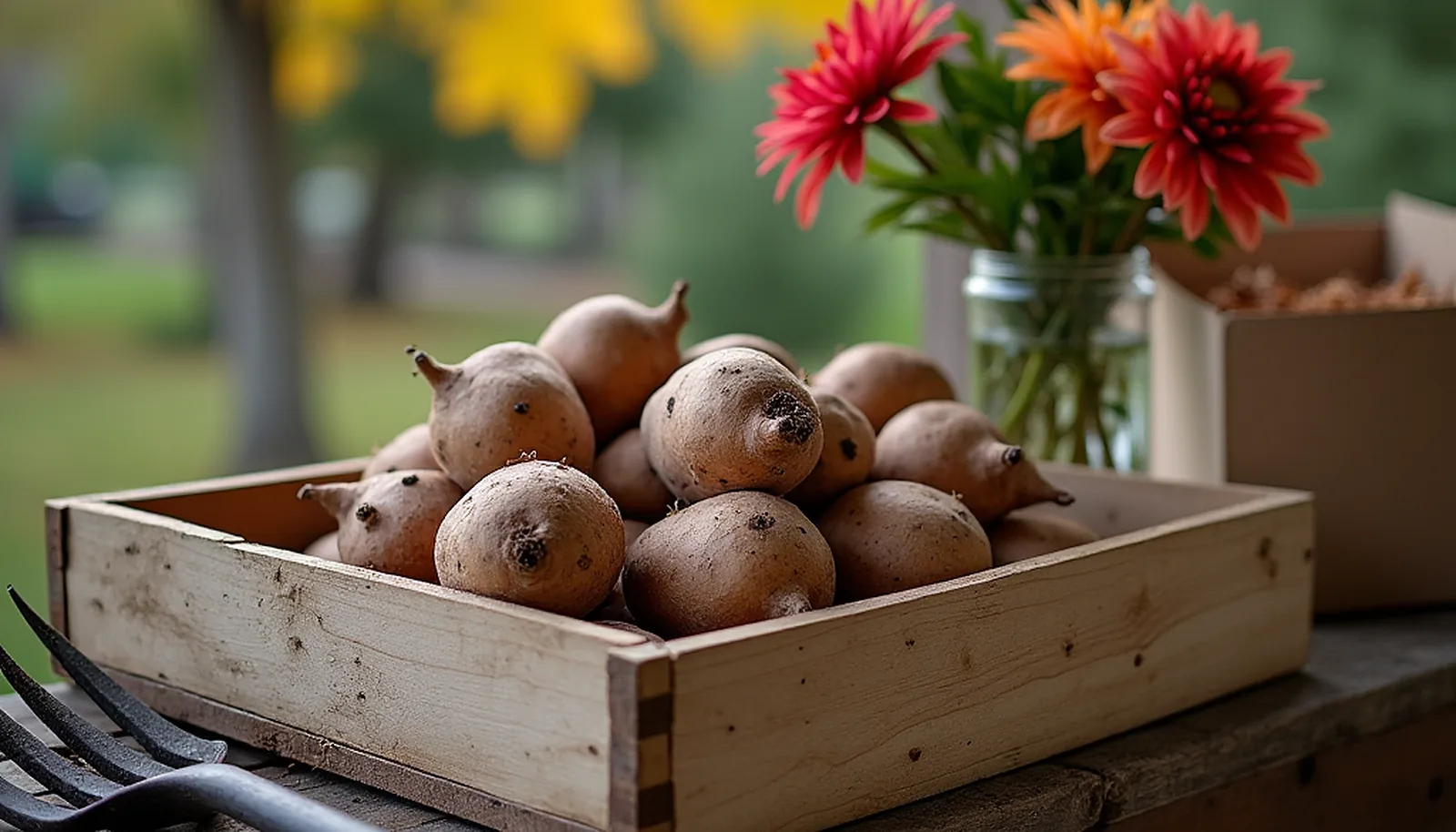
Has frost blackened the foliage of your dahlias and cannas, and are your gladiolus leaves turning yellow? That is your cue. These summer flowers are not hardy: according to the University of Wisconsin, their fleshy storage organs do not survive that state's cold winters. To overwinter them, you dig them up, keep them cool and safe from frost, and replant them in spring. That way, you keep your favourite varieties from one year to the next.
This article is about plants stored dormant, without leaves. For potted plants that spend the winter in the house, follow our method for bringing plants indoors without bringing in bugs instead. Geraniums from your planters can also sleep somewhere cool: it is one of our 3 methods for overwintering geraniums. And add this job to your list for putting the garden to bed before frost.
Tuber, corm, rhizome: not the same thing
We say "bulbs" for convenience, but none of the three is a true bulb like an onion, made of fleshy scales around a bud. According to the University of Florida (UF/IFAS), each one stores its reserves in a different organ, and that changes how you divide, wash and dry them:
- Dahlia: tuberous roots. Its "tubers" are roots swollen with reserves. The eyes (the buds) are found only at the crown, where the roots meet the stem: a tuber separated from its crown will not sprout.
- Gladiolus: a corm, a swollen, solid stem base with a bud on top. Over the summer, a new corm forms on top of the old one, which shrivels: the new one is the one you keep (Iowa State, Wisconsin).
- Canna: a rhizome, a fleshy underground stem that grows horizontally and carries several eyes, which is why it can be cut into pieces.
When to dig them up: the first frost is the signal
For dahlias and cannas, the most often cited cue is the first frost that blackens the foliage. Don't panic if it catches you off guard: according to Wisconsin, a light to moderate frost kills the foliage without reaching the tubers.
The sources vary on how long to wait after that. Wisconsin and the University of Illinois advise digging within a few days, before rot-causing organisms get into the bulbs; Iowa State University (Iowa State) also waits a few days. Penn State cuts dahlia stems back to 15 cm and waits four to eight days for the eyes to develop. The University of Connecticut (UConn) waits a week if possible, so the reserves left in the stems can move down into the roots.
What you want to avoid is a hard freeze: Wisconsin recommends lifting dahlias before one, and warns that it turns canna stems to mush. Waiting too long also exposes the tubers to frozen soil (Illinois). So keep an eye on your local forecast: when nights well below zero are on the way, don't wait any longer.
Do you absolutely have to wait for frost? No, according to Mary Niezelski, a Penn State Master Gardener volunteer, as long as the dahlia has spent at least 120 days in the ground, the time it needs to form mature tubers. But digging too early deprives the plant of part of the reserves it builds up for the following year (Illinois).
Gladiolus are dug up when their leaves turn yellow or after the first frost (Wisconsin), and in any case before the ground freezes (Penn State). As for leaving everything in the ground and crossing your fingers: according to Mary Niezelski, deep freezing and winter rain promote rot, especially in zones 6 and lower on the American (USDA) map. To find out where your garden stands, see our article on Canada's new plant hardiness zone map.
Cleaning, drying, labelling and storing
Digging without damage
Cut the stems back: to 5 to 10 cm above the ground for dahlias, 10 to 15 cm for cannas (Iowa State), and 2.5 to 5 cm above the corm for gladiolus. Dig with a garden fork, which causes less injury than a shovel (Wisconsin), starting at least 20 cm from the crown (UConn) and loosening the soil all around before lifting. A cut or scraped skin opens the door to disease (Illinois), and dahlia roots bruise easily (Wisconsin): handle them like eggs.
Washing, then drying
Gladiolus are not washed: let the soil dry, then remove it (Wisconsin). For cannas, Iowa State leaves a little soil around the clump. For dahlias, Iowa State and Wisconsin wash the tubers, but UConn's Dawn Pettinelli never washes hers. If you do wash them, she advises a slightly moist medium, such as barely dampened peat moss, so they do not dry out.
Then let them dry out of direct sun, in a dry, well-ventilated spot, ideally between 16 and 21°C (Wisconsin, Illinois):
- Dahlias: from a few hours (Wisconsin) to about a day, until dry to the touch (Iowa State). Mary Niezelski found that her tubers rotted more easily after 24 to 48 hours of drying: she now gives them four or five days, out of the sun.
- Cannas: one or two days (Iowa State, Wisconsin).
- Gladiolus: a day or two in the sun, then about three weeks in a well-ventilated spot (Wisconsin). Then remove the old, shrivelled corm; the tiny corms around it can be saved for propagation or thrown away, your choice (Iowa State).
Before storing, inspect each piece for insects and disease, and set aside any with problems (Wisconsin, Illinois).
Label before you forget
Note the name of each dahlia before you even dig it up, UConn advises. Wisconsin suggests writing on the tuber with a permanent marker, attaching a tag to the root or labelling the bag, with the cultivar name or whatever sets it apart, such as flower colour and type.
Container and storage medium
Use a ventilated container, never an airtight one: trapped moisture causes rot (Wisconsin). Wisconsin and Illinois store bulbs between 5 to 8 cm layers of peat moss, sand, vermiculite, sawdust or coconut fibre (coir), without letting them touch, so rot cannot spread from one to the next. So you don't have to use peat.
- Dahlias: upside down in a box, covered with vermiculite, peat moss or wood shavings (Iowa State). Mary Niezelski uses plastic bins with holes drilled in the sides, cedar shavings, and the lid set on without snapping it shut. Even simpler, Dawn Pettinelli keeps hers in pots with a little soil, in the cellar, and gives them a light sprinkle of water once or twice a month.
- Gladiolus: in a mesh bag or an old nylon stocking hung in a cool, dry, well-ventilated place (Iowa State).
- Cannas: wrapped in newspaper, in paper bags or a cardboard box, or between layers of peat moss if your storage spot is dry (Wisconsin).
Cardboard or plastic? The sources contradict each other: Mary Niezelski advises against cardboard and paper, which wick up too much moisture, while Iowa State and Wisconsin suggest them. Test it at home: if your tubers shrivel in cardboard, switch to a ventilated bin; if they stay damp in plastic, go back to cardboard.
The right temperature, and where to find it
Aim for cool, never freezing: 2 to 7°C and about 50% relative humidity for all tender bulbs according to Wisconsin; 4 to 10°C for dahlias and cannas, and 2 to 7°C for gladiolus according to Iowa State; 7 to 13°C for dahlias according to UConn.
An unfinished basement away from heat sources, or a cold room, does the job (Wisconsin), as does a cool spare bedroom (Iowa State). To make the most of a root cellar, see the benefits of a natural root cellar. The garage is a false friend: Wisconsin only accepts it if it never freezes, and Iowa State points out that most garages, even attached ones, drop below freezing in extreme cold. Mary Niezelski adds: never directly on concrete, and a plan B for deep cold (she has had to move her bins when it was around -18°C outside). Leave a thermometer in your chosen spot for a few days before storing anything there. No cool spot? Iowa State suggests growing these plants as annuals.
Plant-by-plant table
| Plant | Organ | When to dig | Prepare | Store | In spring |
|---|---|---|---|---|---|
| Dahlia | Tuberous roots ("tubers"), eyes at the crown | A few days to a week after the frost that blackens the foliage, before a hard freeze | Stems cut to 5 to 10 cm; washing optional; drying from a few hours to 4 or 5 days | 4 to 10°C (up to 13°C for UConn); vermiculite, peat moss, shavings, or a pot with a little soil | Divide: each piece keeps a neck, a bit of crown and an eye; plant 10 to 15 cm deep |
| Gladiolus | Corm, renewed every season | Leaves yellowed or first frost, before the ground freezes | Do not wash; 1 or 2 days in the sun, then about 3 weeks in a ventilated spot; remove the old corm | 2 to 7°C; hanging mesh bag or nylon stocking | No division; plant 5 to 8 cm deep (small) or 10 to 15 cm (large), a batch every 10 to 14 days |
| Canna | Rhizome | A few days after the frost that blackens the foliage, before a hard freeze | Stems cut to 10 to 15 cm; keep a little soil; dry for 1 or 2 days | 4 to 10°C (7 to 10°C for Wisconsin); newspaper, cardboard or peat moss | Divide: at least 1 to 3 eyes per piece depending on the source; plant 8 to 10 cm deep |
Check every month: rot, shrivelling and thrips
Stored does not mean forgotten: Wisconsin advises checking dahlias every month, UConn every two to three weeks. Mary Niezelski, for her part, mostly sees excess moisture during the first month.
- Soft or rotting: remove it; on a large tuber, cut out only the damaged part (Wisconsin).
- Shrivelled: lightly mist the medium with a spray bottle and repack (Wisconsin, Illinois), without overdoing it: too much water leads to rot and mould (Iowa State).
- Too damp: let the tubers air-dry for a few days and repack them in dry material (Wisconsin), or simply replace damp shavings, as Mary Niezelski does.
For gladiolus, the Connecticut Agricultural Experiment Station (CAES), a public agricultural research centre, describes two signs to watch for: a corm that softens or becomes covered in bluish-green mould (Penicillium), and a brown rot that starts at the base and moves upward (Fusarium). Get rid of affected corms.
Another possible stowaway: gladiolus thrips, which overwinter in the corms, according to CAES. What you store in the fall can therefore bring them back to the garden, but storage between 4 and 7°C can break their life cycle.
Dividing and replanting in spring
Dividing: preferably in spring
Most sources keep clumps whole until spring, because any injury before storage increases the risk of rot (Iowa State, Wisconsin, Illinois), and because the eyes are easier to see by then (Penn State, UConn). Mary Niezelski represents the other school: she divides in the fall, when clumps are easier to cut and store, even if it means losing a few eyes.
For dahlias, use a sturdy, clean, sharp knife (see our article on cleaning and sharpening your garden tools). According to Mary Niezelski, each division must keep a tuber, its neck and a piece of crown with at least one eye. A neck thinner than a pencil will probably dry out by spring, and a tuber that looks healthy but has no eye will not grow: it is called a blind tuber.
For cannas, cut the rhizome into pieces with at least three eyes according to Wisconsin, or one or two according to Iowa State and Illinois; Penn State suggests dividing only every few years. Gladiolus are not divided: the sorting was done when you removed the old corm.
Replanting
Do a final inspection and set aside anything rotten or shrivelled (Illinois). Since a light frost is enough to kill the foliage (Wisconsin), plant once frosty nights are behind you, based on your local forecast. You can also start them indoors for earlier blooms (Illinois). For dahlias, remember the 120 days in the ground: the later you plant, the less time your tubers will have to mature. The planting depths suggested by Penn State:
- Dahlias: 10 to 15 cm, eyes facing up.
- Gladiolus: 5 to 8 cm for small corms, 10 to 15 cm for large ones, tip facing up; plant a batch every 10 to 14 days to stretch out the blooms.
- Cannas: 8 to 10 cm, eyes facing up, 45 to 90 cm apart.
Sources
- Storing Tender "Bulbs" for Winter, Susan Mahr, Wisconsin Horticulture, University of Wisconsin–Madison, revised in 2026.
- How to Overwinter Tender Perennials, Aaron Steil, Iowa State University Extension and Outreach, reviewed in 2024.
- Tips for overwintering tender bulbs, Ken Johnson, University of Illinois Extension, 2025.
- Don't Ditch Those Dahlias: Easy Tips for Winter Storage, Mary Niezelski, Penn State Extension, 2025.
- Summer and Fall Blooming Bulbs, Denise D'Aurora, Penn State Extension, 2026.
- Do You Dig Dahlias?, Dawn Pettinelli, UConn Home & Garden Education Center, University of Connecticut, 2024.
- Is This a Bulb?, Gardening Solutions, University of Florida IFAS Extension.
- Gladiolus (Gladiolus), Plant Pest Handbook, The Connecticut Agricultural Experiment Station.
Frequently asked questions
Can you leave dahlias in the ground over winter in Quebec?
It is a risky bet. According to Penn State, deep freezing and winter rain promote rot in tubers left in the ground, especially in zones 6 and lower on the American map. The safest option is to dig them up a few days after the first frost blackens the foliage and keep them cool, safe from frost, until spring.
What temperature should dahlia tubers be stored at over winter?
Cool, but never freezing: 4 to 10°C according to Iowa State and Penn State, up to 13°C according to the University of Connecticut. The University of Wisconsin aims for 2 to 7°C and about 50% relative humidity for all tender bulbs. An unfinished basement away from heat sources, or a cold room, often does the job.
Should bulbs be washed before storing them?
Not gladiolus: let the soil dry, then remove it. For dahlias, most sources wash them, but the University of Connecticut never does. If you wash them, store them in a slightly moist medium so they do not dry out. For cannas, Iowa State leaves a little soil around the clump.
When should dahlias be divided: in the fall or in spring?
Most sources recommend spring: the whole clump keeps better and the eyes are easier to see. A Penn State volunteer divides in the fall instead, because the clumps are easier to cut and store, even if it means losing a few eyes. Either way, each piece must keep a neck, a bit of crown and at least one eye.
My tubers are shrivelling or rotting: what should I do?
If they shrivel, lightly mist the storage medium and repack them, without soaking it. If they are very damp, let them air-dry for a few days, then repack them in dry material. Remove any that rot; on a large tuber, you can cut out just the damaged part. Check your stash every month, especially the first one.