Bringing plants indoors without bringing in bugs: the complete method
A plant that spent the summer on the balcony can bring scale insects, aphids or spider mites into the house, where, in the warmth, they have all winter to multiply. The fix comes down to a few steps: bring plants in at the right time, inspect every nook, clean them outside, isolate them for a few weeks and let them adjust to less light. Here is the complete method, with a pest table and a checklist.
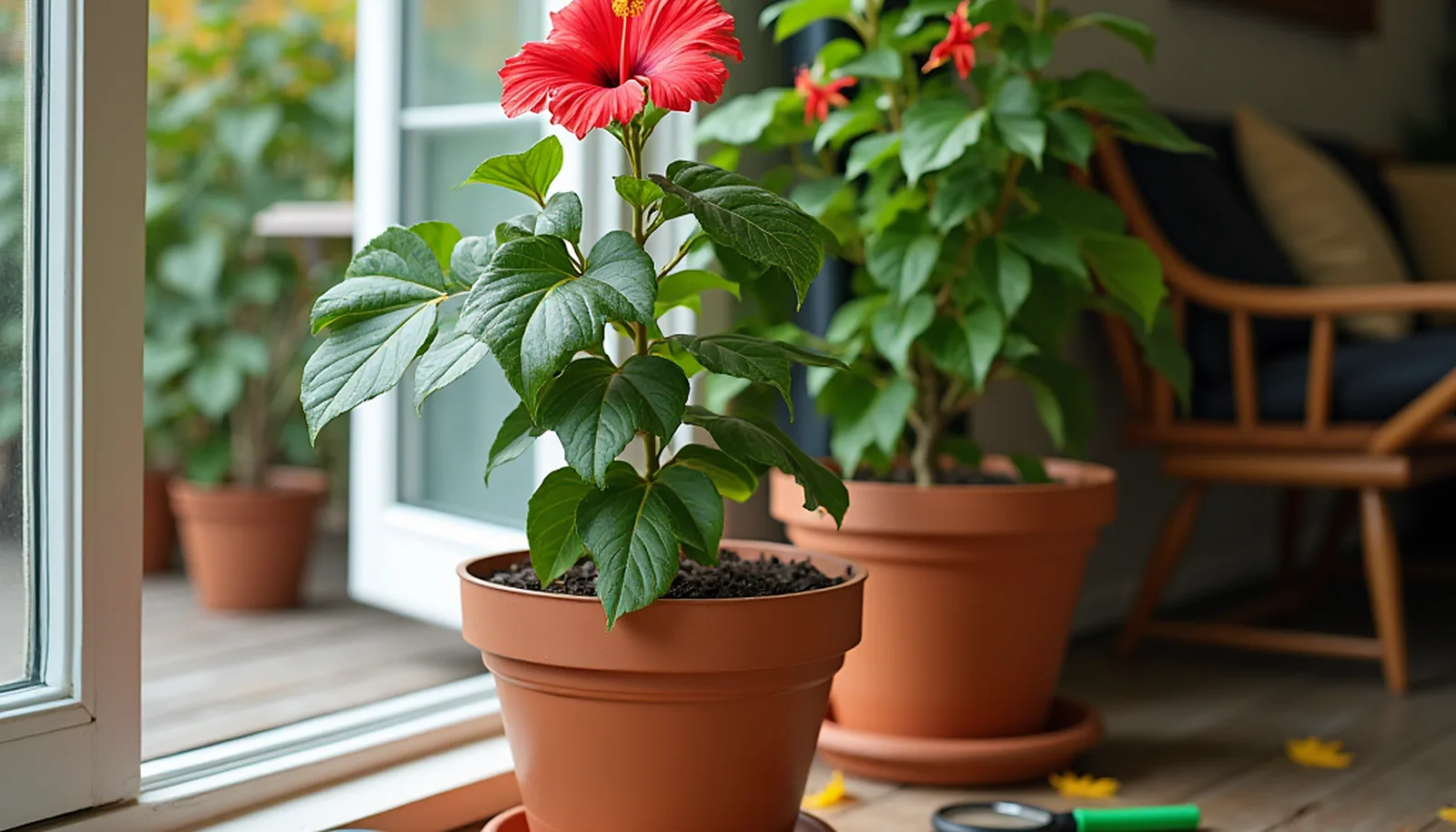
Your ficus, your hibiscus or your spider plant spent the summer on the balcony and have never looked better. The catch: under the leaves, where leaves meet the stems or deep in the pot, a few stowaways often come along for the ride. Outdoors, a handful of aphids hardly matters. Inside the house, the University of Minnesota warns that a pest that stays discreet in summer can turn into a real infestation over the winter, right next to your other plants.
The fix does not call for any miracle product. It comes down to six steps, drawn from university extension services, Espace pour la vie and Health Canada: bring plants in at the right time, inspect, clean and treat outdoors, isolate, acclimatize, then ease off on watering and fertilizer. To find out what your houseplants really do for you, and what is a myth, read our article on the benefits of houseplants.
When to bring your plants in: watch the nights, not the calendar
There is no magic date: what counts is the night temperature, and the published thresholds line up well. The University of Illinois advises starting when the thermometer consistently drops below about 13°C. Iowa State University aims for the point when nights consistently dip to between 10 and 15°C; it notes that many plants are damaged at around 5 to 7°C and that nearly all die below freezing. The University of Minnesota places the start of damage between 7 and 10°C, depending on the species.
In other words, frost is not the starting signal, it is the line you never want to reach. When the nights in the forecast drop below 10°C, it is high time. Go by the forecast, as Iowa State advises: the one from Environment Canada or your weather app is worth more than a date circled on the calendar.
Not waiting until the last minute helps in other ways, too. Mississippi State suggests moving the pot to another spot outdoors for a day or so, then bringing it in in the evening, when slugs and other squatters have gone out to feed; the trick is not much use once it is so cold that they no longer move. And the week of transition in the shade that Illinois recommends requires nights that are still mild.
This guide covers potted plants that will spend the winter in the house: houseplants on a summer vacation on the balcony, hibiscus, ficus and other tropicals. For herbs, we sort things out in our article on the ones that survive indoors; for dahlias, gladiolus and cannas, our guide to storing tender bulbs explains when to dig them up and how to store them. And if you are putting the vegetable garden to bed as well, our complete checklist before the frost is waiting for you.
Inspection: where to look, from leaf tips to drainage holes
Inspect outdoors, in daylight, before you pull out the hose: a jet of water knocks insects off, but it also wipes out clues. Grab a magnifying glass or your phone's zoom: Cornell notes that spider mites are visible with a hand lens. The University of Minnesota recommends looking at the top and underside of the leaves, and at the soil. The full round:
- The undersides of leaves, the favourite hiding place of aphids, spider mites, whiteflies and scale insects. Turn over both young and old leaves.
- Leaf axils and veins. Mealybugs like the spot where the leaf meets the stem (Cornell, Espace pour la vie); some scale insects line up along the veins (Mississippi State).
- Tender shoots and stems, where aphids cluster and scale insects cling, all the way to the base of the leaf stalks.
- Sticky or blackened leaves. Honeydew, a shiny, sticky deposit, gives away insects that suck sap: aphids, scale insects or whiteflies. The black powder that sometimes grows on it, sooty mould, is a fungus (Espace pour la vie).
- The surface of the potting mix: tiny black flies, ants, dead leaves and debris to remove (Mississippi State).
- The bottom of the pot, the drainage holes and the saucer. Slugs, sowbugs and millipedes use the pot as shelter (Mississippi State), and spiders lay eggs in dark, moist spots on the bottom of pots (Illinois).
Found a critter you do not recognize? Photograph it up close, on its leaf, before you squash it. Our how-to on inspecting your plants with Seek before bringing them in explains how to identify it, and our method to diagnose a sick plant in 5 photos helps you document the damage.
Common pests and how to recognize them
From one university to the next, the suspects look much the same: scale insects, aphids, spider mites, whiteflies and thrips on the foliage, fungus gnats and small critters in the pot. Iowa State adds ants and cockroaches.
Scale insects: mealybugs and hard-shelled scales
These are the sneakiest, because the adults barely move and blend in with the plant. Espace pour la vie describes domed scales, flat discs, cotton balls or whitish, powdery insects. Mealybugs are covered in white, waxy filaments and live in groups; other scale insects form small, motionless bumps, about 5 mm long in brown soft scale (Mississippi State). They all suck sap, and many excrete honeydew. According to Espace pour la vie, one female lays 400 to 1,000 eggs, and the full life cycle can be completed in about twenty days under good conditions.
Aphids
Small, soft and often green, they cluster on tender shoots and under the leaves (University of Minnesota, Mississippi State). Their old shed skins, often mistaken for live insects, are a good clue, as are honeydew and distorted leaves. The good news: water often does the job. Mississippi State advises a spray just strong enough to wash them off the leaves.
Spider mites
These are not insects but tiny mites (Cornell). They pierce leaf cells from underneath, which leaves a multitude of tiny dead spots on the upper side: the leaf takes on a speckled look, turns yellow or bronze, and fine webbing may appear (Mississippi State, Cornell). According to Mississippi State, they mostly attack plants placed in a very warm spot, near a heating vent for example, and plants that are not getting enough water.
Whiteflies and thrips
Adult whiteflies are tiny insects with white, powdery wings held like a tent (Mississippi State). On a heavily infested plant, a small white cloud flies up when you disturb it (Cornell). Their larvae, flat and motionless, stay stuck under the leaves: they are the ones to target, because you will not get rid of whiteflies by treating only the adults, Mississippi State warns.
Thrips are slender, tiny insects (on the order of 1 to 3 mm, depending on the source) and often yellowish. You mostly notice them by their damage: silvery or dried-looking leaves marked with brown or black scars (Cornell), and distorted growth (Mississippi State).
Fungus gnats
If tiny black flies are flitting around your pots, they are probably fungus gnats. According to the University of Wisconsin, the adults are about 3 mm long and do not attack plants. Their larvae, pale worms with a black head about 6 mm long, live in moist potting mix and feed mostly on decaying organic matter; they rarely damage roots in a home. The problem often gets worse in fall, when infested plants that spent the summer outdoors are brought back inside, Wisconsin notes. And vinegar traps, useful against fruit flies, do not work on them.
Small critters in the pot: sowbugs, earwigs, slugs and ants
Sowbugs, slugs, millipedes and spiders generally use the pot as shelter rather than attacking the plant (Mississippi State). Earwigs and ants readily settle into potting soil; if ants are nesting in it, the University of Illinois advises repotting. And no garden soil in pots: Cornell points out that it can contain springtails, millipedes and nematodes, and recommends sterilized potting mix, never reused.
The table below sums up the signs to look for and the first things to do. Treatments are covered further down.
| Pest | Where to look and signs | What to do |
|---|---|---|
| Mealybugs | White, cottony clusters in leaf axils and under leaves; honeydew | Cotton swab dipped in alcohol, on the insect only; insecticidal soap or horticultural oil, repeated |
| Scale insects | Small, motionless bumps along veins and stems; sticky leaves, sooty mould | Remove by hand; horticultural oil; closely spaced treatments to reach the young larvae |
| Aphids | Colonies on tender shoots and under leaves; shed skins, honeydew, distorted leaves | Repeated water sprays; insecticidal soap if they persist |
| Spider mites | Tiny pale spots on leaves, fine webbing; mites visible with a hand lens | Water sprays every 3 to 5 days on small plants; soap or oil 2 or 3 times; away from heat, enough water |
| Whiteflies | White cloud when the plant is disturbed; flat larvae under leaves | Soap or oil under the leaves, several times; yellow traps for detection |
| Thrips | Silvery leaves, brown or black scars, distorted growth | Soap or oil, full coverage, repeated |
| Fungus gnats | Tiny black flies; black-headed larvae in moist potting mix | Let the top of the mix dry; coarse sand; yellow traps |
| Sowbugs, slugs, earwigs, ants | Under the pot, in drainage holes, in the potting mix | Soak or thoroughly flush the pot; repot if ants are present |
Clean and treat outdoors, before you walk through the door
The big clean-up happens outdoors, while it is still mild, to leave as many insects and eggs as possible on the balcony. Iowa State recommends rinsing all the foliage thoroughly and letting it dry completely before bringing the plant in.
The clean-up, step by step
- Remove dead leaves and spent flowers, on the plant and on the potting mix (Illinois, Mississippi State).
- Shower the foliage with the garden hose, top and underside, with a spray strong enough to knock insects off without damaging the plant. It sometimes takes a few tries (Illinois).
- Remove scale insects with a sponge, or one by one with a cotton swab dipped in rubbing alcohol. Touch only the insect: spread on the plant, alcohol can injure it (Cornell).
- Soak or flush the pot. Illinois suggests submerging smaller plants in water for 15 minutes to drive critters out of the potting mix, except those that like dry soil, such as succulents, then letting the pot dry before bringing it in. For a big pot, water thoroughly to flush insects out.
- Scrub the pot, especially the bottom, and the saucer (University of Minnesota, Illinois).
- Let the foliage dry before going in.
Dish soap? The sources disagree
The University of Minnesota mentions that some experts recommend washing or soaking plants in water with a mild dish soap added, and Cornell even gives a soapy-water recipe, while specifying that such home remedies are not recommendations for use. Colorado State University is more categorical: dish soaps contain powerful detergents that can injure plants and soil, whereas insecticidal soaps are formulated and tested to limit that damage. And Health Canada strongly advises against making your own pesticides.
Our choice: plain water for the shower and the soak, and a registered insecticidal soap if treatment is needed. For the overall approach, which starts with prevention, read our article on natural alternatives to pesticides.
Insecticidal soap and horticultural oil: how to use them
In Canada, a registered pesticide carries a registration number on its label ("Reg. No. 00000 P.C.P. Act"), and the label must name the target pest and where the product can be used (Health Canada). So look for an insecticidal soap or horticultural oil for domestic use whose label mentions houseplants, and follow it to the letter.
- Contact is a must. Insecticidal soap has no residual effect: it has to wet the insect itself, including under the leaves (Colorado). For oil as for soap, Mississippi State insists on thorough coverage.
- Aim at the right targets. Soap works on small, soft-bodied pests: aphids, young scale insects, whiteflies, mealybugs, spider mites (Colorado). Horticultural oil is especially useful against scale insects, particularly armoured scales (Mississippi State).
- Repeat. Every 4 to 7 days for spider mites and young scale insects, according to Colorado; Mississippi State mentions 2 or 3 treatments 5 days apart against spider mites. With scale insects, the young mobile larvae, called crawlers, are the most vulnerable stage (Cornell), and they stay mobile for only about 48 hours (Espace pour la vie): closely spaced treatments beat a single big application.
- Do a test. In the product page for a commercial insecticidal soap, the Ontario Ministry of Agriculture (OMAFA) notes that the product can injure many species, including poinsettias, azaleas, geraniums, impatiens and palms; it advises testing a small area first, avoiding full sun and not treating stressed plants. Colorado suggests testing a day or two before treating the whole plant. Oil can also injure some plants (Mississippi State).
- Treat outdoors if possible, as Mississippi State recommends for thrips. Indoors, Health Canada asks you to cover or remove food and aquariums, ventilate, and keep children and pets away until the product has dried.
When is it better to give up?
Sometimes it is better not to bring the plant in. Illinois suggests throwing out a heavily infested plant and buying a new one. Cornell advises getting rid of plants with root or crown rot, or other soil pests, and notes that a cutting or a new plant may cost less than treatment. For a serious scale infestation, Espace pour la vie suggests taking cuttings, treating them, then destroying the mother plant without composting the infested parts; then disinfect your pruners with 70% isopropyl alcohol.
Quarantine: three to four weeks apart
Even after a careful inspection, eggs or young larvae can slip past you. Penn State sums it up well: consider any plant that spent the summer outdoors as infested, and keep it apart once it is inside. For how long? Three to four weeks for Iowa State and Illinois, about a month for Cornell. Iowa State notes that problems usually show up within the first month.
That delay roughly matches the time several pests need for one generation: a fungus gnat goes from egg to adult in three to four weeks (Wisconsin), and a scale insect's life cycle can be completed in about twenty days (Espace pour la vie). If nothing shows up, Illinois considers it safe to then move the plant near the others.
- Where to put it? In another room if you can, otherwise in a corner where its leaves touch no other plant.
- Check it every time you water: undersides of leaves, axils, potting mix (University of Minnesota).
- Add a yellow sticky trap on the rim of the pot (Cornell, Wisconsin). It catches some of the adults, but not the larvae: it is an alarm more than a treatment (Mississippi State).
- Treat at the first sign and extend the isolation until the problem is solved (Iowa State, Mississippi State).
- Isolate new plants too (Cornell), after checking the undersides of their leaves before buying (Espace pour la vie).
Acclimatizing: less light, falling leaves (and that is normal)
Once the insects are dealt with, the challenge becomes light. Even a bright spot in the house gets much less light than a shady or partly shaded spot outdoors, Iowa State points out. An abrupt move from balcony to living room can cause shock: yellow leaves, wilting, dieback, sometimes the death of the plant (University of Minnesota).
To ease the transition, Illinois suggests a week in the shade outdoors, then stays of a day or two indoors that get gradually longer. If the nights are already too cold for this back-and-forth, make the transition inside the house: Minnesota suggests placing the plant in a very sunny window for a while, then gradually reducing the sun before moving it to its winter spot.
Expect some leaves to drop all the same. Weeping fig and tropical hibiscus, for example, can lose some after the change in light, and new leaves will replace them, Iowa State says. According to Illinois, this yellowing and leaf drop often come from lower light. So it is not necessarily a sign of disease, but do check the undersides of the leaves and the potting mix anyway.
The right spot for winter
- The brightest window, usually facing south or west, according to Illinois; Iowa State talks about bright but indirect light.
- Supplemental lighting if the house is too dark, as both Iowa State and Illinois suggest.
- Away from drafts and heating vents. Illinois puts the comfort zone of most houseplants between 18 and 24°C during the day, with nights about 5°C cooler.
What if the plant is too big?
The University of Minnesota advises repotting plants that have outgrown their pots, and pruning, dividing or propagating those that are too big for the house. When pruning, remove no more than a third of the plant; when repotting, choose a pot at least 5 cm larger (Illinois) and fresh, sterilized potting mix (Cornell). Cuttings take up little space: Minnesota mentions geraniums, coleus, begonias and impatiens, with cuttings about 10 cm long taken from vigorous plants. For geraniums, cuttings and two other options are compared in Overwintering geraniums: 3 methods that work.
Watering, fertilizer and dry air: winter in slow motion
Indoors, growth slows down and the plant drinks less (Illinois). Light, humidity and temperature all change at the same time, Iowa State points out: the summer watering routine no longer fits.
- Water when the potting mix starts to dry. Push a finger in up to the second knuckle: if it is still moist, wait. A pot that feels light is probably thirsty (Illinois).
- Water thoroughly, then empty the saucer, and check the bottom of decorative pots without drainage holes, where water can collect (Illinois).
- Aim for the happy medium. Soggy potting mix attracts fungus gnats: Wisconsin advises letting the top 2.5 cm dry before watering, and Mississippi State names overwatering as their main cause. On the other hand, a thirsty plant is more vulnerable to spider mites.
- Stop fertilizing until spring, as Iowa State and Illinois recommend: the plant is barely growing. Espace pour la vie also lists excess nitrogen fertilizer among the things to avoid to prevent scale insects.
Dry winter air
In a heated house, indoor humidity can drop as low as 10 to 20% in winter, well below what most houseplants prefer (Illinois). What helps: grouping plants together, setting them on a tray of wet gravel without letting the pots sit in water, placing them in the kitchen or bathroom if the light allows, or running a humidifier. What does not help much: misting, which only raises humidity for a few minutes (Illinois). Mississippi State adds that daily misting may help against spider mites, but can also encourage foliage diseases.
Your checklist, from balcony to living room
Keep it on your phone: every step, in order.
- As soon as forecast nights drop below 10 to 13°C, plan the move, well before frost.
- If nights are still mild, put the plants in the shade for a week.
- Inspect with a magnifier: undersides of leaves, axils, stems, potting mix, bottom of the pot, drainage holes.
- Photograph any unknown critter to identify it.
- Remove dead leaves, spent flowers and debris.
- Shower the foliage, top and underside; remove scale insects.
- Soak small pots for 15 minutes, flush big ones; scrub the pot and saucer.
- If needed, treat with a registered insecticidal soap or horticultural oil, after a test, following the label.
- Repot in fresh potting mix if ants are nesting in the pot.
- Let the foliage dry, then bring the plant in.
- Isolate it for 3 to 4 weeks with a yellow sticky trap, and check it every time you water.
- Set it near the brightest window, away from heating vents.
- Water less, empty the saucers and stop fertilizing until spring.
Seems like a lot for one plant? An hour of care in October beats a battle with scale insects in the middle of February.
Sources
- When to bring houseplants inside for the winter, Robin Trott, University of Minnesota Extension, reviewed in 2026.
- How and when do I bring my houseplants back indoors before winter?, Aaron Steil, Iowa State University Extension and Outreach, 2026.
- Tips for moving houseplants indoors and overwinter care, Ken Johnson, University of Illinois Extension, 2022.
- Time to Bring Plants in for Winter, Minus the Insects, Candice Anderson, University of Illinois Extension, 2015.
- Houseplant Pest Management (chapter 5 of Pest Management Around the Home: Cultural Methods), Cornell Cooperative Extension, 2024.
- Tips for a Bug-Free Houseplant Haven, Mary Jo R. Gibson, Penn State Extension, 2023.
- Fungus Gnats on Houseplants, PJ Liesch and Diana Alfuth, University of Wisconsin–Madison Extension, 2021.
- Insect Pests of Houseplants (publication 2652), Blake Layton, Mississippi State University Extension.
- Insect Control: Insecticidal Soap, W. S. Cranshaw, Colorado State University Extension, 1996 (reviewed in 2025).
- Cochenilles des serres (greenhouse scale insects; in French), Carnet horticole et botanique, Espace pour la vie.
- Use pesticides safely, Health Canada, 2023.
- Opal Insecticidal Soap (product page), Ontario Crop Protection Hub, Ontario Ministry of Agriculture, Food and Agribusiness (OMAFA), 2026.
Frequently asked questions
At what temperature should you bring plants indoors?
When nights consistently drop below about 13°C, according to the University of Illinois; Iowa State University aims for nights between 10 and 15°C. Many houseplants are damaged at around 5 to 7°C, well before frost. Go by the forecast for your area rather than a fixed date.
How long should you quarantine a plant after bringing it in?
Three to four weeks according to Iowa State and the University of Illinois, about a month according to Cornell. That is roughly the time several pests need to complete a generation. Check the plant every time you water and extend the isolation if a problem shows up.
Is it normal for my plant to drop leaves after I bring it in?
Yes, it is common. Lower light makes leaves turn yellow and drop, notably on weeping fig and tropical hibiscus, and new leaves eventually grow in. A gradual transition reduces the shock. Still, take a look under the leaves and at the potting mix to rule out insects.
Can you use dish soap against insects on plants?
Better not. According to Colorado State University, dish detergents can injure plants and soil, and Health Canada strongly advises against homemade pesticides. Use an insecticidal soap registered in Canada (registration number on the label), test it on a small area first and follow the label.
How do you get rid of tiny black flies in potting soil?
They are fungus gnats, whose larvae live in moist potting mix. Let the top 2.5 cm dry out between waterings, cover the surface with a layer of coarse sand and set out yellow sticky traps. According to the University of Wisconsin, it takes 3 to 4 weeks of effort.