Overwintering geraniums: 3 methods that work
Your planter geraniums are still blooming, and tossing them at the first frost breaks your heart. These Pelargonium can be kept from one year to the next: potted by a window, as cuttings or dormant somewhere cool. Here are the three methods, what each one asks of your home and how to get them going again in spring.
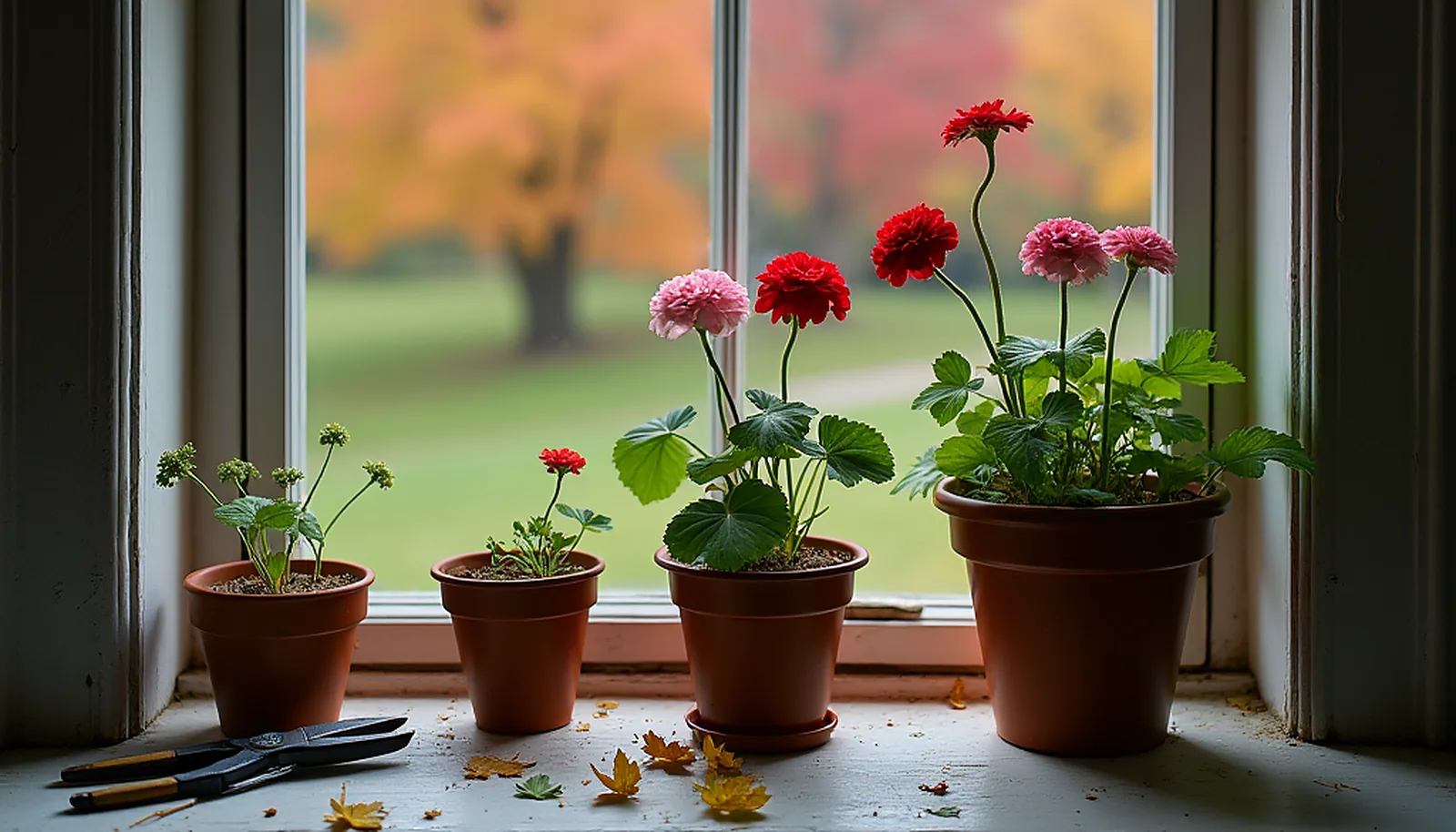
The geraniums in your planters can make it through the winter and bloom again next summer. The extension services of the universities of Minnesota, Wisconsin and Illinois describe the same three methods: keep the plant in a pot as a houseplant, take cuttings, or let it go dormant, bare-root, somewhere cool.
First, inspect your plants: our complete method for bringing plants indoors without bringing in bugs explains where to look and what to do.
Geranium or pelargonium: which one comes in?
The "geranium" in your planters is not a true geranium. It is a Pelargonium, a genus whose species mostly come from South Africa, the University of Minnesota points out. True geraniums, in the genus Geranium, are perennials: in Minnesota, they are grown as such, in the ground.
The confusion goes way back. According to the geranium guide from CRAAQ, Quebec's agriculture and agri-food reference centre, both names come from Greek and refer to the long shape of the fruit: the crane (geranos) for Geranium, the stork (pelargos) for Pelargonium. The second genus was created in 1738 to set our balcony plants apart from perennial geraniums, but the name "geranium" stuck.
- Bring in: zonal geraniums from your planters, trailing ivy geraniums, scented geraniums with fragrant leaves (lemon, mint, rose) and Martha Washington geraniums. They are all Pelargonium, tender plants that do not survive our winters outdoors.
- Leave in the ground: the hardy geraniums in your flower bed, which spend the winter outside. To decide whether to cut them back this fall, see Should you cut back your perennials in fall?
Before you choose: the right timing and the right plants
On timing, the sources agree: bring in or dig up your geraniums before the first frost. The University of Wisconsin draws the line at a hard freeze, but the University of Illinois advises not to wait until the last minute. There is no universal date: watch the overnight forecasts for your area instead, and act as soon as frost is forecast.
Next, sort them. The University of Illinois advises throwing out any plant with spots or discolouration on the leaves or stems, or that is wilting, rotting or harbouring insects: it will overwinter poorly and could spread problems to your other plants. Not sure about a spot? Try our 5-photo method for diagnosing a sick plant. As for insects, CRAAQ's guide lists whiteflies, aphids, two-spotted spider mites, thrips, mealybugs and the small black flies of potting soil (fungus gnats) among geranium pests. To identify a critter, see how to inspect your plants with Seek.
Your home picks the method. A free south-facing window in a fairly cool house: method 1. Little space but a bright windowsill: cuttings. A cool basement or an unheated room, with no light to spare: dormancy. Nothing stops you from combining them: the universities of Wisconsin and Minnesota actually suggest taking backup cuttings when you try dormancy.
The three methods at a glance
| Method | Space | Conditions | Effort | Good to know |
|---|---|---|---|---|
| 1. In a pot, as a houseplant | One large pot per plant, near a window | South-facing window or grow light; 16 to 21°C during the day, a little cooler at night | Medium: water when the soil is dry, pinch, cut back in March | Drops leaves when it comes in; gets leggy by late winter |
| 2. Cuttings | A few small pots on a windowsill | Bright light, no direct sun, then a sunny window or grow light | High at first, light afterwards | Roots in 3 to 8 weeks; a diseased plant gives diseased cuttings |
| 3. Bare-root dormancy | A paper bag, or plants hung up | Cool (7 to 13°C), dry spot | Low: soak the roots now and then | Uncertain success; take backup cuttings |
Method 1: in a pot, as a houseplant
This is the most intuitive option if you have light to spare: the geranium keeps growing all winter, and you already have a full-sized plant in spring.
- Pot it. Dig up each plant and set it in a large pot with drainage holes, in good potting soil, as Iowa State University, Illinois and Espace pour la vie advise. A geranium already in a pot can come in as is (Wisconsin).
- Prune. Advice varies: Espace pour la vie says to remove thin stems and those that cross, then shorten the others to 20 or 25 cm above the soil; Wisconsin and Illinois recommend removing one-third to one-half of the plant, and Minnesota cutting it back to about two-thirds of its size.
- Water thoroughly, then only when the soil feels dry to the touch (Wisconsin, Illinois).
- Give it your best window. A south-facing window is usually best, according to the University of Minnesota. Failing that, it suggests a fluorescent tube 25 to 30 cm above the plants, or an LED grow light that is mostly red, which encourages flower buds, switched on from 6 p.m. to 10 p.m. with a timer.
- Keep it cool. Geraniums like cool homes: 16 to 18°C according to Minnesota and Wisconsin, 18 to 21°C during the day according to Iowa, and a little cooler at night. Avoid cold drafts, heating vents and the area near the fireplace.
Don't panic if it drops a lot of leaves after coming in: the University of Minnesota warns that most geraniums brought indoors do this before growing new foliage. Toward the end of winter, it will tend to get leggy (Iowa): pinch the stem tips just above a node to keep it bushy (Wisconsin). If you have Martha Washington geraniums, a cool room helps: they need nights of 10 to 16°C to bloom, according to the University of Minnesota.
The real challenge is space. If your south-facing window is already taken by the rosemary, see which garden herbs survive indoors. And for what houseplants actually do for your home, read the benefits of houseplants: what is proven, and what isn't.
Method 2: cuttings, to save space
Instead of the whole plant, you bring in a few stem tips and end up with young plants in spring. Espace pour la vie says the best cuttings are taken in September, before the frosts, but the University of Minnesota notes that you can take them at any time of year from a healthy plant. If your geranium is already indoors in a pot, you can still take cuttings this fall.
- Choose. Pick the strongest stems on the most vigorous plants (Espace pour la vie).
- Cut. Take the tip of a stem, 10 cm long according to Espace pour la vie, 7.5 to 10 cm according to Wisconsin and Illinois, cutting just below a node. Remove the lower leaves.
- Let the cuttings dry a little, as Espace pour la vie advises. Rooting hormone is optional: the universities consulted recommend it, but CRAAQ's guide notes that it is not essential when the cuttings are good quality and conditions are good. Some gardeners dust the cut end with charcoal instead, to prevent rot (Espace pour la vie).
- Plant. Push the cuttings into a pot with drainage holes filled with sand, vermiculite, perlite or a mix of sand and peat (Espace pour la vie, Illinois), and keep it moist.
- Give them light. Bright, but no direct sun (Wisconsin): a north- or east-facing window, or a grow light, the University of Minnesota suggests.
Should you cover cuttings with a plastic bag? The sources disagree. Illinois presents it as an option to hold in moisture, as long as you watch for mould; the University of Minnesota warns that it can encourage mildew and reduces air circulation.
For roots, expect three to four weeks according to the University of Minnesota, about six according to Wisconsin and four to eight according to Illinois; in greenhouses, under controlled conditions, CRAAQ gives three to five weeks. Around three weeks, gently lift a cutting to check (Minnesota). Once rooted, each one goes into its own 7.5 to 10 cm pot (Illinois), in a bright spot, until spring.
A word of caution: a cutting inherits its parent plant's diseases. Pennsylvania State University (Penn State) describes bacterial blight, caused by the bacterium Xanthomonas, as the most important disease of geraniums; an infected plant may show no symptoms, in which case its cuttings are probably infected too. Growers do not take that risk: CRAAQ strongly advises them not to keep plants from one season to the next, for plant health reasons, and Penn State, in a fact sheet aimed mainly at greenhouses, advises buying disease-free plants every year.
Universities that write for home gardeners still recommend overwintering, but only healthy plants. Throw out any plant that wilts, with V-shaped yellow areas on the leaf edges or blackening stems, and clean your blade: according to Penn State, the bacterium also spreads on knives. Our article on caring for garden tools explains how to disinfect your pruning tools.
Method 3: bare-root dormancy, somewhere cool
This is the method that takes the least space and care: the plant spends the winter at rest, without soil. It is also the least reliable: the University of Minnesota calls it challenging, and the University of Wisconsin warns that stored plants may not survive.
- Dig up before frost and gently shake the soil off the roots (Wisconsin, Illinois).
- Store cool and dry. Slip the plants into a large paper bag left open so air can circulate (Wisconsin), or hang them upside down. Aim for 7 to 10°C according to Illinois and Minnesota, up to 13°C according to Wisconsin: an unheated room, an enclosed porch, a cool basement, or a garage, as long as it is heated, the University of Minnesota specifies.
- Let the leaves fall. They dry up and drop, and the stem tips may die back: that is normal (Wisconsin, Illinois).
- Rehydrate now and then. To keep the roots from drying out completely, some gardeners soak them in water for a few hours, several times over the winter, then hang the plants back up (Wisconsin, Minnesota).
Why the cold? Because in the cool, geraniums slow right down: according to CRAAQ, their growth almost completely stops at 10°C. The University of Minnesota also describes a simpler variation, dormancy in the pot: before frost, move the geranium, pot and all, to a dark, cool spot (7 to 10°C), and water it about once a month. In early spring, it goes back to a sunny window and you resume regular watering.
Also storing dahlias or gladiolus in the basement? See how to store tender bulbs.
In spring: cut back, wake up and move out
The comeback starts in March, and each method has its own routine.
- Potted plants. In March, cut them back by one-half to two-thirds: according to Iowa, they start growing again within a few days and make nice plants by May. Take the opportunity to make cuttings: Espace pour la vie notes that you can take them in March from geraniums that spent the winter indoors.
- Cuttings. They keep growing in their small pots, in the sun or under the grow light, until it is time to go out (Illinois).
- Dormant plants. In March, remove anything dry or shrivelled and cut the stems back to firm, green tissue (Illinois, Wisconsin). Pot them up in potting soil, water thoroughly and place them in the sun or under a grow light. Be patient: they can be slow to restart, Wisconsin warns.
To move them out, wait until any risk of frost has passed in your area and, ideally, until the soil reaches about 16°C, the University of Minnesota advises. Once again, there is no magic date: follow the overnight forecasts for your area.
Then harden them off: after months indoors, they need to get used to sun, wind and dry air gradually. The classic method, described by the University of Nebraska for plants raised indoors, takes 7 to 10 days; start on a mild or cloudy day:
- On the first day, 2 to 3 hours outside, in the shade and out of the wind, then back inside.
- Each day, a few more hours and a little more sun.
- After a few days at 10 or 12 hours outside, leave them out day and night for two days, then plant.
During this period, water a little less often without letting them wilt, and wait until after planting to give them diluted fertilizer (Nebraska). Once they are in place, give them at least 8 hours of sun a day: with less, they bloom less, according to the University of Minnesota.
Sources
- Hivernage des géraniums (overwintering geraniums; in French), Espace pour la vie, Jardin botanique de Montréal.
- Growing geraniums as annual flowers in Minnesota, Julie Weisenhorn, University of Minnesota Extension, reviewed in 2026.
- Overwintering Tender Geraniums (Pelargonium spp.), Margaret Murphy, University of Wisconsin–Madison Extension, 2024.
- How to overwinter geraniums for next year's garden, Ken Johnson, University of Illinois Extension, 2024.
- How do you over-winter geraniums as potted plants?, Iowa State University Extension and Outreach, 2022.
- Le géranium (in French), Jean-Paul Soucy, agronomist, Centre de référence en agriculture et agroalimentaire du Québec (CRAAQ), 2006.
- Bacterial Blight of Geranium, Gary W. Moorman, Penn State Extension, 2023.
- Hardening Off Transplants, Sarah Browning, Nebraska Extension, Lancaster County, 2020.
Frequently asked questions
Can you leave geraniums outside over the winter in Quebec?
Not the ones in your planters. They are Pelargonium, tender plants whose species mostly come from South Africa: you need to bring them in or dig them up before the first frost. Hardy geraniums, in the genus Geranium, are a different plant: they stay in the ground and spend the winter outside like the other perennials in your flower bed.
Should you prune geraniums before bringing them in?
Yes, if you are keeping them in pots. Advice varies: remove one-third to one-half of the plant according to the universities of Wisconsin and Illinois, or remove thin stems and those that cross, then shorten the others to 20 or 25 cm above the soil, according to Espace pour la vie. For dormant plants, the real pruning happens in March, back to firm, green tissue.
Why is my geranium dropping its leaves since I brought it in?
That is normal: according to the University of Minnesota, most geraniums drop many of their leaves when brought indoors, then grow new ones. Give it your sunniest window and a cool room, and water only when the soil is dry. However, if it wilts, with V-shaped yellow areas on the leaf edges or blackening stems, suspect a bacterial disease such as bacterial blight, and throw it out.
How long does it take a geranium cutting to root?
Three to eight weeks, depending on the source: three to four according to the University of Minnesota, about six according to the University of Wisconsin, four to eight according to the University of Illinois. Around three weeks, gently lift a cutting to check. Rooting hormone can help, but CRAAQ notes that it is not essential with good cuttings and good conditions.
When should you move geraniums back outside in spring?
Once any risk of frost has passed in your area and the soil reaches about 16°C, according to the University of Minnesota. There is no fixed date: go by the overnight forecasts for your area. Before planting them, get them used to the outdoors over 7 to 10 days, starting with a few hours in the shade, out of the wind.