Lomi, FoodCycler and co.: does an electric composter really make compost?
An electric composter turns your food scraps into a dry powder in a few hours. It's handy, especially in an apartment without a brown bin, but it isn't compost: it's dehydrated food that still has to break down. Here's what independent tests measured, what the manufacturers say and how to make good use of these machines.
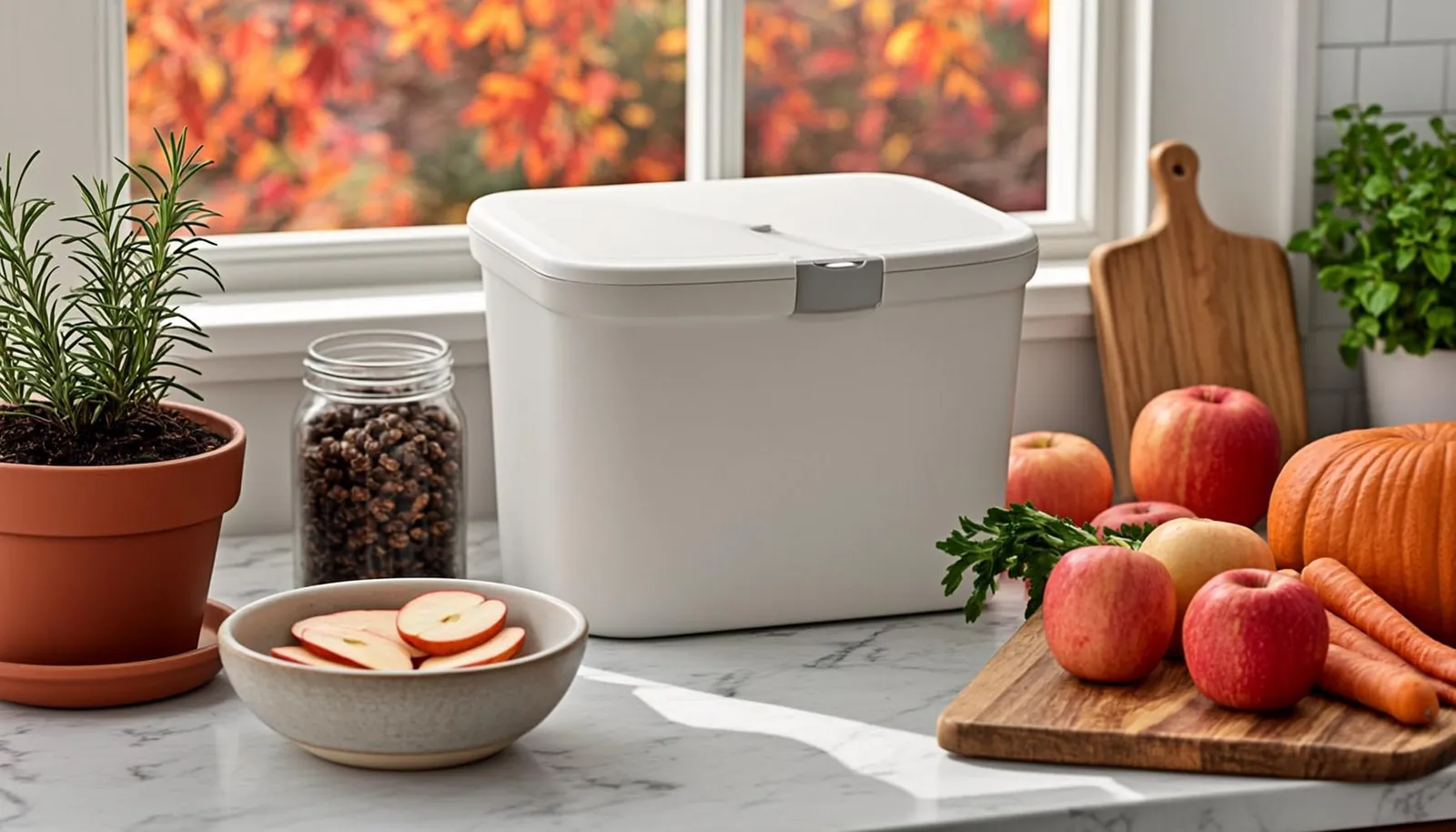
They promise to turn your peels and table scraps into a kind of "soil" in a few hours, right on the counter. The Lomi, the FoodCycler and similar machines are tempting when you live in an apartment without a brown bin, or when you've had enough of fruit flies. Faced with the price tag, one question keeps coming up: does it really make compost?
The short answer is no. An electric composter heats, dries and grinds food. What comes out is dehydrated food, which still has to decompose before it can feed the soil. That doesn't mean these machines are useless: they greatly reduce the volume of scraps, they solve plenty of odour and animal problems, and some municipalities are testing them seriously. Here's what they really do, what independent tests say about them and how they compare with the other options. If you're starting from scratch, our complete guide to composting, even in winter and in an apartment covers the basics.
What an electric composter really does
Whatever the brand, the principle is the same. The machine combines heat and mechanical grinding to dry the scraps and reduce them to a material that looks like very dry soil, sums up a factsheet posted in 2026 by the Regional District of Central Kootenay (RDCK), in British Columbia. According to BioCycle, a magazine that specializes in composting, these machines heat scraps to about 74 to 135°C for 4 to 20 hours. Volume can drop by up to 90%, and the final product contains less than 10% moisture.
The FoodCycler, for example, takes 4 to 9 hours to completely dehydrate scraps, depending on their quantity, density and moisture, then cools down for less than half an hour on average, according to the manufacturer's guide. Carbon filters hold back odours during the cycle. Lomi, for its part, claims to turn scraps into "plant-ready" nutrients in under 24 hours. Its Eco-Express mode is the shortest and most energy-efficient, and the company recommends Grow mode when you want to use the result for plants.
What's missing from this description is decomposition. The RDCK factsheet says it bluntly: the material that comes out of these machines has not decomposed at all and still needs to be broken down by microbes. The machine doesn't do the work of microorganisms; it takes away the water they need. In a sample analyzed during trials published by BioCycle, genetic sequencing actually found no measurable microbial DNA: the heat and drying appear to have eliminated the microbes.
Why it isn't compost (yet)
In Canada, the word compost has a precise definition. In its Guidelines for Compost Quality, the Canadian Council of Ministers of the Environment (CCME) describes it as a solid, mature product, obtained through a controlled bio-oxidation process that includes a thermophilic phase, meaning a hot period when heat-loving microorganisms are very active. To be considered mature and stable, compost must also go through a curing period of at least 21 days. And "mature" has a concrete meaning: used to improve a soil, compost must not have phytotoxic effects, meaning effects that harm plants, for example because it ties up nitrogen.
RECYC-QUÉBEC describes the same thing for compost made from the contents of brown bins: a biological process in the presence of oxygen, a thermophilic phase of 45 to 70°C, then a curing phase. At home, Québec.ca counts about 12 months before backyard compost reaches maturity, brown or black and smelling of earth. That's a far cry from the few hours of a cycle.
An electric composter does heat up, but its heat comes from a heating element, not from microbes at work, and it serves to dry, not to decompose. There is neither biological breakdown nor curing. The product looks like soil because it is dry and finely ground, but its composition still reflects that of the original scraps. BioCycle sums up the nuance this way: it's stable "on the shelf," as long as it stays dry, but not biologically stable. As soon as it gets wet, the microbes come back and decomposition resumes.
What the manufacturers promise
These machines are often called "composters," wrongly so according to BioCycle. Yet when it comes time to explain what to do with the result, the manufacturers themselves choose other words, and their instructions are revealing.
Lomi talks about fertilizer, plant food and soil amendment. On its blog, the company recommends mixing the product into soil at a 1:10 ratio, never using it alone or at more than 10%, and letting the mix sit for 3 weeks before adding it to plants or the garden.
FoodCycler talks instead about a "by-product." In the guide for participants in a pilot project, which the Municipality of Pontiac, in the Outaouais region, posted online in 2025, the manufacturer Food Cycle Science recommends at least 1 part by-product to 10 parts soil, or 1 to 20 if it contains a lot of meat or dairy, ideally about 6 weeks before planting. It also suggests adding it to a composter as a "green," nitrogen-rich material. The same guide warns that by-product that gets wet and is deprived of air gives off odours and methane.
In other words, the manufacturers themselves acknowledge that their product needs time in the soil before it's useful. That's the best proof that the transformation isn't finished when the cycle stops. As for the "up to 90%" volume reduction, it's quoted everywhere, including in the RDCK factsheet and in BioCycle, but we found no published independent measurement that verifies it model by model.
What independent tests show
Studies are still rare and small, but the ones we found point in the same direction.
The rewetting test
In 2023, Ron Alexander, a horticulturist with more than 40 years of experience developing compost products, published in BioCycle the results of trials with the output of two kitchen units. Once rewetted, samples were covered in mould as early as the third day, with a strong odour. By the fifth day, mould had almost completely covered both dehydrated food samples, which also attracted flies. In a ryegrass seeding trial, a blend of 25% dehydrated food and 75% sandy soil produced no germination at all, while the same blend made with compost grew well.
The lab analysis
In 2024, the same author had a specialized laboratory analyze the output of three machines: the Mill, the Lomi and the Reencle. The results show extremely low moisture, a very acidic pH (3.94 to 5.59), electrical conductivity of 9.9 to 12 dS/m, and sodium and chloride levels 4 to 5 times higher than in a compost containing food scraps. In plain terms: an acidic and very salty product. In a growing test, all the growing media containing one third of it by volume went mouldy throughout. The microbial additives used with two of the machines did not noticeably change the quality of the product or its stabilization. The author's conclusion: these machines are not miniature composters. Their product can be used if it is further stabilized, but without that step, it should be used sparingly and with caution.
Two caveats: each trial was pooled into a single sample, so no statistical comparison is possible, and the article was modified after correspondence with one of the manufacturers. The trends are clear, but these values don't apply as is to every model.
A university study
A team from Universiti Brunei Darussalam published a study in 2023, in the scientific journal Sustainability, on the output of a home electric composter that heats below 70°C. Even after four weeks of curing, the samples still contained a substantial amount of phytotoxic compounds, measured with a seed germination test. The authors note that the output of these machines remains immature and needs further curing.
For you, the practical conclusion is simple: what comes out of an electric composter is neither potting soil nor a ready-to-use fertilizer. It's a raw material, a kind of pre-compost, that needs soil, water, microbes and time.
How to use what comes out of the machine
Once you know what it is, the dried product is easy to put to good use. Here are the options, from the safest to the least interesting.
- Add it to a compost pile. This is the safest use, since decomposition can finally take place there. The RDCK factsheet recommends treating it as a nitrogen-rich green: add enough browns (sawdust or straw; the FoodCycler guide also mentions paper and dead leaves), mix well and add water to restart decomposition. No compost in your yard? A community composting site might accept it; ask before you go.
- Dig it into the garden, never on the surface. Instructions range from 1 part to 10 parts soil (Lomi, FoodCycler) to 1 to 15 (RDCK), with 2 to 6 weeks of waiting before planting. The RDCK asks you to mix well, to water, and not to sprinkle the product on the soil, where it attracts animals. In Quebec, fall is a good time: dug in during October in a bed you won't plant until May, it goes well beyond all these waiting times.
- Houseplants, with caution. The product is acidic and salty, and in the lab, growing media containing one third of it went mouldy. If you try it anyway, stay under the 10% maximum given by Lomi and respect the resting time. The simplest approach is still to go through a compost pile.
- Store it dry. The FoodCycler guide says it keeps indefinitely in a sealed container, as long as it stays dry. Handy for accumulating it over the winter and adding it to the compost in spring. The RDCK factsheet insists: keep it in a secure place, in a tightly closed container, because it attracts animals.
- The brown bin or the garbage, as a last resort. The FoodCycler guide accepts both. For the brown bin, your municipality decides. In the garbage, product that takes on moisture without air can give off odours and methane, as the manufacturer itself notes.
Remember that even mature compost isn't used straight: Québec.ca advises mixing 1 to 5 cm of it into the top 15 centimetres of soil, without planting directly in it. A much less decomposed product calls for at least as many precautions.
The real advantages
So no compost, but real benefits, and it would be unfair to brush them aside.
- Volume. Volume reduced by up to 90% means fewer bags, fewer trips and a kitchen bin that no longer overflows. The Sicamous pilot project estimated the savings at 28.5 garbage bags per household per year (more on that below).
- Odours and flies. Once dried, scraps no longer ferment on the counter and keep in a closed container. For the time before the cycle, our tips for keeping the kitchen bin clean and fly-free still apply.
- Animals. According to the RDCK factsheet, a shelf-stable product is easier to keep out of reach of wildlife and pests. In Sicamous, two thirds of participants don't compost, precisely because of concerns about animals and pests.
- Scraps a backyard compost refuses. Depending on the model, these machines accept cooked food, grains, meat and small bones. Québec.ca, for its part, recommends avoiding animal residues in a home compost.
- A solution where there's nothing else. In an apartment, with no yard and no food waste collection, it's a way to stop sending your scraps to landfill, provided you have a plan for the product.
The limits, including cost
- The product isn't finished. You need a plan: a garden, a compost pile, a neighbour who gardens. Otherwise, it ends up in the bin or the garbage, with an electricity bill as a bonus.
- It's acidic and salty. As we saw, without further stabilization, it's best used sparingly.
- The machine doesn't like the cold. The RDCK factsheet says never to use or store these machines outdoors, or at temperatures below 0°C or above 35°C. Forget the balcony or the shed in January.
- Not everything goes in. Each manufacturer has its own list of exclusions. For Lomi, for example: liquids, oils, very hard foods and pits such as avocado or mango pits.
- It doesn't reduce food waste. A machine processes scraps; it doesn't reduce how many there are. For that, our tips on avoiding food waste are a better starting point.
Operating cost, in brief
First, the purchase: the RDCK factsheet puts the price of these machines between $300 and more than $800. Then, electricity: 0.5 to 1.5 kWh per cycle according to the same factsheet, and 0.8 to 1.5 kWh for the FoodCycler according to its manufacturer. Under Hydro-Québec's Rate D, in effect since April 1, 2026, a kilowatt-hour costs 7.065¢ for the first 40 kWh used per day, then 11.142¢ beyond that. For a machine using 0.8 to 1.5 kWh, like the FoodCycler, a cycle therefore costs about 6 to 17¢ before taxes, depending on the model and the price tier, and one cycle a day for a year comes to about $21 to $61 (our calculation). That's in the same range as the FoodCycler manufacturer's estimate of $2 to $4 per month, depending on where you live.
Then add the consumables. FoodCycler carbon filters last 3 to 4 months with regular use, or 500 cycle hours, according to the manufacturer. Some machines also offer microbial additives, which had no notable effect on product quality in the analyses published by BioCycle. The details, including filters, warranty and lifespan, are in our article on the real cost of an electric composter.
Municipal pilot projects: Sicamous and others
A few municipalities are testing these machines, as a replacement for or a complement to food waste collection. Sicamous, in British Columbia, published its results.
Sicamous, 2024: the results
In partnership with the manufacturer Food Cycle Science, the District of Sicamous offered its residents 100 FoodCycler units at a subsidized price. The pilot project ran from February to May 2024: for 12 weeks, households recorded how often they ran their machine. The manufacturer presented the results to council at the end of August 2024, and the District published them:
- 23.7 tonnes of food waste diverted from landfill per year for all 100 units, or about 237 kg per unit (our calculation);
- 28.5 fewer garbage bags per household per year;
- 93% of participants plan to keep using the machine;
- a rating of 4.5 out of 5 for the experience;
- 66.67% of participants don't compost, because of concerns about animals and pests.
What these figures don't tell you
Encouraging, but with caveats. These results were presented by the manufacturer, not by an independent body. The tonnes and bags are annual projections, based on 12 weeks of use recorded by the participants themselves; the District's page mentions no weighing. The 93% reflects an intention, among volunteers who had bought the machine at a subsidized price. Finally, nothing is said about electricity use or about what households did with the dried product: garden, compost, bin or garbage. Yet that is what determines whether the scraps really return to the soil.
In Quebec and elsewhere
In Quebec, the Municipality of Pontiac, in the Outaouais region, posted the guide for its own FoodCycler pilot project online in 2025, with the same 12-week tracking and a final survey. At the time of writing, we had not found its results. In British Columbia, the RDCK takes a remarkably frank tone in its 2026 factsheet: these machines "do not create compost by themselves," and you need to plan where their product will go before buying one.
It's also worth keeping things in proportion. According to RECYC-QUÉBEC, residents of more than 800 Quebec municipalities now have access to organic waste collection. For many Quebecers, the real question is therefore not "electric composter or nothing," but "electric composter or brown bin."
Electric, bokashi, worms, brown bin or backyard compost: the comparison
Each method has its place. The table sums up what our sources say; the times are rough estimates.
| Method | What happens | Time before garden use | Electricity | What you get | Best for |
|---|---|---|---|---|---|
| Electric composter | Heat and grinding: scraps dry out without decomposing | A cycle of a few hours, then 2 to 6 weeks in the soil depending on the instructions | 0.5 to 1.5 kWh per cycle | Dried scraps, not compost | Apartments without collection, animal problems, provided you have a plan for the product |
| Bokashi | Oxygen-free fermentation, with a bran that contains microorganisms | About 2 weeks in the bucket, then at least 2 weeks in the soil or compost | None | A fermented, acidic material, to be finished in the soil or compost | Apartments, if you have somewhere to bury or compost it |
| Worm composting | Red worms break down the scraps | Faster than backyard compost, according to Québec.ca | None | Worm compost that plants can use | Apartments, condos |
| Brown bin | Industrial composting or anaerobic digestion (biomethanization), depending on the facility | Nothing to wait for at home | None at home | Compost or digestate, produced away from home | Anyone whose municipality offers collection |
| Backyard compost | Decomposition by microorganisms, with air | About 12 months | None | Mature compost | Houses with a yard |
When it comes to meat and dairy scraps, the methods aren't equal. The brown bin generally accepts them, according to RECYC-QUÉBEC, and so does bokashi: the RDCK factsheet allows all food scraps in it. Some electric composters take meat and small bones. Backyard compost, on the other hand, has to do without them.
So, should you buy one?
Do you have a brown bin? You already have the simplest option for most scraps, meat, bones and dairy included, with no electricity and no product to manage. An electric composter can reduce volume and odours between collections, but it adds a step that uses electricity before the same destination. Check what your city accepts: according to RECYC-QUÉBEC, the list depends on the type of treatment facility, and the "Ça va où?" app gives you your municipality's rules. Our article on what goes in the brown bin and why it changes from one city to another covers the question.
Living in an apartment with no collection? Look first at the options that don't need an outlet. Bokashi in an apartment accepts all food scraps, and a full kit costs $50 to $200, according to the RDCK. Indoor worm composting, which Québec.ca recommends in a small space like an apartment, produces real worm compost. If neither suits you, the electric composter becomes a sensible option, especially if a garden, a relative or a community site can take its product.
Do you have a yard? Backyard compost is still the simplest, and it produces real, mature compost. Our article on setting up a home composter helps you choose and install your bin, and the one on the benefits of home composting explains what you gain. An electric machine can complement it in winter: you accumulate the dry product in a closed container and add it to the pile in spring, with browns.
Animals prowling, short on time, or a kitchen bin that disgusts the whole household? That's where the electric composter is most convincing, as the Sicamous experience suggests. Choose it knowing what it is: an excellent volume reducer and a first step toward compost, not compost itself.
Sources
- Guidelines for Compost Quality, Canadian Council of Ministers of the Environment (CCME), 2005.
- Matières organiques : collecte municipale (organic materials: municipal collection; in French), RECYC-QUÉBEC, 2026.
- Compost et utilisation au jardin (compost and its use in the garden; in French), Gouvernement du Québec (Québec.ca), 2026.
- Electric Kitchen “Composter” Confusion, Ron Alexander, BioCycle, 2023.
- Analyzing The Outputs — Kitchen Appliances Vs. Facility-Composted Food Scraps, Ron Alexander, BioCycle, 2024.
- The Effect of Initial Carbon to Nitrogen Ratio on Kitchen Waste Composting Maturity, F. A. Azis, M. Choo, H. Suhaimi and P. E. Abas, Universiti Brunei Darussalam, Sustainability, vol. 15, no. 7, 2023.
- FoodCycler Municipal Waste Reduction Pilot Project Results, District of Sicamous (B.C.), 2024.
- Food Appliance factsheet (electric food waste pre-treatment appliances), Regional District of Central Kootenay (B.C.), 2026.
- Home Organics Management: Bokashi, Regional District of Central Kootenay (B.C.), 2026.
- Lomi Dos and Don’ts + How to Troubleshoot Common Problems, Lomi (manufacturer), 2022.
- The FoodCycler Municipal Pilot: Resident Guide, Food Cycle Science (manufacturer), published by the Municipality of Pontiac, 2025.
- 2026 Electricity Rates, effective April 1, 2026, Hydro-Québec, 2026.
Frequently asked questions
Does an electric composter make compost?
No. It heats, dries and grinds scraps, but it doesn't decompose them: its product still has to be broken down by microbes, in the soil or in a compost pile. In Canada, according to the CCME, compost must have gone through a thermophilic phase and a curing period of at least 21 days.
Can the dried product go straight into plants?
Not as is. Mix it into soil, at about 1 part to 10 to 15 parts soil depending on the instructions, and wait 2 to 6 weeks before planting. Don't sprinkle it on the surface. In pots, be careful: the product is acidic and salty, and growing media containing one third of it went mouldy in a test.
How much electricity does a Lomi or a FoodCycler use?
These machines use 0.5 to 1.5 kWh per cycle, according to the Regional District of Central Kootenay, and 0.8 to 1.5 kWh for the FoodCycler, according to its manufacturer. Under Hydro-Québec's Rate D, in effect since April 1, 2026, a cycle of 0.8 to 1.5 kWh costs about 6 to 17¢ before taxes.
Can the product of an electric composter go in the brown bin?
The FoodCycler manufacturer accepts it in the brown bin as well as in the garbage, but your municipality sets the rules: according to RECYC-QUÉBEC, the list depends on the type of treatment facility. Check with the "Ça va où?" app. And if you have a brown bin, you can put your scraps in it directly, without a machine.
Is an electric composter worth it in an apartment?
Yes, if you have no food waste collection, if odours or animals are a problem and if you have a plan for the product: a community compost site or a relative's garden. Otherwise, bokashi (a kit costs $50 to $200) and worm composting work without electricity.