Indoor worm composting: starting a worm bin in a condo
No yard, no brown bin, or you simply want to feed your plants with your peelings? A bin of red wigglers fits in a closet or a corner of the kitchen, doesn't smell when it's well run, and turns your scraps into vermicompost all year round. Here's how to start one in a condo, with the numbers to back it up.
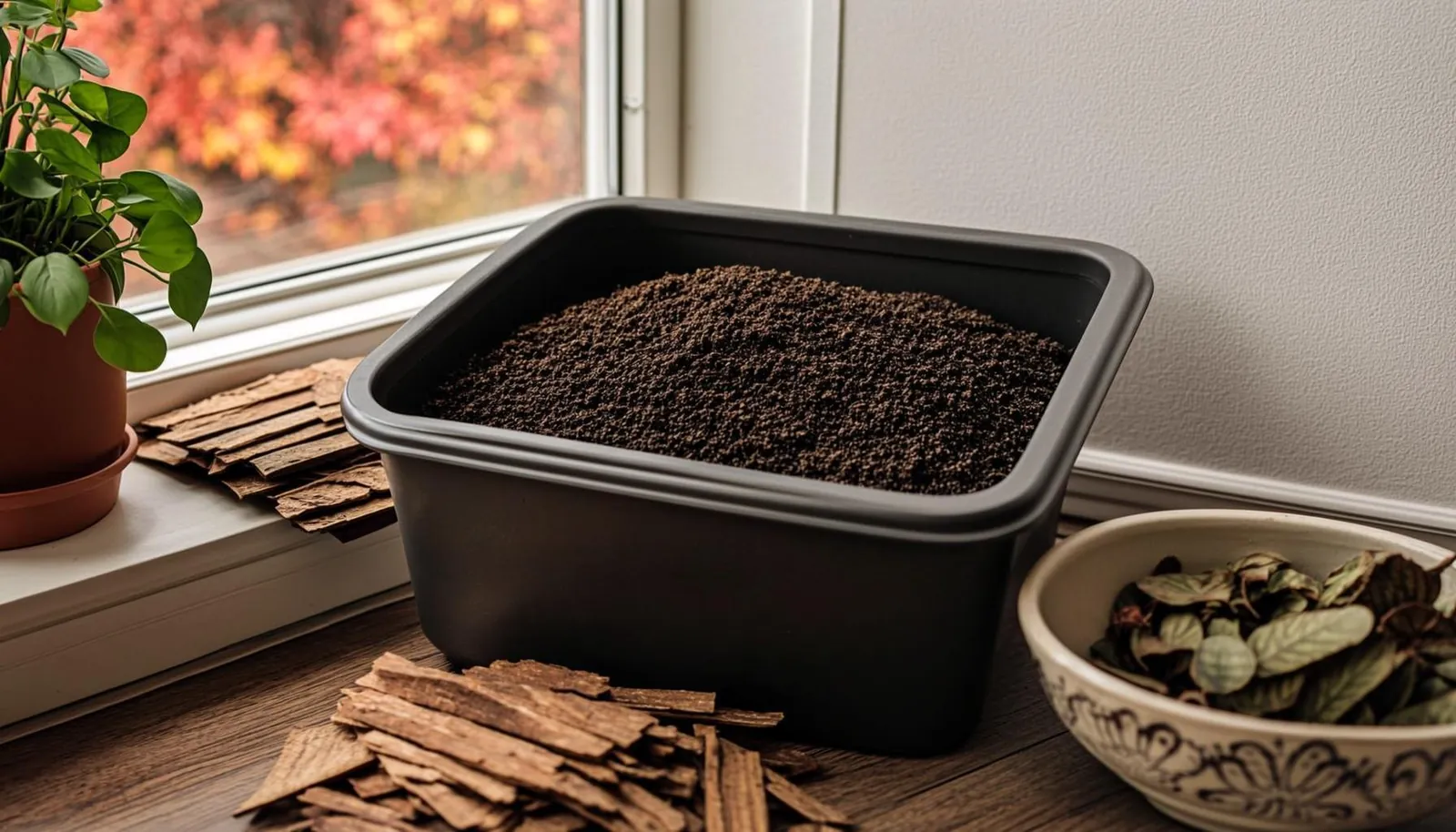
In a condo, peelings and coffee grounds often have only two destinations: the brown bin, when your building has access to one, or the garbage. Indoor worm composting adds a third. Québec.ca describes it as particularly well suited to small spaces such as an apartment: it is done indoors, all year round, in a closed bin where red wigglers turn your scraps into vermicompost, a fine-textured amendment for your plants.
No plug, no filter, no motor: just worms, newspaper and a bit of regularity. Our overview of ways to make the most of your organic waste introduced the method; here, we get down to specifics, with the numbers to back them up. And if you are still torn between a worm bin, bokashi and an electric appliance, our feature on electric composters like Lomi and FoodCycler, and whether they really make compost, compares the options.
Red wigglers, not garden worms
The worm that does the work is the red wiggler, Eisenia fetida. Of more than 9,000 earthworm species, only seven are recognized as suitable for vermicomposting, according to NC State Extension, and the red wiggler is the one most people use. Québec.ca explains the choice: it reproduces very quickly and breaks down organic matter fast.
Why not garden worms? The red wiggler lives at the surface, in leaves and decaying matter, without digging burrows. Common earthworms and the European nightcrawler (Lumbricus terrestris) are burrowers that live in the soil: according to Oregon State University (OSU), they will not survive in an indoor bin. NC State also advises against bait worms, and against worms dug up in the yard, since you can't easily confirm their species.
How many worms, and where to find them
There are about 1,000 red wigglers per 450 g (one pound). NC State recommends at least 450 g of worms for every 30 cm by 30 cm square of bin surface. OSU's model bin, about 50 litres (30 cm by 30 cm by 60 cm), holds 0.9 to 1.1 kg of worms and processes nearly 1 kg of scraps per week: enough for a household of two or three.
Worms are sold by specialized growers. NC State advises comparing prices, which vary a lot, and the University of Washington's horticultural library advises checking that the supplier knows which species it sells. If someone around you has a healthy bin, ask them for part of their colony: each cocoon holds 2 to 7 baby worms, and the population rebuilds quickly. You'll simply feed less at first.
Some cities help pay for the bin. In Mirabel, the home composter subsidy accepts worm composters and reimburses up to $50 before taxes, for property owners (2026 brochure). In the Saint-Laurent borough of Montreal, worm composters were eligible for the 2026 subsidy for eco-friendly household equipment (50% of the bill before taxes, up to $125), but at the time of writing, the program has ended because its funds ran out. Before buying, check what your city offers.
The bin and its bedding
The right bin is opaque, shallow and has a tight-fitting lid, because worms avoid light. A well-rinsed plastic storage tote does the job. NC State allows about a 30 cm by 30 cm square of surface per 450 g of scraps produced each week; OSU advises no more than 30 cm of depth.
Drill drainage holes about 6 mm wide in the bottom (six according to NC State, up to about twenty according to OSU), then small ventilation holes near the top of the sides, covered with fine screen to keep flies out (OSU). Set the bin on a tray, or inside a second bin with spacers, to catch the liquid. Espace pour la vie adds a piece of geotextile (landscape fabric) at the bottom to hold in the bedding and the worms.
The lid divides the sources: Espace pour la vie and Québec.ca put holes in it for ventilation, while NC State recommends never drilling the lid, to avoid light and drying out. The goal is the same: air, without light. Bedding that dries out too fast is a sign of too much ventilation.
Bedding: a wrung-out sponge
Worms live in their bedding and eat it too. Use black-and-white newspaper torn into strips about 1 cm wide, paper bags, corrugated cardboard, coconut coir or dead leaves, but no glossy paper. OSU suggests mixing two or three of them, 10 to 15 cm deep. Your delivery boxes get a second life (more ideas for reusing cardboard boxes).
Soak the bedding for 5 to 10 minutes, then wring it out: when you squeeze it, only two or three drops should come out (NC State), which corresponds to 75 to 85% moisture according to OSU. Add a handful of garden soil, or a little sand or potting soil as Espace pour la vie and Québec.ca suggest, and fill the bin about halfway without packing it down. After that, never pour water in: mist instead. About every two months, OSU adds half a cup (125 ml) of fine mineral grit, such as pulverized eggshells, to a 50-litre bin; Espace pour la vie recommends powdered eggshell to control acidity.
Where to put the bin in a condo
Red wigglers do well between 15 and 25°C, according to NC State, which sets their limits at 0 and 35°C; OSU starts the ideal range at about 13°C. Below 10°C, they eat less and slow down (OSU), and they cannot survive freezing (Espace pour la vie).
In a heated condo, you have options: NC State lists the kitchen, a closet, the bathroom or the basement, as long as air circulates around the bin. Avoid the laundry room and high-traffic spots: according to OSU, vibrations from a washer, a dryer or constant comings and goings can make worms try to escape. Also keep the bin away from heat sources and direct sun, which can overheat it enough to kill the worms (NC State).
The balcony? Espace pour la vie allows it in summer: keep the bin in the shade and bring it in before the first frost. During a heat wave, NC State suggests adding dry bedding or a container of ice.
What to feed them, and how often
Wait a few days after the worms arrive before the first feeding (NC State), then start small. OSU recommends starting with 125 to 250 g of scraps per week for 500 g of worms, increasing as the colony grows. NC State sets the ceiling higher: 450 g of worms can eat up to 900 g of scraps per week. Don't add anything until the previous meal has been eaten. Scraps still untouched after two or three weeks? You've overfed: OSU then advises stopping feeding for up to two weeks.
Espace pour la vie suggests one to three feedings a week. Cut scraps into pieces of 1 to 2.5 cm or smaller (OSU), bury them in the bedding in a different spot each time and cover them with 2.5 to 5 cm of bedding: that is what keeps fruit flies away.
- Yes: fruit and vegetable peels and scraps, coffee grounds and filters, tea bags without staples, crushed eggshells.
- A little: plain bread, pasta and cereal, moistened first (OSU). Go easy on banana and melon peels, which attract fruit flies (OSU).
- No: meat, fish, bones, dairy products, oils and fats, salty foods, condiments, citrus, onions, garlic, pet waste, diseased or pesticide-treated plants, weeds gone to seed.
When in doubt, leave it out, as OSU puts it. For what worms won't take, check what your brown bin accepts: it changes from one city to the next. Between feedings, keep your scraps for a few days in a lidded container under the sink or in the freezer (NC State); freezing fruit peels also helps against fruit flies (OSU). To organize this small kitchen container, see how to compost food scraps.
Harvesting vermicompost and using it
A dark, fine material builds up at the bottom after a few weeks. Espace pour la vie and OSU put the harvest three to six months after setup, NC State at about four months. Vermicompost is ready when it looks like crumbly chocolate cake and smells like fresh earth, according to OSU, which advises harvesting at least twice a year. Three methods:
- Side to side. Push everything to one side, add fresh bedding to the other and feed only that side. The worms migrate there: Espace pour la vie harvests the old side about three weeks later, while Cornell allows about a month.
- Cones under light. Empty the bin onto a tarp under bright light, form small cones and wait 5 to 20 minutes: the worms move down, away from the light. Scrape off the top, layer by layer, until only worms are left (NC State, OSU).
- Two stacked bins. Set a second bin with holes in its bottom directly on the compost and feed only the top one. The worms move up; the bottom bin ends up holding only vermicompost (NC State).
As you sort, put the cocoons back in the bin: small, shiny, light-brown, lemon-shaped beads about the size of a match head.
How to use it
Vermicompost is an amendment: it enriches potting soil, it doesn't replace it. OSU allows up to 25% of the volume of a potting mix for container plants and suggests a thin layer on the surface for houseplants. The sources disagree: Cornell warns that pure vermicompost can be very salty and advises against mixing it into houseplant potting soil or sprouting tender seeds in it, while Espace pour la vie recommends it as an amendment for seedlings and potted plants. The cautious compromise: a thin layer on the surface, then watch how your houseplants react. Remove the worms first, since they don't survive in a pot (NC State). The liquid collected under the bin, for its part, is diluted in 10 parts water before going on the garden (OSU).
Finally, never empty a worm bin into a wooded area. The University of Washington's horticultural library notes that introduced worms do the most damage in North America's northern temperate forests, where they change the soil structure, which affects plants and wildlife. Your surplus makes a nice gift instead, as Espace pour la vie suggests.
Fruit flies, odours, escaping worms: the fixes
A well-run bin normally doesn't smell, Espace pour la vie points out: an odour signals an imbalance, most often too much food or bedding that is too wet.
| Problem | Likely cause | What to do |
|---|---|---|
| Fruit flies | Exposed scraps, too many fruit peels, too much food | Bury the scraps, cover the bedding with cardboard, freeze peels, stop feeding for two or three weeks, trap the flies with a small glass of vinegar or wine (OSU). They don't harm the worms (Cornell). |
| Bad odour | Too much food, soggy bedding, lack of air, foods to avoid | Add about 10 cm of dry bedding, stop feeding for two or three weeks, unblock the drainage holes, remove meat, dairy and grease (OSU, NC State). |
| Worms climbing the walls or escaping | Soggy or overly acidic bedding, vibrations, brand-new bin | Fix the moisture, add powdered eggshell, move the bin away from the washer; for a new bin, leave a light on day and night for a few days (Espace pour la vie, OSU, NC State). |
| Liquid at the bottom | Too much water, very wet scraps (coffee grounds, cooked food), lack of air | Leave the lid off for two days, add dry bedding, cut back on wet scraps (NC State). |
| Ants | Bedding too dry | Mist the bedding (OSU). |
| Sowbugs, springtails, mites, small white worms | Nothing abnormal: they help with decomposition | Nothing to do (NC State, OSU). |
Once the balance is found, NC State describes vermicomposting as a method that needs little space, labour or upkeep. The first weeks of your indoor worm composting are mostly about learning your worms' rhythm: feed lightly, watch, adjust.
Sources
- Vermicompostage (vermicomposting; in French), Espace pour la vie, Montréal Botanical Garden.
- Compost et utilisation au jardin (compost and its use in the garden; in French), Gouvernement du Québec (Québec.ca), 2026.
- Worms Can Recycle Your Garbage, Rhonda Sherman, NC State Extension, 2017.
- Composting with worms (EM 9034), Sam Angima, Michael Noack and Sally Noack, Oregon State University Extension Service, 2011, reviewed in 2024.
- Vermicomposting: Indoor Container Composting, Cornell Cooperative Extension, Monroe County, 2011.
- Vermicomposting best practices, Elisabeth C. Miller Library, University of Washington.
- Subvention pour l'achat d'équipements écologiques domestiques à Saint-Laurent (subsidy for eco-friendly household equipment in Saint-Laurent; in French), Ville de Montréal, 2026.
- Composteurs domestiques : demande de subvention (home composter subsidy application; in French), Ville de Mirabel, 2026.
Frequently asked questions
Does a worm bin smell bad in a condo?
Not if it's well run. According to Espace pour la vie, a worm bin normally gives off no odour. When it does smell, it is almost always too much food or bedding that is too wet: add dry bedding, bury the scraps well and stop feeding for about two weeks.
Can you use earthworms from the garden?
No. You need red wigglers (Eisenia fetida), which live at the surface in decaying organic matter. Common earthworms and the European nightcrawler (Lumbricus terrestris) dig burrows in the soil and, according to Oregon State University, will not survive in an indoor bin.
How much food waste can a worm bin handle?
According to Oregon State University, a bin of about 50 litres (30 cm by 30 cm by 60 cm) holding about 1 kg of worms processes nearly 1 kg of scraps per week, enough for a household of two or three. At first, give them much less, then increase as the colony grows.
What do you do with the bin during a vacation?
Worms can go two to three weeks between feedings, according to NC State Extension. Before leaving for two weeks, spread a layer of food about 1 cm thick and cover it with 5 cm of moist shredded paper.
Can worms spend the winter on the balcony?
No. Red wigglers cannot survive freezing, Espace pour la vie points out. The balcony works only in summer, and in the shade: in full sun, the bin can overheat enough to kill the worms. Bring it in before the first frost.