Quebec cranberries: season, buying, storage and freezing
Quebec grows about 72% of Canada's cranberries, but their peak season lasts only a month. The good news: they freeze right in the bag and go into recipes without thawing. Here is how to choose them, keep them until the holidays and sort fact from fiction about them.
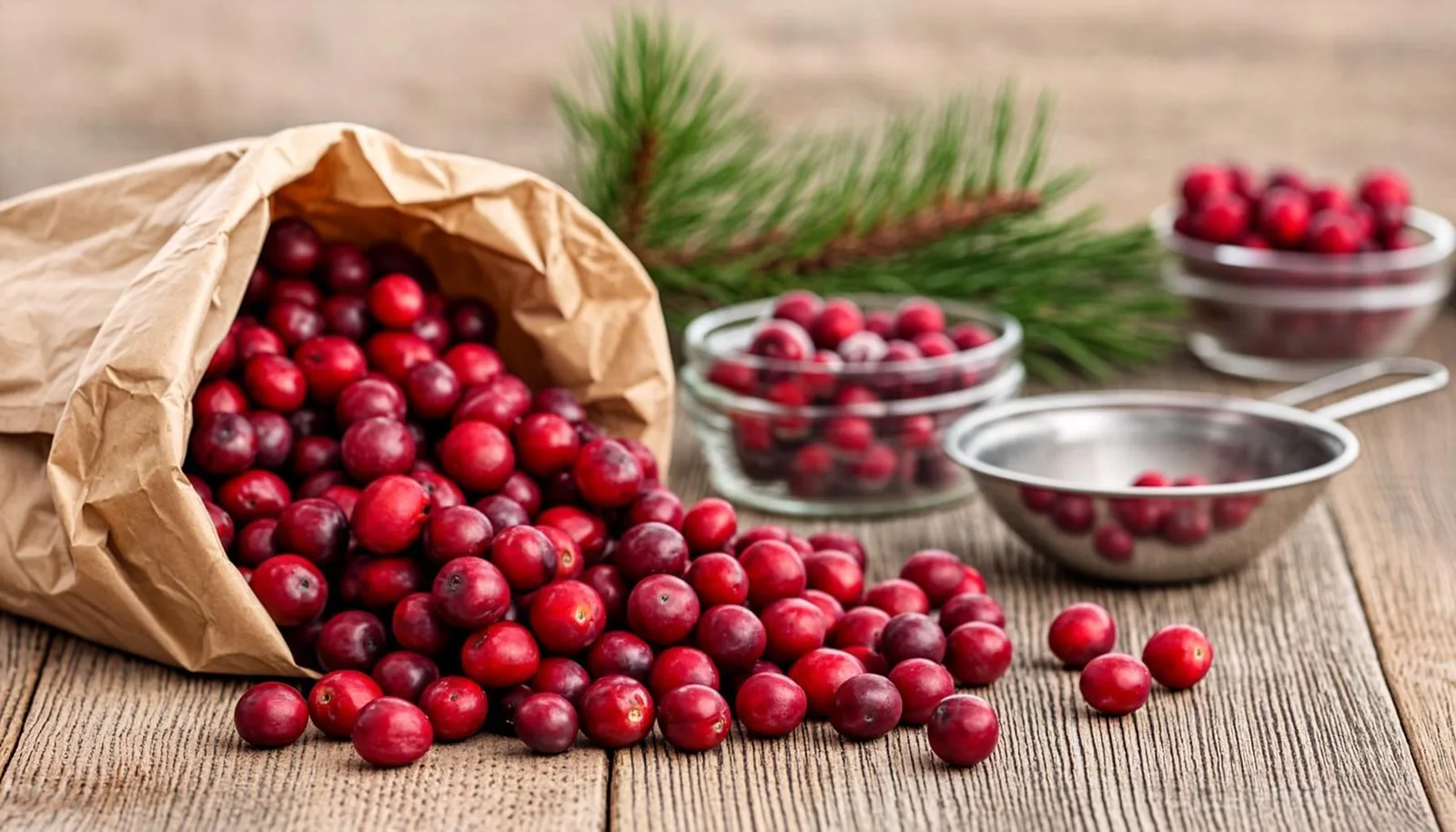
They arrive in October, bright red, and vanish from the shelves almost as fast. Yet cranberries are one of the easiest fruits to keep until the holidays, and even until the following fall: they freeze in their bag with no preparation at all, and go into recipes without thawing. They are also one of the most local foods on your holiday menu, since Quebec is by far the largest producer in Canada.
Here is where our cranberries come from, why the fields are flooded to harvest them, how to choose, store and freeze them, what to know about dried cranberries, and what the science really says about juice and urinary tract infections. To find them a place on the table, take a look at our traditional Quebec réveillon menu, dish by dish.
Quebec, a cranberry giant
In 2025, Quebec harvested 153,919 tonnes of cranberries, almost as much as in 2024, according to Statistics Canada. That is about 72% of Canadian production, grown on 5,505 hectares. Worldwide, the Quebec government ranks the province 2nd or 3rd depending on the year, behind two American states, Wisconsin and Massachusetts. For organic cranberries, Quebec is nothing less than the world's top producer, with 34 certified cranberry farms.
Production is highly concentrated: 78% of growers are in Centre-du-Québec, far ahead of Lanaudière (8%) and Saguenay–Lac-Saint-Jean (5%), according to the Quebec government. The fruit itself has always been from here. Native to North America, the cranberry belongs to the heath family (Ericaceae) and also grows wild in peat bogs and sandy soils, Aliments du Québec points out. Choosing Quebec cranberries is therefore an easy way to eat more locally over the holidays; you will find more ideas in our tips for eating more local food in Quebec.
Atoca or canneberge?
Both are correct in Quebec French. Usito, the Université de Sherbrooke dictionary, defines atoca as another name for the cranberry (canneberge), both the fruit and the shrub. It is a feature of Quebec and Canadian usage, attested since 1656 and of Iroquoian origin. The variant "ataca" is also heard. Whether you say atoca, canneberge or cranberry, you are talking about exactly the same little fruit.
No, cranberries do not grow in water
Myth: "Cranberries grow in water." False. Photos of flooded fields covered with a carpet of red berries keep the myth alive. Aliments du Québec states it plainly: contrary to what many people believe, cranberries do not grow in water. The cranberry is a low-growing perennial plant with trailing, vine-like shoots, cultivated in fields known in Quebec as cannebergières.
Water is rather a tool, used at three times of the year. First for the harvest, which happens once a year, between September and November: the fields are flooded one after another and the berries rise to the surface. They float because the centre of each cranberry contains small air pockets, Penn State Extension explains. Next, watering becomes more frequent in the fall to protect the berries from frost, since they cannot tolerate temperatures below -4°C. Finally, the fields are flooded again in winter to protect the crop against cold, drying winds.
This water is not wasted: once the harvest is over, it is pumped out to be reused, the Quebec government notes. It also points out that growers have greatly reduced their use of chemical fertilizers over about fifteen years. One fun detail to finish: according to Aliments du Québec, as they ripen, the berries turn from white to bright red, and their rising sugar and anthocyanin content makes them more resistant to cold.
Choosing and storing fresh cranberries
The peak season for Quebec cranberries is short: from the beginning to the end of October, according to the Aliments du Québec calendar. The rest of the year, availability varies. If you want local cranberries for the réveillon, your safest bet is to buy a few bags in October and freeze some of them.
At the store, look for bright red, firm, shiny berries with no spots or cracks: according to the Quebec growers' information sheet, those are the ones that keep the longest. Before cooking, remove soft, shrivelled or blemished berries along with the stems, then rinse the rest in cold water and drain well.
Myth: "A fresh cranberry bounces." True. Penn State Extension confirms it: a fresh cranberry bounces when you drop it. Small air-filled chambers inside the fruit make it bounce and float. Kids love the test, and it helps you spot the freshest berries before cooking.
In the fridge: from two weeks to three months, depending on the source
Published storage times vary a lot. Penn State Extension says fresh cranberries usually keep for two weeks in the fridge, and up to four weeks in their original packaging in the crisper drawer; another of its pages goes up to a month for top-quality berries. The Quebec growers' information sheet goes much further: up to three months in the refrigerator, for berries sold in perforated bags or clamshells. Penn State notes that quality declines gradually, with more and more soft or bruised berries.
In practice, keep the bag closed in the fridge and do a quick sort every week. If you do not plan to cook them within two or three weeks, do not take chances: put them in the freezer right away. It is the best anti-waste habit there is, and it takes ten seconds. For more habits like this, read our guide to avoiding food waste at home.
Freezing: local cranberries until next fall
Freezing is the best way to make the most of the short season. According to Penn State Extension, you can put bags of cranberries straight into the freezer, unwashed, for up to 12 months; that is in fact the method commercial companies recommend. The Quebec growers' information sheet also gives one year in the freezer.
Prefer to sort them first? It is a good idea if the bag contains damaged berries, stems or leaves. Remove them, wash the cranberries, drain them, then dry them very well, for example by rolling them gently on a towel: water left on the skin makes the berries blister in the freezer. Then pack them in containers, leaving 1 cm (½ inch) of headspace, or freeze them spread out on a tray first before transferring them to bags.
Myth: "Cranberries must be thawed before cooking." False. Penn State specifies that it is not necessary, even for baking: just rinse them in cold water and use them as they are. Quebec growers go further and advise cooking them while still frozen.
From the freezer to the holiday table
With a bag in the freezer, you have everything you need for a homemade cranberry sauce in 15 minutes, straight from frozen berries. It can be made ahead and goes perfectly with a roast turkey, a pork roast or local cheeses. For a colourful vegetarian dish, our squash stuffed with wild rice and cranberries works with dried cranberries as well as fresh or frozen ones, coarsely chopped. And if you want to spread out the work, our make-ahead holiday dishes calendar helps you plan everything.
On the zero-waste side, the rule is simple: buy in October what you expect to use during the year, freeze it within the following days and help yourself as needed. A half-used bag still lingering in September? Now is the time to cook it, before the new harvest arrives.
Dried cranberries: handy, but read the label
Commercial dried cranberries are not just dehydrated fruit. Penn State Extension points out that they are sweetened, and chewier than the ones you dry at home. The Aliments du Québec nutrition table shows the difference clearly: 60 ml (¼ cup) of dried cranberries provides 25.3 g of carbohydrates, compared with 6 g for 125 ml (½ cup) of fresh cranberries. For a serving half the size, that is more than four times the carbohydrates.
No need to ban them, though: a few dried cranberries in a stuffing, a salad or cookies are still a nice addition. But read the label before buying. The ingredient list tells you whether sugar has been added, and the Nutrition Facts table how much sugar a serving contains. It takes thirty seconds and helps you compare products.
In the kitchen, Penn State gives two useful rules. To replace fresh cranberries with dried ones in baking, use a quarter less. And do not try to make a sauce with them: they do not have the pectin needed for it to set. As for storage, the Quebec growers' information sheet gives up to 12 months in an airtight container, at room temperature or in the freezer.
Cranberry juice and urinary tract infections: preventing is not curing
Myth: "Cranberry juice cures a urinary tract infection." False. This is probably the most widespread belief about cranberries, and it mixes up two things. The reference on the subject, a Cochrane review updated in 2023, analyzed 50 trials involving 8,857 participants. It looks only at prevention: trials on treating an existing infection were excluded. Even the Quebec growers' information sheet makes the distinction: juice may help prevent urinary tract infections, not cure them.
For prevention, the results are encouraging, but not for everyone. Overall, cranberry products (juice, tablets or capsules) reduce the risk of symptomatic urinary tract infection, confirmed by a urine culture, by about 30%. The benefit is seen in women with recurrent infections, in children and in people made more vulnerable by certain medical procedures. The data show no effect, however, in older people living in care facilities, in pregnant women or in people who have trouble emptying their bladder.
Several questions remain open. We do not know whether juice works better or worse than tablets, there is no standard dose of proanthocyanidins (the compounds studied), and their content is often missing from the packaging. The authors call for more well-designed trials. In short, a glass of juice is no substitute for a consultation: if you think you have a urinary tract infection, talk to a health professional or call Info-Santé 811.
Free gift: get The Quebec Recipe Advent Calendar, 24 recipes ready in 30 minutes or less with local ingredients, one a day until Christmas Eve. The same page gathers all our holiday recipes and guides.
Sources
- Area, production and farm gate value of marketed fruits (table 32-10-0364-01), Statistics Canada, 2026.
- Culture de la canneberge (cranberry growing in Quebec; in French), Gouvernement du Québec, 2026.
- Canneberge (cranberry product page; in French), Aliments du Québec / Mangez Québec, 2026.
- Canneberge du Québec (cranberry information sheet; in French), Association des producteurs de canneberges du Québec, 2020.
- Atoca (dictionary entry; in French), Usito, Université de Sherbrooke.
- Preserving Cranberries, Martha Zepp, Penn State Extension, 2023.
- Cranberry Season, Stacy Reed and Martha Zepp, Penn State Extension, 2024.
- Cranberries for preventing urinary tract infections, G. Williams, D. Hahn, J. H. Stephens, J. C. Craig and E. M. Hodson, Cochrane Database of Systematic Reviews, 2023.
Frequently asked questions
Do cranberries grow in water?
No. The cranberry is a low-growing perennial plant grown in fields, and it also grows wild in peat bogs and sandy soils. The fields are flooded in the fall for the harvest, because the berries float, then again in winter to protect the crop from the cold.
Do frozen cranberries need to be thawed before cooking?
No. According to Penn State Extension, just rinse them in cold water and use them frozen, even in baked goods. The Quebec growers' information sheet even advises cooking them while still frozen.
How long do cranberries keep in the freezer?
About a year. Penn State Extension says you can freeze the bags as they are, unwashed, for up to 12 months, and the Quebec growers' information sheet also gives one year.
Does cranberry juice cure a urinary tract infection?
No. The 2023 Cochrane review looks only at prevention. Cranberry products reduce the risk in certain groups, such as women with recurrent infections and children, but not in everyone. If you have symptoms, see a health professional or call Info-Santé 811.
What is an "atoca"?
A cranberry. According to the Usito dictionary, atoca is another name for the cranberry (canneberge in French), typical of Quebec and Canadian usage. The word has been attested since 1656 and comes from Iroquoian.