Family zero-waste challenge: getting the kids on board with the fridge chart
Écodici's 30-day zero-waste challenge fits on a 30-box grid that you stick on the fridge, a ready-made format for getting the whole household on board. Here is how to give each child steps that suit their age, turn the garbage inventory into a game and get through the month without guilt, with guidance from Naître et grandir and RECYC-QUÉBEC.
This week, from October 15 to 21, 2026, is Quebec Waste Reduction Week (Semaine québécoise de réduction des déchets, or SQRD), coordinated by Zéro Déchet Québec under the theme "Je réduis, donc je suis" (I reduce, therefore I am). Our article on 7 habits for cutting waste without breaking the bank covers the week. To keep the momentum going for more than a week, there is the 30-day zero-waste challenge: one small step a day for a month.
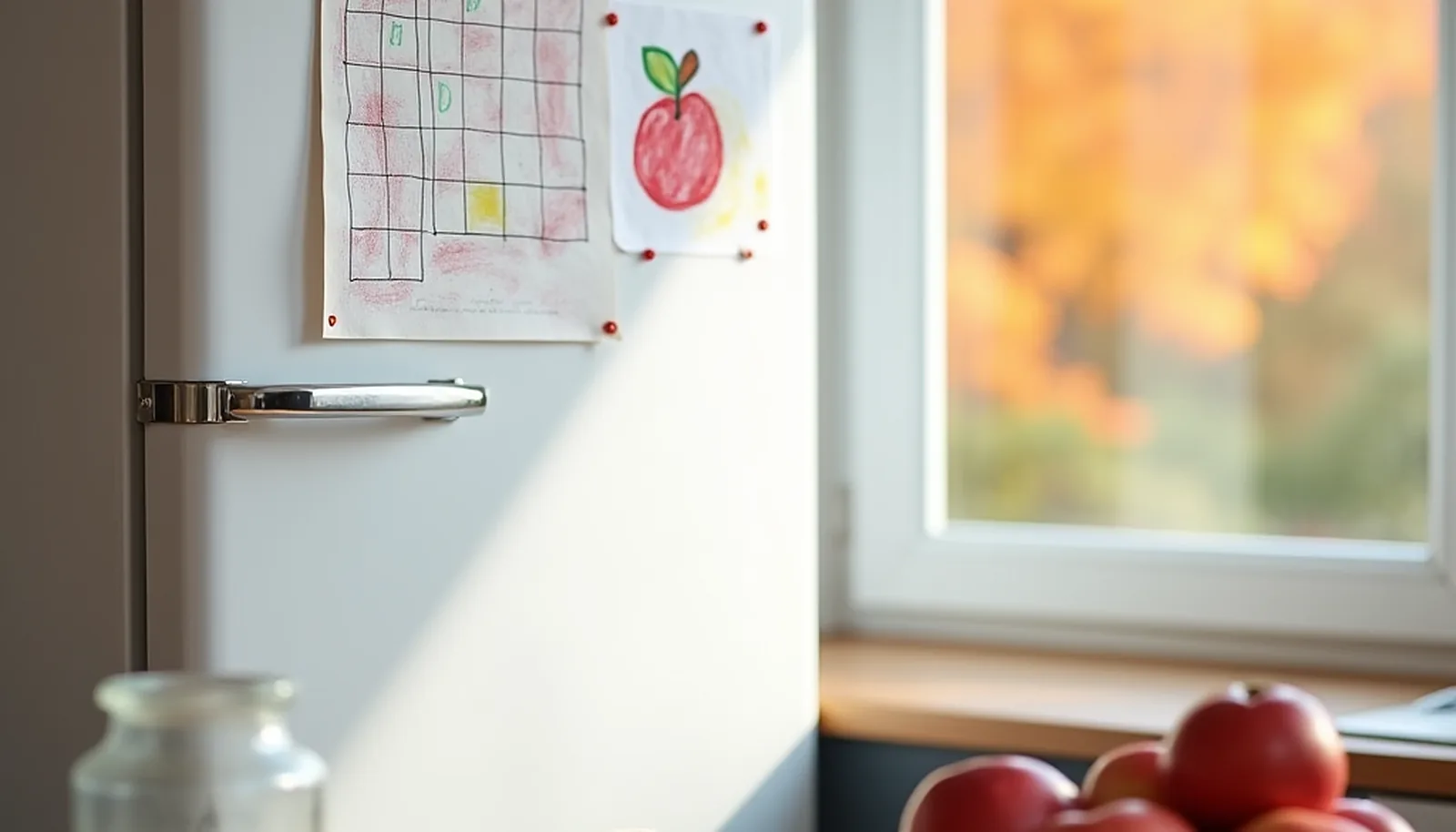
The challenge PDF suggests sticking its grid on the fridge, with a simple instruction: "Embarque la maisonnée" (get the whole household on board). Good idea: Naître et grandir recommends displaying a motivation chart somewhere easy for the child to reach, such as the refrigerator. Here is how to turn the challenge into a team project, from ages 3 to 18, without making anyone feel guilty.
What the PDF contains, and the page that goes on the fridge
The challenge has four weeks, each with its own theme: "observe and get started", "the kitchen", "the bathroom and cleaning" and "consume differently". Days 29 and 30 are for the review. The free 10-page PDF (in French) gives a tip for each step and three tools that lend themselves well to a family game.
- The 30-day grid (page 4): six rows of five boxes, each with its day number, a keyword ("Vrac" for bulk, "Réparer" for repair) and a box to check. Each theme has its own colour: green for observing, burnt orange for the kitchen, blue for the bathroom, purple for consuming differently and dark green for the review. Handy with a child who cannot read yet: the blue week is the bathroom week.
- The garbage inventory (page 3): seven categories to fill in on day 1, then on day 29.
- The review page (page 9): the three steps you keep, the easiest one, the one to try again later and the person you share them with.
The rules seem written for a family: you start whenever you want, the order is up to you, a missed day does not cancel the others, and you finish a product before replacing it. And since the boxes can also be checked off on screen, you can print just the grid and the inventory, and keep the rest on the tablet.
Who does what: roles by age
There is no question of handing all 30 steps to a four-year-old. For a motivation chart, Naître et grandir recommends targeting no more than two or three behaviours at a time between ages 3 and 6, and up to four or five for older children. If a child succeeds less than four times out of five, the bar is too high and they may get discouraged. The simplest approach: every Sunday, suggest three or four steps for the coming week and let each child pick their own, as the organization suggests for household chores.
| Age | What they can do, according to the sources | Their steps on the grid |
|---|---|---|
| 3 to 4 | Help put away groceries; measure dry ingredients, pour them into a bowl and mix; cut fruits and vegetables with a round knife that has no sharp blade | Unpack the reusable bags (day 2), pour bulk food into jars (day 8), help with the clean-out-the-fridge meal (day 9) |
| 5 to 6 | On their own: set the table, fold clean towels, water the plants | Check off the day's box, choose the "ugly" fruit (day 14), fold the rags (day 19) |
| 7 and up | Put items in the grocery cart, carry light bags, help with meals, prepare their lunch for the next day, take out the garbage | Keep the inventory (days 1 and 29), remember the bags (day 2), make their lunch (day 13), choose at the market (day 28) |
| 12 to 18 | According to the zero-waste guide made for and by teens, distributed by RECYC-QUÉBEC: a waste-free lunch, a "no thanks" to useless plastic items, bar soap and shampoo, a bamboo toothbrush, washable makeup remover pads | The lunch (day 13), the bathroom steps (days 15, 16, 17 and 21) and turning down promotional items (day 26) |
These ages are guidelines, not tests: children learn at their own pace, Naître et grandir reminds us, and a chart should not demand what a child is not yet able to do. Anything involving a credit card, an email inbox or cleaning products remains mostly a job for adults.
Week by week: what kids can lead
Week 1, observe (green). A child can become the keeper of the bags: before every grocery run, they check that the bags are in the car (day 2). They can put the "No flyers" sticker on the mailbox (day 4) and take charge of the food scraps container (day 5), once you have checked together what your city accepts in the brown bin. Unsubscribing from the day 7 newsletters falls to the adults, or to a teen who has their own email address.
Week 2, the kitchen (orange). At the bulk counter (day 8), the child brings the container that gets weighed empty at the checkout: that is the tare. For the clean-out-the-fridge meal (day 9), they pick from the PDF's ideas: omelette, soup, fried rice, homemade pizza or pasta. They look after the bag of peels in the freezer for the broth (day 12) and pack their lunch in reusable containers (day 13), with no need to buy a new lunch box: our article on replacing plastic containers without throwing everything out tells you what to change first.
Week 3, the bathroom and cleaning (blue). Teens can lead the bathroom steps, which the guide for 12- to 18-year-olds recommends. Younger kids choose their soap (day 15) and fold the rags cut from old T-shirts (day 19). The rule applies to everyone: the bamboo toothbrush arrives when the old one is worn out, not before. The vinegar and citrus peel cleaner (day 18) remains a job for adults: the PDF reminds you never to mix vinegar and bleach, because the mixture gives off a toxic gas. The child saves the peels; the adult does the rest.
Week 4, consume differently (purple). Repairing a toy together (day 22), choosing three items to give away (day 25), saying "no thanks" to the plastic toy that comes with a meal (day 26): let the child decide what they give away or turn down. And since the order is up to you, nothing stops you from moving day 24, buying used, up to Halloween: a thrift-store costume or one swapped between families, as our article on waste from holidays and celebrations suggests.
The garbage inventory, game version
The PDF's principle: for one day, you note what you throw out, one tally mark per item, in seven categories (plastic packaging; bottles, jars and containers; paper and cardboard; table scraps and wasted food; disposables; personal care and cleaning products; clothes, broken items and other). No need to weigh anything: counting is enough. To turn it into a game:
- Appoint a clerk. They post the sheet near the garbage can. Every time someone throws something out, they call out the category and the clerk draws a tally mark. Nobody digs through the bag: you count as you throw.
- Draw symbols (a bottle, an apple, a T-shirt) next to the categories for those who cannot read yet.
- Place your bets. In the morning, everyone guesses which line will overflow; in the evening, you compare.
- Settle doubts with the "Ça va où?" app, which RECYC-QUÉBEC recommends to young people for learning to sort properly. Our article on the single list for the recycling bin and our golden rules of recycling round out the exercise.
The category that overflows the most becomes your priority, the PDF says: lots of table scraps, focus on week 2; lots of disposables, on week 3. If the bottles line fills up quickly, check which ones carry a deposit with our article on the expanded deposit-return system.
On day 29, you repeat the exercise in the next column. Start with the category that dropped the most, then let everyone fill in the "What surprised me" box. At the end of a motivation chart, Naître et grandir advises inviting the child to assess themselves and say whether they are proud of what they accomplished. A line that went up? That is information, not failure. The tally marks of day 29 tell you what really changed, not the new water bottle bought to ease your conscience.
Staying motivated without the guilt
The fridge grid is a team project: you check the box when the step is done, no matter who did it. For an individual reward chart, Naître et grandir recommends one chart per child, with goals suited to their age; otherwise, siblings may see it as unfair. An older child may also prefer a private chart in their room: the on-screen version of the PDF then does the job. Other principles from the organization apply well to the challenge.
- Praise right away. Up to about age 7, reinforcement should come the same day. Tell them why they get to check the box: "You thought of the bags before I even asked. Well done, go ahead and check it!"
- Choose waste-free rewards. A reward does not need to be material, and quality family time is often children's favourite: a board game night, choosing the menu for a supper, a cushion fort. That is the experience gift of day 27, applied at home. Avoid bargaining where every step earns an object: the child may then behave well only in front of the person handing out the rewards.
- No punishment, no reproach. If a child forgets or refuses, look for what is wrong (tiredness, hunger, a step that is too hard) and value the effort, even when the result is not perfect. The challenge says it in its own way: a missed day does not cancel the others.
- Switch roles halfway. Naître et grandir suggests changing tasks every two weeks or every month. On day 15, the keeper of the bags becomes the person in charge of the rags.
- Plan the exit. A motivation chart remains temporary support; afterwards, praise gradually replaces the stickers. That is what day 30 is for: everyone chooses the step they will keep and writes it on the review page. As the PDF puts it, three steps kept are worth more than thirty tried only once.
Also keep the focus on action: the challenge is about bags and lunches, not disasters. For heavier questions about the climate, our guide to teaching kids about ecology without worrying them offers age-by-age pointers.
At school: resources from the SQRD and RECYC-QUÉBEC
The SQRD offers two resources designed for schools, and RECYC-QUÉBEC a section for young people. All three are in French.
- The Fiches Z, which can be downloaded from the SQRD website, help teachers lead class discussions on reducing waste at the source. They cover four themes (repair, source reduction, clothing and overpackaging), adapted from preschool to the second cycle of secondary school, with background, inspiring initiatives and interactive activities. Pass them on to your child's teacher: they extend week 4 of the challenge.
- The Bourse Michel Séguin, a $1,000 bursary, rewards each year the Quebec elementary or secondary school that stood out most with a source reduction project already carried out. For the 2026 edition, the deadline is December 4: the school sends a letter of about 500 words and 3 to 10 photos to info@sqrd.org. An idea to pass on to the parents' committee: Guy-Drummond school won it in 2024 with a Halloween costume swap.
- RECYC-QUÉBEC's Zone jeunesse (youth zone) speaks to young people (the 3RV, tips, reading) and has a corner for teachers and parents, with teaching tools, activities and quizzes. That is where you will find the zero-waste guide for 12- to 18-year-olds, written by members of the Conseil national des jeunes ministres de l'environnement 2020-2021, a council of young environment ministers, with support from the Fondation Monique-Fitz-Back.
To explain at home why you reduce before you recycle, our article on the 3RV-E waste hierarchy presents each level with concrete examples.
Sources
- Semaine québécoise de réduction des déchets : Réduire, c'est agir (Quebec Waste Reduction Week; in French), Zéro Déchet Québec (SQRD), 2026 (consulted in October 2026).
- Fiches Z : fiches pédagogiques pour les écoles (teaching sheets for schools; in French), Zéro Déchet Québec (SQRD), 2025 (consulted in October 2026).
- Bourse Michel Séguin (Michel Séguin bursary; in French), Zéro Déchet Québec (SQRD), 2026 (consulted in October 2026).
- Le tableau de motivation (motivation charts; in French), Naître et grandir, scientific review by Benoît Hammarrenger, neuropsychologist, updated June 2023 (consulted in October 2026).
- Faire participer les enfants aux tâches ménagères (getting young children to help with chores; in French), Naître et grandir, scientific review by Solène Bourque, psychoeducator, updated February 2026 (consulted in October 2026).
- What household tasks should be entrusted to a child?, Naître et grandir, scientific review by Solène Bourque, psychoeducator, updated December 2021 (consulted in October 2026).
- Zone jeunesse (youth zone; in French), RECYC-QUÉBEC, updated December 2, 2025 (consulted in October 2026).
- Le zéro déchet : un guide fait pour et par les adolescents (zero waste: a guide for and by teenagers; in French), Conseil national des jeunes ministres de l'environnement 2020-2021 and Fondation Monique-Fitz-Back, distributed by RECYC-QUÉBEC, 2021 (consulted in October 2026).
Frequently asked questions
From what age can a child take part in the zero-waste challenge?
From age 3 or 4, with a parent's help. According to Naître et grandir, that is when a motivation chart starts to be useful, the optimal age being 5 to 8. A 3- or 4-year-old can already help put away groceries or pour ingredients into a bowl. Between ages 3 and 6, aim for two or three steps at a time at most.
Should you reward children who do the challenge steps?
It is not required. Naître et grandir points out that positive attention may be enough and that a reward does not need to be material: quality family time is often children's favourite. The organization also advises against paying a child for routine household chores.
What if a child no longer wants to take part?
First look for what is wrong, such as tiredness, hunger or a step that is too hard, and avoid punishment, Naître et grandir advises. Let them choose among three or four steps, switch roles, and remember the challenge rules: a missed day does not cancel the others, and the order is up to you.
How do you take inventory of the garbage with kids without digging through the trash?
You count when you throw things out, not afterwards. For one day, each item thrown out gets a tally mark in one of the seven categories of the PDF's table, with no weighing. A child keeps the sheet by the garbage can, and RECYC-QUÉBEC's "Ça va où?" app helps settle it when you are not sure which bin an item goes in.
Do you need to print the whole challenge PDF?
No. The free 10-page PDF (in French) can be downloaded from the challenge page, and its boxes can also be checked off on screen. To save paper, print only the 30-day grid (page 4) for the fridge and the garbage inventory table (page 3).