Highbush cranberry or guelder rose: how to tell them apart
Same three-lobed leaves, same clusters of red fruit that hang on all winter: our native highbush cranberry, the pimbina, has a European twin that is often planted, the guelder rose. A tiny detail on the leaf stalk tells them apart, as long as you know where the sources contradict each other. Here is how to do it, and what we know about eating each one.
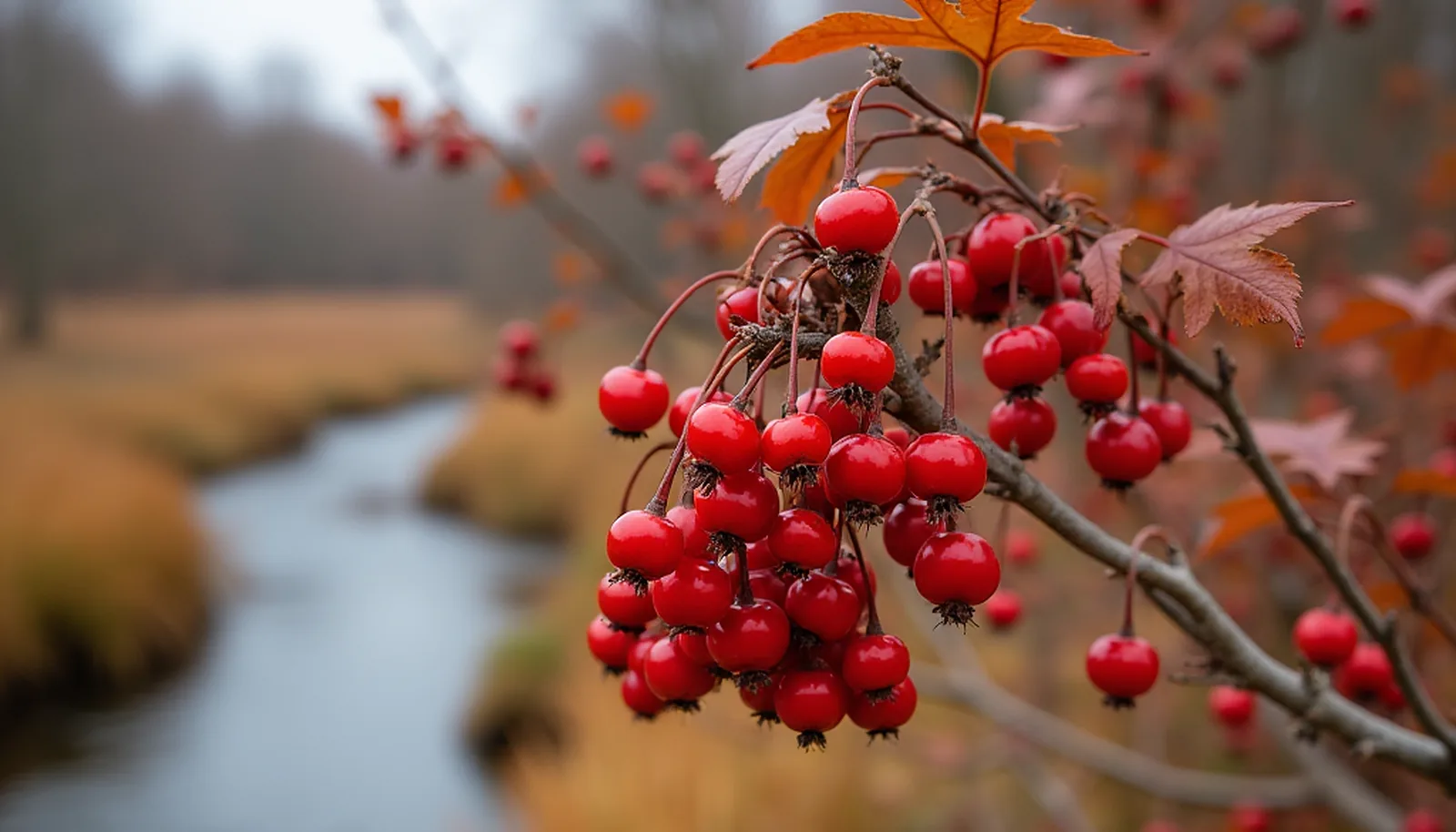
In October, along a stream or in a park hedge, two nearly identical shrubs carry the same clusters of red fruit, under the same three-lobed leaves that look like maple leaves. The first, the highbush cranberry, which Quebecers call pimbina, is native: its tart fruit makes jellies and sauces. The second, the guelder rose, comes from Europe: it is planted as an ornamental, and its fruit has a reputation for being bitter.
Since the guelder rose escapes from gardens and now grows across almost the entire range of the highbush cranberry, it pays to know how to tell them apart before you fill your basket. Here is the feature botanical guides rely on, the clues that back it up, and what the sources say about eating each one. For picking and preparation, our main guide to mountain ash and highbush cranberry, harvested after the frost takes over.
One native, one European, and confusing names
Botanists do not agree on the rank of these two plants. The Database of Vascular Plants of Canada (VASCAN) puts them in a single species, Viburnum opulus: the highbush cranberry is Viburnum opulus var. americanum, with Viburnum trilobum and V. opulus subsp. trilobum as synonyms; the guelder rose is V. opulus var. opulus. In 2025, David Tork and his colleagues at the University of Minnesota analyzed the DNA of nearly 1,000 plants: the two are genetically distinct, and the authors propose giving the highbush cranberry back its species rank.
Their status, on the other hand, is clear. According to VASCAN, the highbush cranberry is native to Quebec, as it is in every province; in French, it is called viorne trilobée, pimbina or viorne pimbina. The guelder rose, native to Europe and to parts of Asia and North Africa, is listed as introduced in Quebec. It arrived in North America as a landscape plant, and it was birds and mammals that got it out of the gardens, by spreading the seeds of its fruit. The 2025 study reports more than 3,200 records of naturalized populations, which overlap almost entirely with the range of the highbush cranberry in North America.
In French, the European shrub is the viorne obier. Despite its English name, the highbush cranberry is not a cranberry, the University of Maine points out: viburnums do not belong to the same family as Vaccinium. Its fruit does taste a bit like cranberry, though, according to the 2025 study.
The best feature: the glands at the top of the leaf stalk
All the botanical guides consulted, including Go Botany, the online flora of New England's Native Plant Trust, rely on the same detail: the small glands on the leaf stalk (petiole), where it meets the leaf blade. The University of Maine warns right away that it is not easy. These glands are nectaries, nectar-producing glands located outside the flowers, and a pocket magnifier helps a lot to see their shape.
- Highbush cranberry: raised glands, shaped like a dome, a club or a small column, taller than wide, sometimes carried on a short stalk (University of Maine, Go Botany, Tork et al.).
- Guelder rose: glands hollowed into a small cup, usually wider than tall and without a stalk (same sources). The CliniTox database at the University of Zurich also describes cup-shaped nectar glands on the guelder rose.
In practice, a clear cup with a rim, wider than tall, points to the guelder rose, and a small dome- or club-shaped gland, taller than wide, to the highbush cranberry. But on three points, the sources do not say the same thing:
- The flat top. The University of Maine puts glands that are flat on top on the guelder rose side, while Go Botany accepts a truncate, meaning flat, top on the highbush cranberry, and Minnesota Wildflowers describes its glands as flat or rounded at the tip, with no distinct rim. A flat gland settles nothing.
- The stalk. Go Botany treats the stalk as a highbush cranberry trait, Tork and his colleagues say it is only occasional in that plant, and the plant guide of the United States Department of Agriculture (USDA) reports, on the contrary, that the guelder rose's glands are mostly carried on a short stalk, with a rounded to concave top. A stalk, on its own, proves nothing.
- How reliable the feature is. According to the 2025 study, the value of gland shape for identifying these viburnums has been questioned because of their variation.
The numbers from that study show how easy it is to get it wrong. Among the plants analyzed, which came from the wild, botanical gardens, nurseries and herbaria, 119 had been misidentified when collected, compared with 710 correctly identified, and 10% of the guelder roses had been taken for highbush cranberries. Our method: examine five or six leaves on different branches. If most of them do not clearly show a cup or a dome, you have no answer, and when in doubt, you don't pick.
Leaves, fruit, taste: clues, not proof
The rest of the plant mostly helps you confirm that you are dealing with one of these two viburnums, not choose between them.
- The leaves are opposite and simple (University of Maine), with three lobes that look like a maple leaf on both shrubs (Tork et al.). The blade is 5 to 12 cm long (Go Botany).
- The flowers and fruit look alike too: on both, a ring of large sterile flowers surrounds the flower cluster, and the fruit ripens in bright red clusters (Tork et al.). This single-seeded fruit (University of Maine) often stays on the shrub all winter (Go Botany). The guides do not use it to separate the two viburnums. In winter, guelder rose fruit shrivels like red raisins, according to a 2020 scientific review of the species (Kajszczak et al.).
- The snowball bush, a guelder rose cultivar called 'Roseum', bears only sterile flowers (Kajszczak et al.): its big white balls will not produce fruit.
- The location. The highbush cranberry grows naturally in wet woods, along streams and on moist wooded hillsides (USDA). A shrub planted in a park, a hedge or a flower bed deserves more suspicion: the University of Maine warns that a nursery can mistakenly sell a European cultivar.
- Other viburnums. Squashberry (Viburnum edule) lacks the ring of large sterile flowers, and its leaves have no stipules; maple-leaved viburnum (V. acerifolium) has dark blue to dark purple fruit (Go Botany).
What about taste?
It is the feature everyone mentions. The highbush cranberry has a tart taste reminiscent of cranberry (University of Maine, Tork et al.). The guelder rose is described as bitter, even inedible (University of Maine, USDA), astringent and with a strong, unpleasant smell (Kajszczak et al.). But tasting means putting in your mouth the fruit of a shrub you are not yet sure about. So taste is no way to decide: Germany's BfR classifies the guelder rose as slightly toxic, mainly for its fruit. Rely on the leaves and glands and, when in doubt, don't pick.
Edibility: what the sources say about each one
Highbush cranberry: edible, mostly cooked
The guides consulted agree: the fruit is edible. According to the University of Maine, you can eat it raw, but it is not very tasty that way; it is usually cooked into preserves, jellies and sauces that go well with meat and game. The USDA guide adds juices. Foragers and small producers still harvest it from the wild (Tork et al.).
On when to pick, opinions vary. The USDA finds the fruit best picked slightly underripe, while still sour, and Go Botany says slightly unripe berries make good jellies. But the USDA also notes that after a heavy frost, the fruit is softer and more palatable, and the University of Maine combines the two: best after a frost, picked slightly underripe. Our main guide sums it up: according to Manitoba Agriculture, the fruit is lower in pectin after a frost, and for jelly, it advises picking it slightly before it is ripe.
At Écodici, we always eat it cooked, as a jelly, a syrup or in our sweet and sour sauce for game, and only when the identification is certain. A reassuring detail: according to the 2025 study, worries about hybrids with the guelder rose have created confusion about the edibility of the highbush cranberry itself, yet those hybrids turned out to be rare, 8 out of nearly 1,000 plants analyzed.
Guelder rose: bitter, and sources that disagree
In North America, the sources keep it out of the kitchen: inedible or bitter for the University of Maine, bitter for the USDA, which adds that its cultivars are grown strictly as ornamentals, and more bitter than the highbush cranberry, so of little culinary interest, for Tork and his colleagues. Elsewhere, though, people eat it. According to the 2020 review, in Russia and Ukraine its fruit goes into marmalades, jams, liqueurs and pies, and in Turkey it is used to make gilaburu, a commercially sold drink made by letting the fruit ferment in water for 3 to 5 months. In every case, the fruit is processed, not eaten raw.
On toxicity, the same disagreement. The CliniTox database of the Institute of Veterinary Pharmacology and Toxicology at the University of Zurich notes that the literature contradicts itself on these berries, described as anywhere from non-toxic to mildly toxic, and it lists unripe fruit, bark and leaves among the toxic parts. Germany's Federal Institute for Risk Assessment (BfR) classifies the guelder rose as slightly toxic, mainly for its fruit: eating several raw berries can cause digestive upset. The Lille Poison Centre in France considers viburnums of low toxicity: according to its guelder rose fact sheet, the red berries are probably not toxic and are edible once cooked, but green berries are laxative. None of the sources consulted gives a safe amount.
Our position: in Quebec, with the native highbush cranberry within reach, there is no reason to cook the guelder rose. Don't pick it for the table. If it grows on your property, you can gradually replace it with a highbush cranberry: several U.S. states already consider it invasive, because it can compete with and replace the native species (Tork et al.).
The comparison table
What settles the question, what helps, and what is useless, according to the sources consulted.
| Feature | Highbush cranberry | Guelder rose | Useful to decide? |
|---|---|---|---|
| Latin name | Viburnum opulus var. americanum (syn. V. trilobum) | Viburnum opulus var. opulus | No |
| Status in Quebec | Native | Introduced, escaped from gardens | No |
| Leaf-stalk glands | Dome-, club- or column-shaped, taller than wide, sometimes on a short stalk | Cup-shaped, wider than tall, stalkless according to most sources (short stalk according to the USDA) | Yes, the best feature, but variable; a flat gland settles nothing |
| Leaves | Opposite, three-lobed, like a maple leaf | Same | No |
| Fruit | Red, one seed, often stays on all winter | Same, shrivelled in winter | No |
| Taste | Tart, reminiscent of cranberry; not very tasty raw | Bitter, astringent, strong smell | No: do not taste to identify |
| Where you find it | Wet woods, stream banks | Parks, hedges, gardens, and escaped into the wild | Clue only |
| Edibility according to the sources | Edible, mostly cooked: jelly, sauce, juice | Considered bitter, even inedible, by North American sources; eaten processed in Russia, Ukraine and Turkey; slightly toxic according to the BfR, toxicity debated according to CliniTox | No |
| Cultivars mentioned | 'Wentworth', 'Andrews', 'Hahs' | 'Roseum' (snowball bush, no fruit) | If the label is reliable |
Picking or planting without making a mistake
- Confirm it is a viburnum from this group: opposite three-lobed leaves, clusters of red fruit with a single seed. Missing a feature? It is not a highbush cranberry. Our article on red fall berries not to confuse with rose hips covers the toxic look-alikes, such as bittersweet nightshade.
- Examine the glands of five or six leaves, with a magnifier, on different branches.
- Consider the location: a planted shrub, even one labelled "highbush cranberry," may be a guelder rose. An app such as PlantNet, Seek or iNaturalist, covered in our article on identifying plants with your phone, gives you a lead; it is up to you to check the glands.
- Do not taste to identify: taste settles nothing and means putting a doubtful fruit in your mouth.
- When in doubt, don't pick. And if someone, especially a child, has eaten fruit you cannot identify with certainty, call the Quebec Poison Control Centre (Centre antipoison du Québec) at 1 800 463-5060, even if there are no symptoms.
Pick like a good neighbour. Don't strip a shrub bare: in the fall, its fruit feeds birds, including ruffed grouse, and even black bears (Go Botany). Ask permission on private land, and stay away from busy roadsides. For the right time of year, check our foraging calendar.
In the garden, plant the right one
If you want fruit to cook, plant a highbush cranberry, for example 'Wentworth', 'Andrews' or 'Hahs', which the University of Maine names as examples of the American form, the better-tasting one. Still, check the glands on the nursery plant before you buy it. A highbush cranberry also belongs in a wildlife corner for birds and small animals, and if you are looking for other hardy small fruits, read our article on aronia and sea buckthorn.
Sources
- Viburnum opulus var. americanum Aiton (highbush cranberry, pimbina), Database of Vascular Plants of Canada (VASCAN), Canadensys, 2026.
- Viburnum opulus var. opulus (guelder-rose), Database of Vascular Plants of Canada (VASCAN), Canadensys, 2026.
- Viburnum opulus (highbush-cranberry), subspecies trilobum and opulus, Go Botany, Native Plant Trust.
- Viburnum opulus var. americanum (American Highbush Cranberry), with a comparison with guelder rose, Minnesota Wildflowers.
- Highbush Cranberry (not a true cranberry), Cooperative Extension, University of Maine, updated 2026.
- Plant Guide: Highbush Cranberry, Viburnum opulus var. americanum, G. Nesom, Natural Resources Conservation Service, United States Department of Agriculture (USDA), 2001.
- Highbush Cranberry Production in Manitoba (harvest, pectin), Manitoba Agriculture.
- American highbush cranberry maintains strong population structure despite naturalization of Eurasian relatives in North America, D. G. Tork, N. O. Anderson, A. Brusa and A. G. Smith, American Journal of Botany, 2025.
- Viburnum opulus L.—A Review of Phytochemistry and Biological Effects, D. Kajszczak, M. Zakłos-Szyda and A. Podsędek, Nutrients, 2020.
- Arznei- und Giftpflanzen: Viburnum opulus (in German), CliniTox, Institute of Veterinary Pharmacology and Toxicology, University of Zurich.
- Risiko Pflanze – Einschätzung und Hinweise (guelder rose; in German), Bundesinstitut für Risikobewertung (BfR, German Federal Institute for Risk Assessment), 2017.
- Viorne obier: plante à baies toxique (guelder rose; in French), Centre antipoison de Lille (Lille Poison Centre), CHU de Lille, 2021.
Frequently asked questions
How can I tell whether my viburnum is a highbush cranberry or a guelder rose?
Use a magnifier to look at the small glands at the top of the leaf stalk, just below the leaf, on five or six leaves from different branches. Dome- or club-shaped and taller than wide: highbush cranberry. Hollowed like a cup and wider than tall: guelder rose. If the glands are flat or the leaves do not agree, the sources do not let you decide: when in doubt, don't pick.
Are guelder rose berries poisonous?
Sources disagree. The CliniTox database at the University of Zurich notes that the literature describes them as anywhere from non-toxic to mildly toxic, and it lists unripe fruit among the toxic parts. Germany's BfR classifies the guelder rose as slightly toxic, mainly for its fruit: several raw berries can cause digestive upset. They are also very bitter. If someone has eaten some and you have doubts, call the Quebec Poison Control Centre at 1 800 463-5060.
Can you eat highbush cranberries raw?
According to the University of Maine, yes, but they are not very tasty that way: tart, they are mostly enjoyed cooked, in jelly or sauce. None of the sources consulted gives a safe amount, though, and a guelder rose, which is slightly toxic, can pass for a highbush cranberry. At Écodici, we always eat them cooked, and only when the identification is certain.
Do highbush cranberry and guelder rose hybridize?
The University of Maine says they do. But a genetic study published in 2025, covering nearly 1,000 plants, found only 8 hybrids between the two, 6 of them in North America, and concludes that the highbush cranberry remains genetically isolated. Hybrids exist, but they seem rare.
Which viburnum should I plant to harvest fruit?
The highbush cranberry, native to Quebec. The University of Maine names the cultivars 'Wentworth', 'Andrews' and 'Hahs' as examples of the American form, the better-tasting one. Before buying, check the leaf-stalk glands on the plant: a nursery can mistakenly sell a guelder rose as a highbush cranberry.