Make-ahead holiday dishes for the freezer: the December calendar
Tourtières, meatballs, pie crust and cookies can spend a few weeks in the freezer before the réveillon. Here is a week-by-week calendar, the recommended freezer times and the rules for thawing and reheating safely.
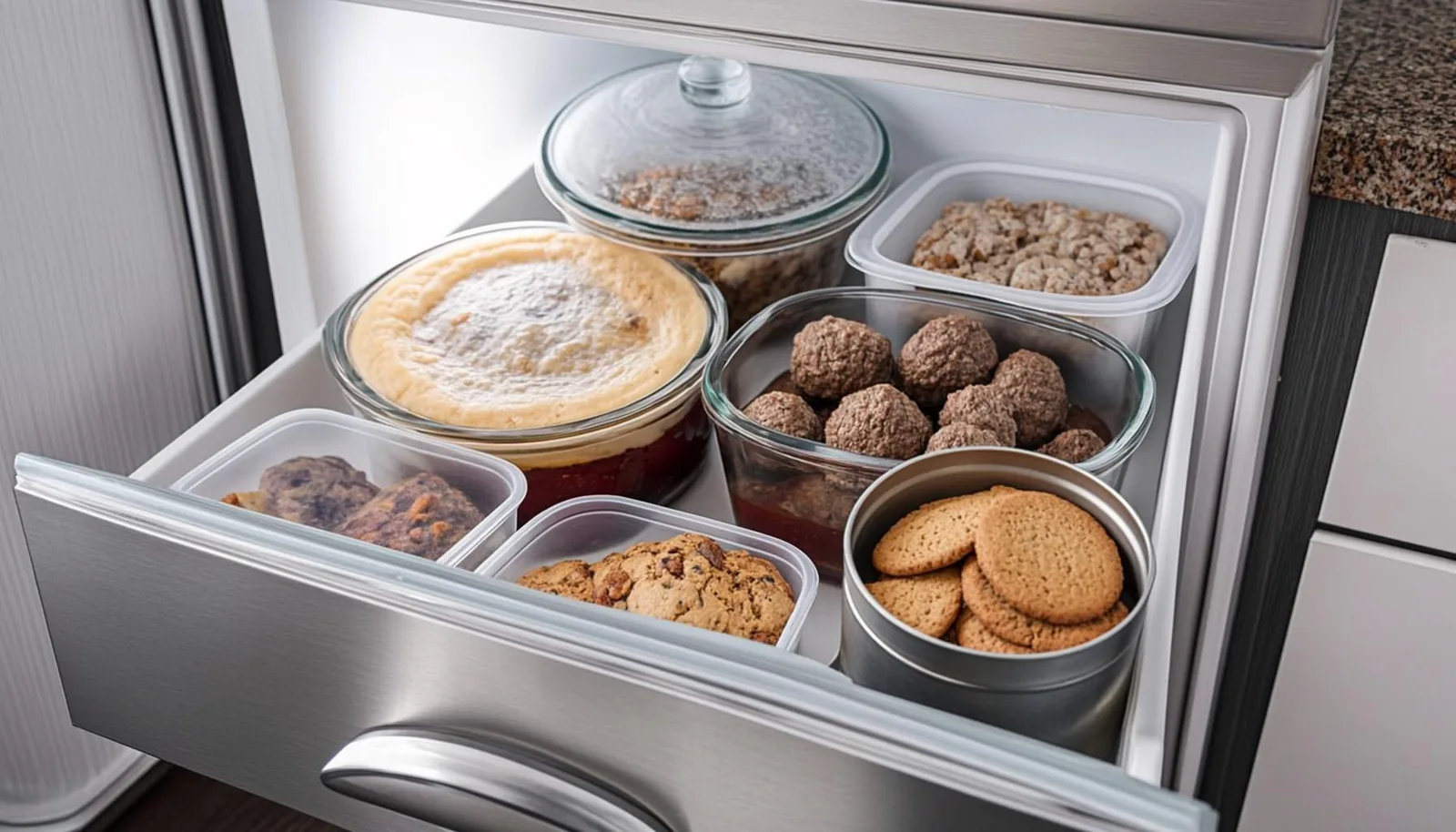
At 5 p.m. on December 24, nobody feels like rolling out pastry. Good news: a big part of the réveillon, the Christmas Eve dinner, can be cooked weeks ahead. Tourtières, meatballs, pie crust, cookie dough, doughnuts and sucre à la crème all keep well in the freezer. On the day itself, all that is left is to reheat, roast the turkey and set the table.
You still need to know what to do and when, how long each dish keeps and how to bring it back to the table safely. Here is a calendar based on Health Canada, the Quebec government, the U.S. Department of Agriculture (USDA) and university extension services. For the full menu, see our traditional Quebec holiday recipes, dish by dish, and to avoid cooking for an army, our guidelines on quantities per guest.
The calendar, from late November to the réveillon
The steps are planned for a meal on the evening of the 24th: shift them if your big dinner is on the 25th or the 31st. The storage times are detailed and sourced in the next section.
| When | What to do | Guidelines |
|---|---|---|
| 3 to 4 weeks before (late November) | Make the pie crust and freeze it. Assemble the tourtières, meat or vegetarian. Cook the meatball stew, without potatoes. Freeze the dough for the ginger molasses cookies, or the baked cookies. | Unbaked pie crust: 6 to 8 weeks. Unbaked tourtière: 4 to 6 months; baked: 2 to 3 months. Stew: 2 to 3 months. Cookie dough and baked cookies: 3 months. |
| 2 weeks before | Make the doughnuts (unglazed), the sucre à la crème and, if you like, the chocolate maple Yule log, then freeze them. | Doughnuts: 3 to 4 weeks. Sucre à la crème: up to 1 year. Yule log: follow its recipe. |
| 1 week before | Take inventory of the freezer and check the thermometers. Work out the day to take out the frozen turkey, or order a fresh one. Clear a shelf in the fridge. | Fridge at 4°C or lower, freezer at -18°C or lower. |
| 1 to 5 days before, depending on weight | Put the frozen turkey in the fridge to thaw, in a dish. Our guide to fresh or frozen turkey helps you choose the size. | About 24 h for 3 kg, plus 1 day for each additional 2 kg: about 3 days for 7 kg. |
| 2 or 3 days before | Make the cranberry sauce and keep it in the fridge, in a closed jar. Fresh turkey? Pick it up 1 or 2 days before the meal, as our turkey guide explains. | Fresh whole turkey: 1 to 3 days in the fridge. |
| The day before | Move the stew and the Yule log to the fridge. Make the stuffing if you like, but keep it in the fridge, separately. | Never stuff the turkey the day before. |
| On the day | Take out the baked cookies. Put the tourtières in the oven still frozen. Reheat the stew. Roast the turkey. Glaze the doughnuts just before serving. | 74°C in the centre of reheated dishes, 82°C for a whole turkey. |
| After the réveillon | Store leftovers in small containers and put the carcass in the pot for turkey broth. | Leftovers: 2 to 3 days in the fridge, otherwise in the freezer. Broth: 4 to 6 months. |
On the day, Health Canada asks you to throw out any cooked food left at room temperature for more than 2 hours. The details are in our article on the holiday buffet.
How long in the freezer, dish by dish
Published times do not always agree: for a stew, 2 to 3 months according to Health Canada and the USDA, 3 months according to the University of Missouri and up to 4 to 6 months according to Clemson University. No need to panic: these times are about quality, not safety. Health Canada says so in its chart, and the USDA explains that freezing keeps food safe almost indefinitely. Past these times, it is the quality that declines. With a four-week calendar, you stay well within the limits.
| Dish | In the freezer (-18°C) | Source |
|---|---|---|
| Stew, cooked meat dish (including baked tourtière), cooked vegetarian dish | 2 to 3 months | Health Canada, USDA |
| Unbaked meat pie (cooked filling, raw pastry) | 4 to 6 months | Clemson, University of Missouri |
| Meat broth and gravy | 4 to 6 months | Health Canada |
| Unbaked pie shell | 6 to 8 weeks | University of Missouri |
| Unbaked cookie dough, baked cookies | 3 months; 6 months | University of Missouri; Clemson |
| Cakes (no egg white frosting) | About 3 months | University of Missouri |
| Doughnuts | 3 to 4 weeks | University of Missouri |
| Sucre à la crème (like fudge) | Up to 1 year | University of Missouri |
| Whole raw turkey | 1 year; 10 to 12 months | Health Canada; Quebec government |
Tourtières, stew, desserts: tips for freezing well
Unbaked or baked tourtière? Both work. Clemson recommends freezing an unbaked meat pie before wrapping it, then baking it without thawing. A small surprise: Clemson and the University of Missouri also advise skipping the bottom crust in that case. If you are attached to yours, freeze the tourtière baked and well cooled instead. Health Canada gives cooked meat dishes 2 to 3 months, and puts cooked vegetarian dishes, like the vegetarian tourtière, in the same category.
Meatball stew, hold the potatoes. Clemson and Missouri recommend leaving potatoes out of a stew meant for the freezer: cook them on the day. Missouri also advises making sure the meat is well covered with sauce or broth. Another sensitive point: a flour-thickened sauce tends to separate after freezing. Stir it while reheating, which helps keep a smooth texture according to Missouri, or do as Clemson suggests: freeze the meatballs in their broth and thicken the sauce with browned flour just before serving.
Pie crust and cookies. Missouri suggests fitting the pie crust right into the pie plates before freezing it. Unbaked cookie dough thaws in the fridge, while baked cookies thaw in their wrapping at room temperature. Clemson advises storing the latter in a rigid container, in layers separated by waxed paper.
Desserts. For the Yule log, forget egg white frostings, which Clemson and Missouri advise against freezing. Freeze it uncovered, wrap it once firm and thaw it in the fridge, as Missouri recommends for frosted or filled cakes. Doughnuts are frozen unglazed, because the glaze soaks into a doughnut that is frozen and then thawed, Missouri explains: glaze them just before serving. As for sucre à la crème, it can go in the freezer, like homemade fudge.
Freezing without disposable plastic: glass, labels and order
Cool quickly and do not overload. Before freezing a pot of stew, cool it quickly: Clemson suggests setting the pan in a large basin of ice water, and Health Canada recommends shallow containers. Then add no more food than your freezer can freeze in 24 hours, about 0.9 to 1.4 kg per cubic foot (28 litres) of capacity, according to Clemson. For a 5 cubic foot freezer (about 140 litres), that is 4.5 to 7 kg per day: spread out your cooking sessions. The USDA also advises spreading packages out in a single layer and stacking them only once frozen. Ideally, food 5 cm thick freezes completely in about 2 hours.
Glass, yes, but the right kind. According to the National Center for Home Food Preservation (NCHFP), rigid glass containers are especially good for liquid foods, like stew or broth. But regular jars break easily in the cold. Choose wide-mouth jars made for both freezing and canning, which are tempered to withstand temperature extremes. Leave headspace under the lid, because the contents expand as they freeze; a narrow-mouth jar needs more, otherwise it may break at the neck. The headspace to leave is detailed in our article on reusing glass jars. For tourtières, watch out for glass pie plates: according to Missouri, a cold glass dish may break in a preheated oven, unless the manufacturer says it can go from freezer to oven.
Label, date, organize. Clemson recommends labelling and dating every package and keeping an inventory of frozen foods. Write down the name of the dish, the date and the number of servings on tape designed for the freezer, which sticks in the cold. Post the inventory on the door and put in front what needs to come out first. Not enough containers? Use the ones you already have first, plastic included: our article on replacing plastic containers without throwing everything out explains in what order to go about it.
Thawing and reheating: the fridge, the oven and 74°C
In the fridge, never on the counter. The USDA rules out thawing on the counter, and Missouri wants any prepared dish containing meat, poultry, fish, eggs or dairy products to thaw in the refrigerator. For the turkey, the Quebec government allows about 24 hours for 3 kg, then one more day for each additional 2 kg. Health Canada gives the same order of magnitude, with 24 hours per 2.5 kg. A 7 kg turkey therefore needs about 3 days in the fridge, in a dish to catch any drips. Running late? According to Quebec, you can submerge it in cold water, in a plastic bag, changing the water every 30 minutes: allow at least 1 hour per kilogram.
From freezer to oven. A prepared dish can be reheated without thawing: the USDA says it takes about one and a half times as long, and Missouri suggests starting with a little less than double the usual time for a casserole. The thermometer has the final word: Health Canada asks for 74°C in the centre of reheated leftovers, and Clemson aims for the same temperature for a meat pie baked from frozen. The stew sauce, like soups, must reach a full, rolling boil while you stir. Only reheat what you will serve: Health Canada recommends throwing out reheated leftovers that were not eaten. For leftovers, all the timelines are in our article on holiday leftovers.
True or false: 4 common beliefs about freezing
"Freezing kills bacteria." False.
According to the USDA, freezing at -18°C (0°F) inactivates bacteria, yeasts and moulds without killing them: once the food is thawed, they can become active again and multiply. A thawed dish must therefore be handled like any perishable food. And a dish forgotten on the counter for more than 2 hours goes in the garbage, not the freezer: that is Health Canada's rule.
"Refreezing thawed food is always dangerous." False, but the rules vary.
On its page about thawing, Health Canada is the strictest: do not refreeze food that has completely thawed, or leftovers thawed in the microwave, but you can refreeze partly thawed food if it still has ice crystals on its surface. Its poultry page is more flexible: thawed poultry can be refrozen if the meat has stayed cold, at 4°C or lower. The USDA is more permissive: food thawed in the refrigerator can be refrozen without cooking, with a possible loss of quality. The USDA also settles a common December case: a dish made with raw meat that was previously frozen can be frozen once cooked. Ground pork bought frozen can therefore end up in a tourtière that goes back in the freezer, once the filling is cooked.
"A full freezer stays cold longer during a power outage." True.
According to the USDA, a full freezer keeps food about 2 days if the door stays closed, compared with about one day when it is half full. A freezer packed with tourtières and meatballs in December is therefore better protected. That does not mean loading all your batch cooking at once: only add what it can freeze in 24 hours, as Clemson recommends.
"Freezer burn makes food unsafe." False.
The dry, greyish-brown spots on a tourtière or a bag of meatballs do not make the food unsafe, the USDA explains: it is just dried out in those spots. Cut away the affected parts before or after cooking; heavily freezer-burned food is only thrown out for quality reasons. Freezer burn comes from air in contact with the food: wrap tightly and press as much air as possible out of bags before closing them, as the NCHFP recommends.
Free gift: get The Quebec Recipe Advent Calendar, 24 recipes ready in 30 minutes or less with local ingredients, one a day until Christmas Eve. The same page gathers all our holiday recipes and guides.
Sources
- Safe food storage, Health Canada, 2024.
- Food safety tips for leftovers, Health Canada, 2025.
- Poultry safety, Health Canada.
- Safely defrosting foods, Health Canada, 2017.
- Turkey and holiday meals, Gouvernement du Québec, 2024.
- Freezing and Food Safety, Food Safety and Inspection Service, USDA.
- Freezing Prepared Foods (HGIC 3065), Clemson Cooperative Extension, revised in 2012 (copy hosted by K-State Research and Extension).
- How to Freeze Home-Prepared Foods (GH1505), University of Missouri Extension, revised in 2021.
- Containers for Freezing, National Center for Home Food Preservation, University of Georgia, from So Easy to Preserve, 2014.
Frequently asked questions
How long does a tourtière keep in the freezer?
Baked, Health Canada gives it 2 to 3 months, like other cooked meat dishes. Unbaked (cooked filling, raw pastry), Clemson University and the University of Missouri give 4 to 6 months. These times are about quality: after that, it stays safe if the freezer has stayed at -18°C, but it loses quality.
How long does it take to thaw a turkey in the fridge?
About 24 hours for a 3 kg turkey, plus one more day for each additional 2 kg, according to the Quebec government. Health Canada allows 24 hours per 2.5 kg. A 7 kg turkey therefore needs about 3 days. In cold water changed every 30 minutes, allow at least 1 hour per kilogram.
Can I freeze food in Mason jars?
Yes, if they are wide-mouth jars made for both freezing and canning, which are tempered to withstand temperature extremes. Regular jars break easily in the freezer. Always leave headspace under the lid, and more with a narrow-mouth jar.
What temperature should a dish from the freezer be reheated to?
To 74°C (165°F) in the centre, checked with a thermometer, according to Health Canada. Sauces and soups should be brought to a full, rolling boil while stirring. A dish that is still frozen takes about one and a half times as long to cook, according to the USDA.
Can I freeze meatball stew with the potatoes?
Better not. Clemson University and the University of Missouri recommend leaving potatoes out of a stew meant for the freezer. Freeze the meatballs well covered with sauce or broth, and cook the potatoes on the day of the meal.