Roast turkey: cooking time per kilo and safe internal temperature
A 5 to 6 kg turkey takes about 3 hours at 180°C (350°F), but it is the thermometer, not the clock, that tells you when it is ready: 82°C (180°F) for a whole bird, according to Health Canada. Here is the cooking time chart by weight, exactly where to insert the thermometer, and a simple herb butter recipe, with gravy.
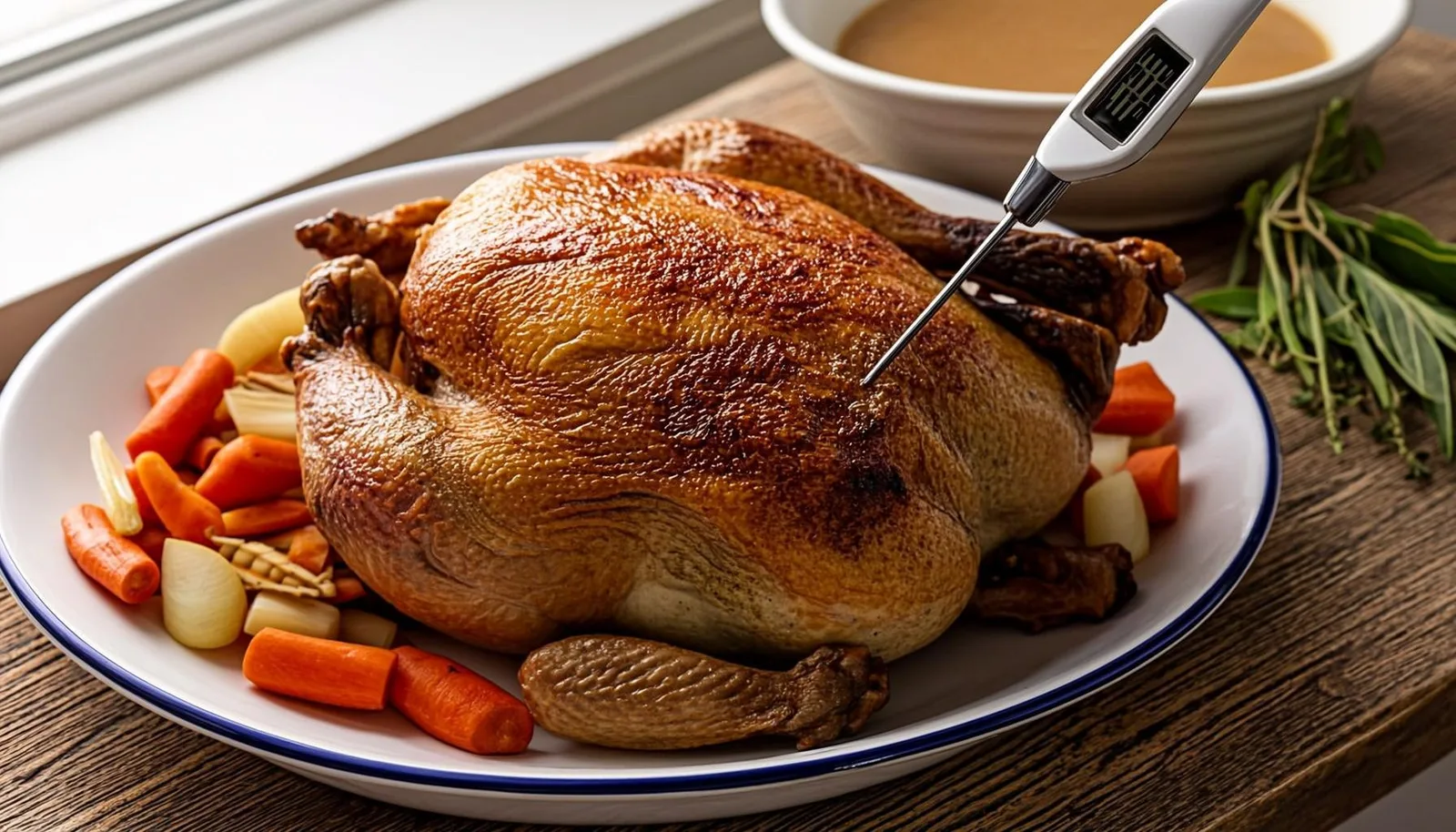
Around noon on December 24, the same question comes up in many kitchens: "How long is this turkey going to take?" The cooking time helps you plan the meal, but it is the thermometer that tells you whether the turkey is cooked: 82°C (180°F) for a whole bird, according to Health Canada and the Quebec government.
Here is the chart of cooking times by weight, stuffed or not, where to insert the thermometer, and a simple roast turkey recipe with herb butter and gravy. Is your turkey still frozen? Start with our guide fresh or frozen turkey: what size to buy and how to thaw it. For the rest of the menu, follow our traditional Quebec holiday recipes for the réveillon, dish by dish.
- Prep
- 20 min
- Cook
- 195 min
- Servings
- 12
- Season
- Holiday season
- Rating
- Not rated yet
Ingredients
Turkey
- 1 turkey, 5 to 5.9 kg (11 to 13 lb), thawed, giblets and neck removed
- 60 ml (¼ cup) softened butter (or oil)
- 15 ml (1 tbsp) chopped fresh thyme (or 5 ml/1 tsp dried thyme)
- 15 ml (1 tbsp) chopped fresh sage (or 5 ml/1 tsp dried sage)
- 2 garlic cloves, finely chopped
- 10 ml (2 tsp) salt
- 5 ml (1 tsp) ground black pepper
- 1 onion, quartered
- 1 lemon, quartered (optional)
- A few sprigs of parsley and thyme
- 250 ml (1 cup) water or turkey or chicken broth
Gravy
- 60 ml (¼ cup) reserved pan fat (or butter)
- 60 ml (¼ cup) all-purpose flour
- 750 ml (3 cups) skimmed pan juices topped up with turkey or chicken broth
- Salt and pepper, to taste
Directions
- Thaw. If your turkey is frozen, put it in the fridge on a tray, on the bottom shelf, 2 to 3 days ahead (about 10 hours per kilo). Never thaw it on the counter.
- Preheat. Place the rack in the lower part of the oven and preheat to 180°C (350°F).
- Dry. Remove the giblets and neck (keep them for broth), then pat the turkey dry with paper towels, inside and out. Do not rinse it.
- Season. Mix the butter, thyme, sage, garlic, salt and pepper. Gently loosen the skin over the breast with your fingers, slide about half the mixture underneath, then spread the rest over the skin. Wash your hands with hot, soapy water.
- Fill. Place the onion, lemon and herb sprigs loosely in the cavity, without packing them.
- Arrange. Set the turkey breast side up on a rack in a shallow roasting pan, then pour the water or broth into the bottom.
- Roast. Roast uncovered, 2 h 45 min to 3 h 15 min for an unstuffed turkey of this size. If the skin browns too quickly, tent it loosely with foil. Open the oven door as little as possible.
- Check. After about 2 h 30 min, insert a thermometer into the meatiest part of the inner thigh, without touching the bone, then into the thickest part of the breast. The turkey is cooked when every reading reaches 82°C (180°F). If not, keep cooking and check again.
- Rest. Transfer the turkey to a cutting board and let it rest for 20 to 30 minutes before carving.
- Skim. Meanwhile, pour the pan juices into a measuring cup and let the fat rise to the top. Reserve 60 ml (¼ cup) of fat and top up the skimmed juices with broth to make 750 ml (3 cups).
- Thicken. In a saucepan, heat the fat over medium heat, add the flour and stir for 2 to 3 minutes, until lightly golden. Pour in the liquid all at once, whisking.
- Simmer. Bring to a boil while whisking, then simmer for 5 to 10 minutes, until the gravy coats a spoon. Season with salt and pepper.
- Store. Debone the remaining meat and refrigerate it in small containers within 2 hours of cooking. Keep the carcass in the fridge for broth.
Tried this recipe? Rate it
Be the first to rate it.
Cooking time by weight: the chart
This chart from Turkey Farmers of Canada applies to a conventional oven at 350°F (177°C); Le Dindon du Québec, the consumer site of the Éleveurs de volailles du Québec (Quebec's chicken and turkey farmers), publishes an almost identical one. Set your oven to 180°C (350°F). These approximate times vary with the temperature of the turkey when it goes in, the oven and the roasting pan.
| Turkey weight | Unstuffed | Stuffed |
|---|---|---|
| 3.6 to 4.5 kg (8 to 10 lb) | 2 h to 2 h 30 min | 2 h 40 min to 3 h 30 min |
| 5 to 5.9 kg (11 to 13 lb) | 2 h 45 min to 3 h 15 min | 3 h 40 min to 4 h 20 min |
| 6.4 to 7.3 kg (14 to 16 lb) | 3 h 30 min to 4 h | 4 h 40 min to 5 h 20 min |
| 7.7 to 8.6 kg (17 to 19 lb) | 4 h 15 min to 4 h 45 min | 5 h 40 min to 6 h 20 min |
| 9.1 to 10 kg (20 to 22 lb) | 5 h to 5 h 30 min | 6 h 40 min to 7 h 20 min |
| 10.4 to 10.9 kg (23 to 24 lb) | 5 h 45 min to 6 h | 7 h 40 min to 8 h |
Do the math and the chart works out to about 33 minutes per kilo (15 minutes per pound) unstuffed, and 44 minutes per kilo (20 minutes per pound) stuffed. Other published guidelines are more generous: 45 minutes per kilo for the Quebec government; 40 minutes in Le Dindon du Québec's cooking guide, and 45 to 50 minutes, plus an hour of leeway, in its FAQ. So plan generously: a turkey that is ready too early simply waits while it rests.
The Quebec government asks that turkey be cooked at 165°C (330°F) or higher, and rules out slow cooking below that threshold. Using a convection oven? Keep it at 165°C or more, follow the manufacturer's instructions for timing, which is shorter according to Turkey Farmers of Canada, and rely on the thermometer. And check the temperature a little before the planned end time, as Health Canada advises.
Internal temperature: 82°C, and where to insert the thermometer
Health Canada and the Quebec government set 82°C (180°F) for a whole turkey. Stuffing, whether cooked on its own or inside the bird, must reach 74°C (165°F), like poultry pieces cooked separately. The numbers vary elsewhere: 77°C (170°F) for an unstuffed turkey and 82°C stuffed according to Turkey Farmers of Canada and Le Dindon du Québec, 74°C (165°F) for the whole bird according to the United States Department of Agriculture (USDA). Here, we follow Health Canada.
Where to insert the thermometer:
- In the thigh: slide the probe between the thigh and the breast, into the meatiest part of the inner thigh, without touching the bone, as the farmers' organizations recommend.
- In the breast: also check the thickest part of the breast, where Health Canada measures the 82°C for a whole bird; the USDA adds the wing to the list.
- In the stuffing: in the centre, if the turkey is stuffed.
Every reading must reach the target temperature. Health Canada recommends a digital thermometer, washed between uses, and the USDA advises against relying only on the pop-up timer that comes with some turkeys.
Then let the turkey rest for 20 to 30 minutes before carving (20 minutes according to Turkey Farmers of Canada and the USDA, 30 according to Le Dindon du Québec), so the juices can set. It can wait up to an hour without cooling down too much, Le Dindon du Québec points out: perfect for making the gravy. Refrigerate leftovers within 2 hours, as Health Canada advises; we cover storage times in holiday leftovers: how long to keep them in the fridge and freezer, and the carcass will make an excellent turkey carcass broth.
Washing, judging by the juices, stuffing, basting: 4 myths
"You have to wash the turkey before cooking it." False.
Health Canada is clear: never rinse raw poultry, because bacteria spread wherever the water splashes. The Quebec government and Le Dindon du Québec agree. Pat the skin dry with paper towels instead, then wash your hands with hot, soapy water for at least 20 seconds. It is the temperature reached during cooking that makes the turkey safe, not rinsing.
"Clear juices prove the turkey is cooked." False.
Clear juices are a clue, not proof. The farmers' guides still mention them, but the USDA points out that the colour of cooked poultry is not always a sure sign of its safety: a turkey can stay pink even at 74°C (165°F), and only a thermometer can confirm the temperature. Health Canada and the Quebec government also recommend a thermometer.
"Cooking the stuffing inside the turkey is risk-free." False.
For Health Canada, stuffing is a breeding ground for bacteria: it is better to bake it separately, in an ovenproof dish, to 74°C (165°F). The USDA does not recommend stuffing the turkey either. If you are attached to tradition, stuff the bird loosely just before it goes in the oven, about 125 ml (½ cup) of stuffing per 500 g of turkey according to Turkey Farmers of Canada, aim for 74°C in the centre of the stuffing and 82°C in the turkey, and remove the stuffing as soon as the bird comes out of the oven. Never the night before: the Quebec government points out that it encourages microbial growth. Also allow 40 minutes to 2 hours of extra cooking depending on the size, as the chart shows.
"You have to baste the turkey often to keep it juicy." False.
Le Dindon du Québec flatly calls basting a myth: every time you open the door, the oven temperature drops and cooking takes longer, and the juices you pour over the skin add neither flavour nor moisture to the meat; basting mostly evens out the colour of the skin. Turkey Farmers of Canada considers it optional: once an hour is enough.
To go with your turkey, make a homemade cranberry sauce with Quebec cranberries a few days ahead. For a big crowd, a traditional Quebec tourtière rounds out the menu nicely. And the next day, dig into our 7 leftover turkey recipes so nothing goes to waste.
Free gift: get The Quebec Recipe Advent Calendar, 24 recipes ready in 30 minutes or less with local ingredients, one a day until Christmas Eve. The same page gathers all our holiday recipes and guides.
Sources
- Safe cooking temperatures, Health Canada, 2024.
- Poultry safety, Health Canada, 2019.
- Poultry Facts, Health Canada, 2023.
- Holiday food safety, Health Canada, 2017.
- Dinde et repas des fêtes sans intoxication (turkey and holiday meals without food poisoning; in French), Gouvernement du Québec, 2024.
- Roasting a Whole Turkey, Turkey Farmers of Canada.
- On passe à l'action (whole turkey cooking guide; in French), Le Dindon du Québec, Éleveurs de volailles du Québec.
- FAQ (in French), Le Dindon du Québec, Éleveurs de volailles du Québec.
- Dindon entier rôti à la toscane (Tuscan-style roast whole turkey; in French), Le Dindon du Québec, Éleveurs de volailles du Québec.
- Whole Turkey Roasted With Vegetables in a Mushroom Sauce, Turkey Farmers of Canada.
- Traditional Roast Turkey Unstuffed, University of Illinois Extension.
- Giblet Gravy, University of Illinois Extension.
- Let's Talk Turkey—A Consumer Guide to Safely Roasting a Turkey, Food Safety and Inspection Service, USDA, 2023.
- Is Pink Turkey Meat Safe?, Food Safety and Inspection Service, USDA.
Frequently asked questions
At what internal temperature is turkey cooked?
Health Canada and the Quebec government call for 82°C (180°F) for a whole turkey, measured with a thermometer in the thickest part, without touching the bone. Stuffing must reach 74°C (165°F). In the United States, the USDA uses 74°C (165°F) for the whole bird.
How many minutes of cooking per kilo?
At 177°C (350°F), the Turkey Farmers of Canada chart works out to about 33 minutes per kilo for an unstuffed turkey and 44 minutes per kilo for a stuffed one. The Quebec government estimates 45 minutes per kilo instead. Allow some extra time and trust the thermometer.
Should I wash the turkey before cooking it?
No. Health Canada says never to rinse raw poultry: bacteria spread wherever the water splashes. Pat it dry with paper towels instead and wash your hands.
How long should the turkey rest before carving?
20 to 30 minutes: 20 minutes according to Turkey Farmers of Canada and the USDA, 30 minutes according to Le Dindon du Québec. The latter adds that a turkey can wait up to an hour without losing too much heat, which gives you time to make the gravy.
Can I stuff the turkey the night before?
No. The Quebec government advises against it because it encourages microbial growth. Keep the stuffing in the fridge and stuff the bird just before it goes in the oven, or better yet, bake the stuffing separately to 74°C (165°F), as Health Canada recommends.