Mountain ash and crabapple jelly
Raw, mountain ash berries are bitter and are not eaten. Cooked with crabapples, which supply the pectin, they make a deep orange, slightly bitter jelly that is made for game, lamb and cheese. Here is the recipe (plan for an overnight drip), the cold plate test and the right way to store it.
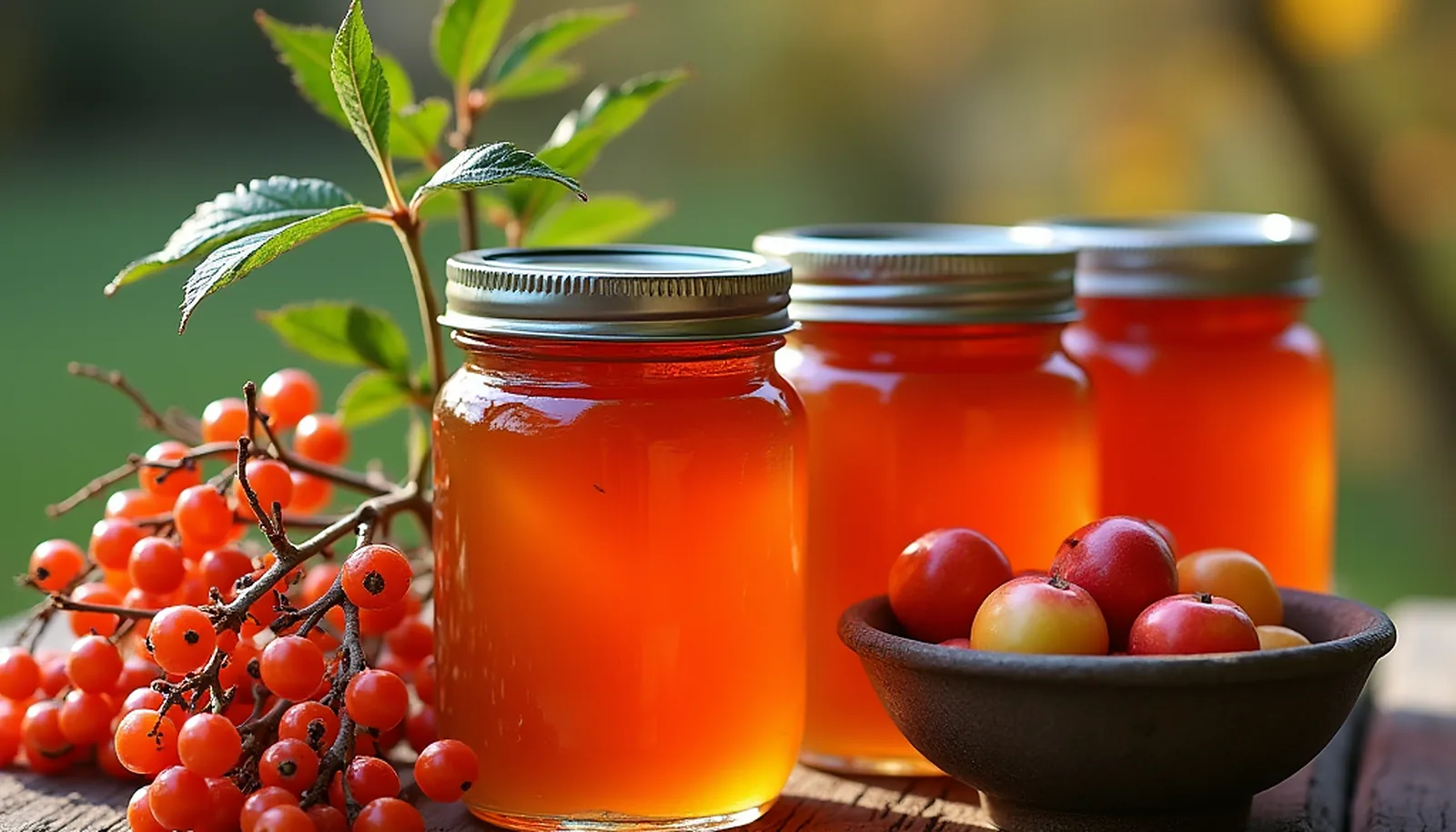
In October, mountain ash trees bend under clusters of small orange-red berries, which often stay on the tree into winter. Raw, these berries are bitter: they are always eaten cooked. Their great classic is jelly, cooked with crabapples that supply the pectin mountain ash lacks. In Newfoundland, where they are called dogberries, this jelly was often eaten with meat, and it was considered bitter, even with the sugar.
Before you pick, read our guide mountain ash and highbush cranberry: the fruit to forage after frost. And if you have made our rose hip and crabapple jelly, you know the method: jelly bag, overnight dripping, cold plate test.
- Prep
- 40 min
- Cook
- 45 min
- Servings
- 4 to 6 jars of 250 ml (1 cup)
- Season
- October and November
- Rating
- Not rated yet
Ingredients
The fruit
- 750 g (1 ⅔ lb) mountain ash berries, stemmed
- 750 g (1 ⅔ lb) crabapples, or tart apples
- 1 litre (4 cups) water, or just enough to cover the fruit
- 1 piece fresh ginger, 30 g (1 oz), chopped (optional)
The jelly
- Sugar: 250 ml (1 cup) per 250 ml (1 cup) of juice obtained, about 1 litre (4 cups) in total
- 15 ml (1 tbsp) lemon juice (optional)
Directions
- Stem the berries. Rinse the mountain ash clusters in cold water, then pull the berries off the stems. Discard any that are blackened, shrivelled or mouldy.
- Prepare the crabapples. Rinse them, remove the stems and blossom ends, then cut them into pieces without peeling or coring them: the core is rich in pectin.
- Cook the fruit. Put the mountain ash berries, crabapples and water in a large pot, with the ginger if using. Bring to a boil, then simmer for 20 to 25 minutes, mashing the fruit halfway through, until tender. Do not cook it longer: overcooking damages the pectin, colour and flavour.
- Drip overnight. Pour everything into a damp jelly bag or a double layer of damp cheesecloth, hung over a large bowl. Let it drip for at least 4 hours, ideally overnight, without squeezing: squeezing makes the jelly cloudy.
- Measure. Measure the juice and plan 250 ml (1 cup) of sugar for every 250 ml (1 cup) of juice. If you get much more juice than expected, cook it in two batches rather than one big one. Put 3 or 4 plates in the freezer for the set test.
- Cook the jelly. Pour the juice into a large heavy-bottomed pot, add the sugar and heat, stirring, until it dissolves. Add the lemon juice, then boil hard, skimming as needed.
- Do the plate test. After about 10 minutes of boiling, take the pot off the heat and put a small spoonful of jelly on a cold plate. Put the plate back in the freezer for a few minutes, then push the jelly with your finger: if it has set and the surface wrinkles, it is ready. If not, boil a few more minutes and test again with another plate. With a thermometer, aim for 104°C (220°F) at sea level, and subtract about 1°C (2°F) for every 300 m (1,000 ft) of altitude.
- Fill the jars. Skim, then pour the hot jelly into sterilized jars. To freeze, use freezer-safe jars and leave 1.25 cm (½ inch) of headspace. Close and let cool slightly.
- Store. Keep the jelly in the fridge for about 1 month, or in the freezer for up to 1 year. This recipe is not meant for the pantry.
Tried this recipe? Rate it
Be the first to rate it.
The right tree, the right time, and always cooked
American mountain ash (Sorbus americana), also called mascouabina in Quebec, is the one forager chef Alan Bergo recommends; showy mountain ash (Sorbus decora) and European mountain ash, or rowan (Sorbus aucuparia), have similar berries. According to the Maine Forest Service, American mountain ash is a small tree with alternate leaves made up of 11 to 17 finely toothed leaflets, and its berries are about 6 mm across.
The look-alike to know: red elderberry (Sambucus racemosa), which the Centre antipoison du Québec (Quebec Poison Control Centre) lists as toxic. Its leaves are opposite, with 5 to 7 leaflets, its clusters are pyramid-shaped and its berries ripen in summer, according to the Missouri Department of Conservation. See also the small red fall berries not to confuse. When in doubt, don't pick. If someone swallows berries, call the Quebec Poison Control Centre (Centre antipoison du Québec) at 1 800 463-5060.
People say the berries are better after the first frost. Alan Bergo, who forages in Minnesota, believes it takes several hard frosts on the tree; the freezer did not help him. None of the sources consulted measured this effect: it is knowledge from experience.
Why always cooked? According to a publication by the Bavarian State Institute of Forestry (LWF) on the European mountain ash, the raw berries contain parasorbic acid, which is bitter, irritates the lining of the digestive tract and would be largely destroyed or driven off by cooking; the author cites no source or measurement, and we found none. Yet the Centre antipoison du Québec lists American mountain ash among the non-toxic plants in its leaflet, while pointing out that "non-toxic does not mean edible." Details in our article on parasorbic acid.
Pick away from roads and from low branches where dogs are walked, advises the UK's Woodland Trust. Leave some clusters for the birds and ask permission on private land. While picking, keep an eye on young children, the Poison Control Centre reminds us. For the rest of the season, see our foraging calendar.
Crabapples, sugar and the cold plate: getting a good set
Why crabapples? Mountain ash lacks the pectin to set well on its own, explains chef Fraser Wright in The Scotsman; it is for their pectin that Alan Bergo adds apples. Yet the Bavarian publication credits its berries with about 1% pectin: the sources disagree, but almost all the recipes consulted add apples. Keep their peel and core, which is rich in pectin, and use firm crabapples, about one quarter slightly underripe to three quarters fully ripe, as the National Center for Home Food Preservation (NCHFP) advises for jellies with no added pectin. More ideas: our 5 crabapple recipes.
Proportions vary: as much apple as mountain ash for the Woodland Trust and Fraser Wright, twice as much for Alan Bergo. For sugar, they range from 450 g per 600 ml of juice (Woodland Trust) to 1 kg per litre (Fraser Wright). We went with equal weights of both fruits and 250 ml of sugar per 250 ml of juice, like Alan Bergo and the NCHFP crabapple jelly.
Do not double the recipe: in larger batches, jelly sets poorly, warns the University of Alaska Fairbanks. For the plate test, take the pot off the heat, put a spoonful of jelly on a cold plate and put it in the freezer for a few minutes, as the University of Alaska Fairbanks does: if the jelly has set and wrinkles when you push it with your finger, it is ready. With a thermometer, aim for 104°C (220°F) at sea level, or 4.4°C (8°F) above the boiling point of water, according to the NCHFP. At altitude, subtract about 1°C for every 300 m (2°F per 1,000 ft), the University of Minnesota Extension adds.
Storage and serving
We found no mountain ash jelly recipe tested for canning by a recognized organization, and Health Canada says to use only tested recipes. So this jelly goes in the fridge or the freezer. According to the University of Minnesota Extension, a cooked spread that is not heat-processed keeps for one month in the fridge and one year in the freezer, in sterilized jars (see how to sterilize jars), with 1.25 cm (½ inch) of headspace for freezing. Once thawed, use it within 3 or 4 weeks. For the pantry, make the tested NCHFP crabapple jelly instead.
The Woodland Trust recommends it with game, lamb and cheese: a venison roast, a leg of lamb or a Quebec cheese board. For game, also try our sweet and sour highbush cranberry sauce.
Sources
- Des plantes toxiques chez nous? (toxic plants leaflet; in French), Centre antipoison du Québec, 2017.
- Pharmazie und Medizin, Volksmedizin (pharmacy, medicine and folk medicine; in German), Klaus Storm, Beiträge zur Vogelbeere no. 17, Bavarian State Institute of Forestry (LWF), 1998.
- Sorbus americana (American mountain-ash), VASCAN, Canadensys.
- Mountain Ash (Forest Trees of Maine), Maine Forest Service, 2008.
- Red-Berried Elderberry, Missouri Department of Conservation.
- Rowan jelly recipe, Woodland Trust, 2018.
- Fraser Wright recipe: Rowan jelly from Rodden Trees, The Scotsman, 2015.
- Classic Rowanberry Jelly, Alan Bergo, Forager Chef, 2022.
- The Tangled Lore of Dogberries, Robert Hiscock, Product of Newfoundland, 2025.
- Crabapple Jelly without Pectin, National Center for Home Food Preservation, University of Georgia.
- Making Jelly without Added Pectin, National Center for Home Food Preservation, University of Georgia, 2015.
- Jams and Jellies (FNH-00730), University of Alaska Fairbanks, 2025.
- Remaking Soft Jams or Jellies (FNH-00731), University of Alaska Fairbanks, 2024.
- Preserving food at home: Fruit spreads, University of Minnesota Extension, 2026.
- Home canning safety, Health Canada, 2024.
Frequently asked questions
Can you eat mountain ash berries raw?
No, they are always eaten cooked. According to a publication by the Bavarian State Institute of Forestry on the European mountain ash, the raw berries contain parasorbic acid, which irritates the digestive tract and would be largely destroyed or driven off by cooking, with no source or measurement to back it up. The Centre antipoison du Québec lists American mountain ash among non-toxic plants, but it points out that non-toxic does not mean edible.
Do you have to wait for frost to pick mountain ash berries?
That is the tradition. Forager chef Alan Bergo believes it takes several hard frosts on the tree to calm the bitterness, and he picks around mid-October; the freezer did not help him. None of the sources consulted measured this effect.
Can this jelly be canned for the pantry?
Not this one: we found no version tested by a recognized organization, and Health Canada says to follow tested recipes without changing them. Keep it for one month in the fridge or one year in the freezer, as the University of Minnesota Extension advises. For the pantry, make the tested crabapple jelly from the National Center for Home Food Preservation instead.
My jelly did not set. What can I do?
Wait three days in a cool place before deciding, advises the University of Alaska Fairbanks. If it stays runny, boil it again for 3 to 4 minutes with 30 ml (2 tbsp) of bottled lemon juice per litre of jelly, then repeat the plate test. If it still does not set, serve it as a syrup, on pancakes or ice cream.
Can I use apples instead of crabapples?
Yes, tart apples: Alan Bergo uses green apples such as Granny Smith, with the peel and seeds, and Fraser Wright uses tart cooking apples and keeps the cores, which are rich in pectin.