Bringing garden herbs indoors: which ones survive inside
Rosemary and bay laurel will never survive winter outside here, chives and mint couldn't care less, and basil is easier to renew than to overwinter. Before you fill your windowsills, sort your herbs one by one: which ones come in, which ones stay in the garden, which ones start over from cuttings or seed. And plan for light: with short days, a window is not always enough.
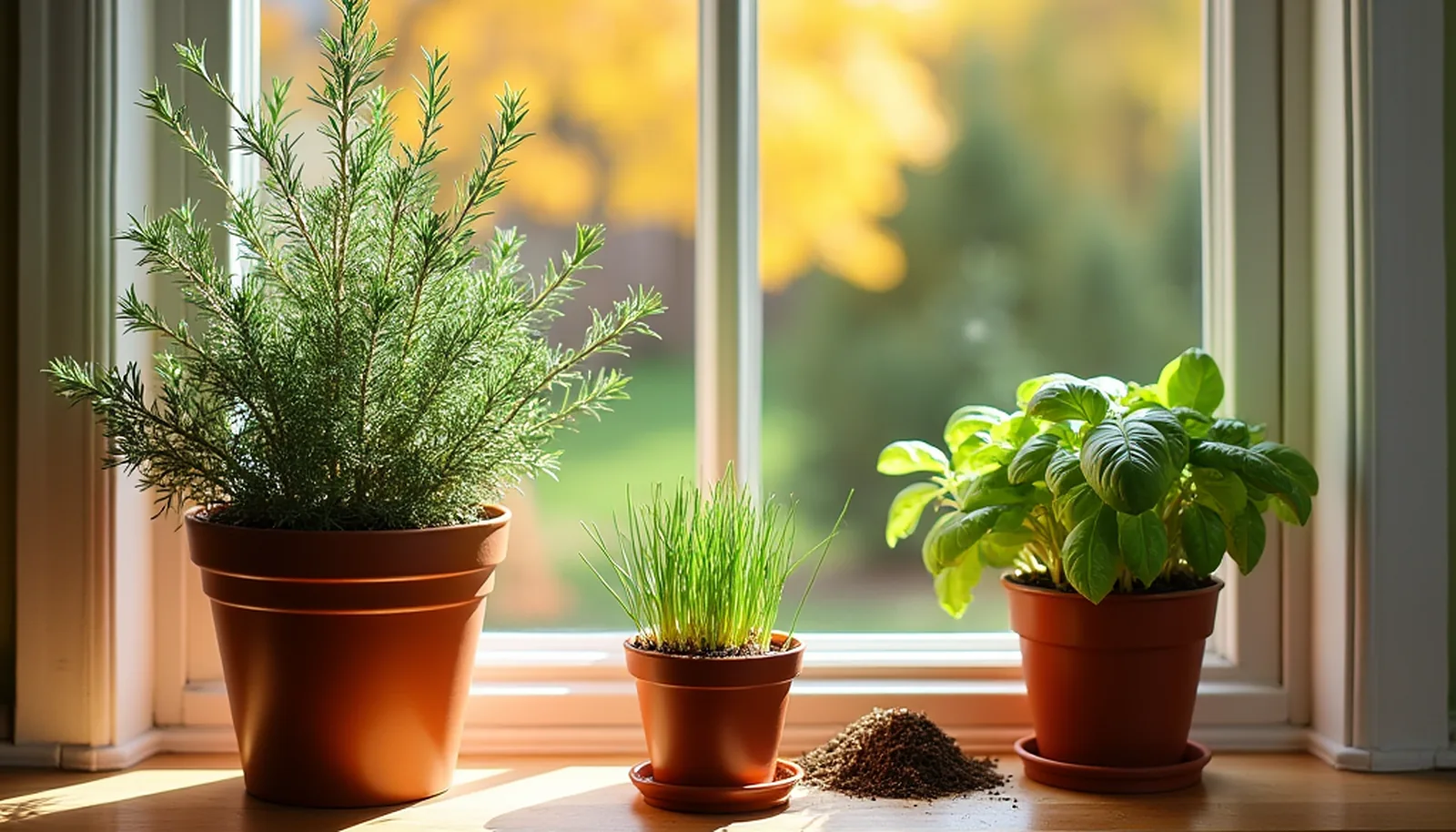
In mid-October, basil has often turned black at the first cold snap, while rosemary still looks great in its pot. Should you bring everything in? No. A few herbs will never survive winter outside here, others take it in stride, and some are easier to renew than to overwinter. That makes three groups: the tender ones you bring in, potted; the hardy perennials you leave in the garden (and maybe pot up a piece of); and the annuals you restart from cuttings or seed.
For the general method (inspection, cleaning, quarantine), follow our guide to bringing plants indoors without bringing in bugs.
Sorting your herbs, one by one
Montana State University (Montana State) lists parsley, mint, chives, basil, oregano, cilantro and thyme among the easiest herbs to grow indoors, and rosemary, sage, lemon balm and marjoram among the hardest. The paradox: rosemary, which you have no choice but to bring in, is also one of the most demanding.
The zones in the table come from the American (USDA) map; Minnesota, for example, is in Zone 3 in the north and Zone 4 in the south, according to the Anoka County Extension Master Gardeners. To find your own zone, see our article on the new Canadian plant hardiness zone map.
| Herb | Hardiness according to the source | For winter | Indoors |
|---|---|---|---|
| Rosemary | Perennial in Zone 8 and above, not reliable in Zone 6 or colder (Illinois) | Bring in, potted, just before frost; can be propagated from cuttings | Sun or grow light, cool, neither soggy nor bone-dry |
| Bay laurel | Evergreen in Zone 8 and above, very frost-sensitive (Illinois) | Bring in, potted, before frost; hard to root from cuttings | Brightest spot, little water |
| Lemongrass | Not hardy in cold climates (Illinois) | Bring in, potted, before frost | Very bright light, water as needed |
| Chives | Comes back every year even in Zone 3 (Anoka) | Stays outside; pot up a clump after a light frost | Tolerates less light |
| Mint | "Extremely hardy" perennial (Illinois) | Stays outside; pot up a division after a light frost | Tolerates less light |
| Thyme | Can overwinter in Zone 4 with protection (Anoka) | Stays outside in well-drained soil; pot up a plant or take cuttings | Full sun or grow light; let dry between waterings |
| Sage | Same (Anoka); golden, purple and tricolour sages not reliably hardy in Zone 5 (Illinois) | Stays outside in very well-drained soil; take cuttings | Sun; let dry between waterings |
| Oregano | Same (Anoka); true oregano marginal in Zone 5 (Illinois) | Stays outside, mulched once the ground freezes; take cuttings | Sun; let dry between waterings |
| Parsley | Hardy biennial grown as an annual; goes to seed in its second year (Illinois) | Pot up a plant without damaging the taproot, or sow seeds | Plenty of light, cool spot |
| Basil | Tender annual; leaves damaged at 10°C (Illinois) | Take cuttings or sow indoors | Full sun, warm, soil never completely dry |
Rosemary, bay laurel, lemongrass: the tender ones you bring in, potted
These three will not survive a winter here in the ground. According to the University of Illinois Extension (Illinois Extension), rosemary is perennial only from Zone 8 up and is not reliably hardy in Zone 6 or colder; even 'Arp', one of the most cold-tolerant cultivars, may only make it to Zone 6. Bay laurel is evergreen in Zone 8 and above, and very frost-sensitive elsewhere. Lemongrass is not hardy in cold climates; the same source recommends growing it in a container, like any rosemary you plan to bring in.
When? Before frost, according to Illinois Extension, and just before frost for rosemary. Keep an eye on your local forecast: as soon as a night below 0°C is announced, it is last call. Until then, most herbs can handle nights of 4 or 5°C (Cornell, Penn State). Not basil, as you will see below.
Where? Rosemary likes a cool, sunny spot: the University of Wisconsin–Madison (UW–Madison) recommends a room that stays at or below 18°C, in a south- or west-facing window, away from heat vents and radiators, turning the pot every week. Bay laurel wants the brightest spot in the house, and lemongrass, very bright light (Illinois Extension).
Watering rosemary: the real trap. Too much water rots its roots; a root ball that dries out leads to brown tips and dieback, explains Illinois Extension, which recommends keeping the soil on the dry side. UW–Madison advises checking once or twice a week by pushing a finger 2.5 cm into the soil, watering thoroughly if it is dry and not letting water sit in the decorative pot. Aim for soil that is dry on top, never a bone-dry root ball.
Bay laurel and lemongrass. Bay laurel grows very little in winter: water without overdoing it and cut way back on fertilizer. Its seeds germinate poorly and its cuttings are hard to root, so Illinois Extension recommends buying established plants: take good care of yours. Lemongrass, on the other hand, is easy to propagate by division or stem cuttings, and a stalk bought at the grocery store can often be rooted, the same source notes.
Chives, mint, thyme, sage, oregano: the perennials that stay outside
These herbs get through winter without you, or nearly. The Anoka master gardeners include chives among the herbs that come back even in Zone 3, in bigger clumps every year. Mint is "extremely hardy" according to Illinois Extension, and so invasive that growing it in a container is recommended.
Thyme, sage and oregano are more fragile. Anoka lists them, along with parsley, among the herbs that may overwinter in Zone 4, especially if sheltered from winter winds: a protected corner or the foot of the house, a good insulating layer of snow, and watering until a hard freeze. Illinois Extension adds that golden, purple and tricolour sages are not reliably hardy in Zone 5, that true oregano is marginal there, and that all three dislike poorly drained soil in winter. For oregano, the same source suggests a mulch of evergreen boughs or straw, applied once the ground has frozen and removed in spring. For the rest of your fall garden chores, see also should you cut back perennials in fall? and putting the garden to bed before frost.
To harvest this winter: pot up a piece
Cornell suggests dividing chives and mint, taking cuttings of thyme, sage and oregano, and propagating rather than bringing in large plants or plants that might be hiding insects.
- Chives and mint: pot up a clump of chives with at least 4 to 6 bulbs, or a division of mint, and leave the pot outside until a light frost. According to Montana State, the frost triggers a rest period that benefits both, and Illinois Extension notes that the best potted chives come from clumps dug after a freeze.
- Thyme, sage, oregano: cut healthy 10 to 15 cm stems at a node, keep leaves only on the top 2.5 to 5 cm and stick them in moist, sterile potting mix in a pot with drainage holes. Take several: they need one to six weeks to root (Cornell). Thyme can also be potted up in fall and kept in the sun all winter (Illinois Extension).
Before potting up a division, check the leaves and roots: Cornell advises rinsing off any insects and eggs with a hose. Penn State advises against growing herbs with large root systems indoors, such as horseradish, fennel and lovage, as well as tarragon if you have a dog or a cat, since it is toxic to them.
Basil and parsley: better to start fresh
Basil is a tender annual: cold can blacken its leaves at 10°C (Illinois Extension), and it cannot survive below that temperature (Penn State). Two ways to start fresh:
- From cuttings: 10 to 15 cm stems taken from a plant that is still healthy can root in two weeks, according to Cornell.
- From seed: a few seeds in a small pot, in the sun, in moist potting mix. They germinate in 5 to 7 days if the mix is at least 21°C, and harvest begins 4 to 5 weeks later; sow again every two weeks to keep a steady supply (Illinois Extension).
Keep it warm, away from cold windows (Penn State, Cornell), and pinch off flower buds as soon as they form: they affect the flavour of the leaves. Taking geranium cuttings too? See our three methods for overwintering geraniums.
Parsley is a biennial: it survives winter, but in its second year it goes to seed and its leaves turn tough and bitter, explains Illinois Extension. You can pot up a plant, taking care not to damage its taproot; it then grows best with plenty of light in a cool spot, and makes way for young plants in spring. Otherwise, sow it: the seeds are slow to germinate, and the same source suggests soaking them overnight. Cilantro also does well from seed indoors: Penn State counts it among the best choices, along with chives and basil.
Light: a south-facing window, and often a grow light
Iowa State University (Iowa State) ideally aims for 4 to 6 hours of direct sun a day; Penn State and Montana State call for 6 hours or more. A south-facing window is a good choice, but as the days get shorter, supplemental light will probably be needed, Cornell warns. Chives, mint and parsley tolerate less light (Iowa State), as do cilantro and lemon balm (Penn State). Rosemary, thyme and bay laurel, on the other hand, need full sun (Penn State) and may need a grow light (Iowa State).
The grow light. Iowa State recommends a full-spectrum LED or fluorescent light on a timer, 12 to 16 hours a day. For fluorescents, Penn State and Cornell suggest two 40 W cool white tubes placed 15 to 30 cm from the plants, 14 to 16 hours a day. For an LED light, follow the distance recommended by the manufacturer.
The warning signs. Long, spindly stems and smaller, less fragrant leaves: the plant is not getting enough light (Penn State). Turn the pots regularly.
Water, heat and dry air: winter in a heated house
Water according to the plant
Water when the potting mix is dry to the touch, before the plant wilts (Iowa State). Overwatering is the most common houseplant problem and leads to root rot, Montana State points out. Bay laurel, oregano, sage, thyme and rosemary like to dry out between waterings; basil, never completely (Penn State). A porous terracotta pot helps the mix dry out, and a drainage hole is a must (Iowa State).
Heat and dry air: the sources disagree
Penn State aims for 18 to 21°C during the day and 13 to 16°C at night; rosemary prefers it cooler, basil warmer. For the dry air of homes with forced-air heating, Penn State suggests grouping pots, setting them on a tray of moist pebbles or using a humidifier, and Illinois Extension and UW–Madison add misting for rosemary. Montana State puts this in perspective: dry air is generally not a major problem for herbs, though a wood stove can cause more trouble. As for what plants really do for the air in your home, our article on the benefits of houseplants sums up what is proven.
Fertilizer: less is more
Too much fertilizer hurts flavour and aroma, according to Penn State and Cornell, which suggest a low dose of water-soluble fertilizer every two weeks; Iowa State dilutes an all-purpose fertilizer to half or even quarter strength. For plants that are barely growing, even less: UW–Madison does not fertilize rosemary in winter. Feed lightly what is actively growing under the light, like seeded basil, and leave the rest alone.
Insects: keep watching all winter
For aphids, Penn State advises cutting off infested stems and putting them in the garbage; for fungus gnats, yellow sticky traps and better watering. If treatment becomes necessary, choose a domestic product registered in Canada, such as an insecticidal soap or a horticultural oil, and follow the label to the letter, especially on a plant you are going to eat; rinse the leaves well before using them. For inspection and quarantine, everything is in our complete method, and if a critter puzzles you, our guide to inspecting your plants with Seek will help you name it.
In spring: a gentle move outside
Perennial herbs overwintered indoors go back outside in late spring, once the weather has warmed (Iowa State). After the last frost, Montana State advises hardening them off over about two weeks, starting with a few hours of partial shade a day; Penn State, increasing light exposure every few days while checking for insects.
Sources
- Herbs, Illinois Extension, University of Illinois: fact sheets Rosemary, Bay Laurel, Lemon Grass, Chives, Mint, Thyme, Sage, Oregano, Parsley and Basil.
- Hardy Herbs, Ash Barsody, Anoka County Extension Master Gardeners (Minnesota).
- Growing Herbs Indoors, E. S. Sánchez and E. Kinley, Penn State Extension, 2024.
- Can I grow herbs indoors over the winter?, Aaron Steil, Yard and Garden, Iowa State University Extension, 2024.
- Propagate Herbs Now to Enjoy All Winter, Lydia Fernandez, Cornell Cooperative Extension, Orleans County, 2026.
- Holiday Rosemary, Vijai Pandian, Extension Kenosha County, University of Wisconsin–Madison, 2020.
- Pots of Possibility: Herbs that Thrive Indoors, Allison Kosto, Montana State University Extension, 2025.
Frequently asked questions
Which herbs should you bring indoors for winter?
The ones that cannot survive outside here: rosemary and bay laurel, perennial only from Zone 8 up according to Illinois Extension, and lemongrass, which is not hardy in cold climates. Chives, mint, thyme, sage and oregano can stay in the garden; you can pot up a piece to harvest in winter. Basil and parsley are better renewed from cuttings or seed.
Can you keep garden basil alive indoors all winter?
It is hard: its leaves can blacken at 10°C and it needs full sun. Take 10 to 15 cm cuttings instead, which can root in two weeks according to Cornell, or sow a few seeds every two weeks: according to Illinois Extension, harvest begins 4 to 5 weeks after sowing. Keep it warm, away from cold windows.
Why is my rosemary drying out indoors?
Usually because of watering, too much or too little. Excess water rots the roots, and a dried-out root ball leads to brown tips and dieback, according to Illinois Extension. Check the soil 2.5 cm deep once or twice a week and water thoroughly when it is dry. Put it in a cool room, ideally 18°C or less, in a south- or west-facing window, away from heat sources.
Should you bring chives indoors for winter?
No, chives get through winter outside without any trouble. To snip some this winter, pot up a clump of at least 4 to 6 bulbs and let it go through a light frost before bringing it in: according to Montana State University, the frost triggers a rest period. Illinois Extension notes that the best potted plants come from clumps dug after a freeze.
How many hours of grow light do herbs need?
12 to 16 hours a day, on a timer, according to Iowa State University. With fluorescent tubes, Penn State suggests two 40 W cool white tubes placed 15 to 30 cm from the plants, 14 to 16 hours a day. Long, spindly stems with small, less fragrant leaves are a sign of too little light.
Do you offer this service?
Readers of this page are looking for this kind of pro (eco-friendly landscaper). Join our recommended partners.
Become a partner