Ginger molasses Christmas cut-out cookies
A spiced dough you cut into gingerbread people and stars, and that bakes in under 10 minutes. Here are our ginger molasses Christmas cookies, with the right moves for the dough, decorating without food colouring, freezing and gifting in a jar.
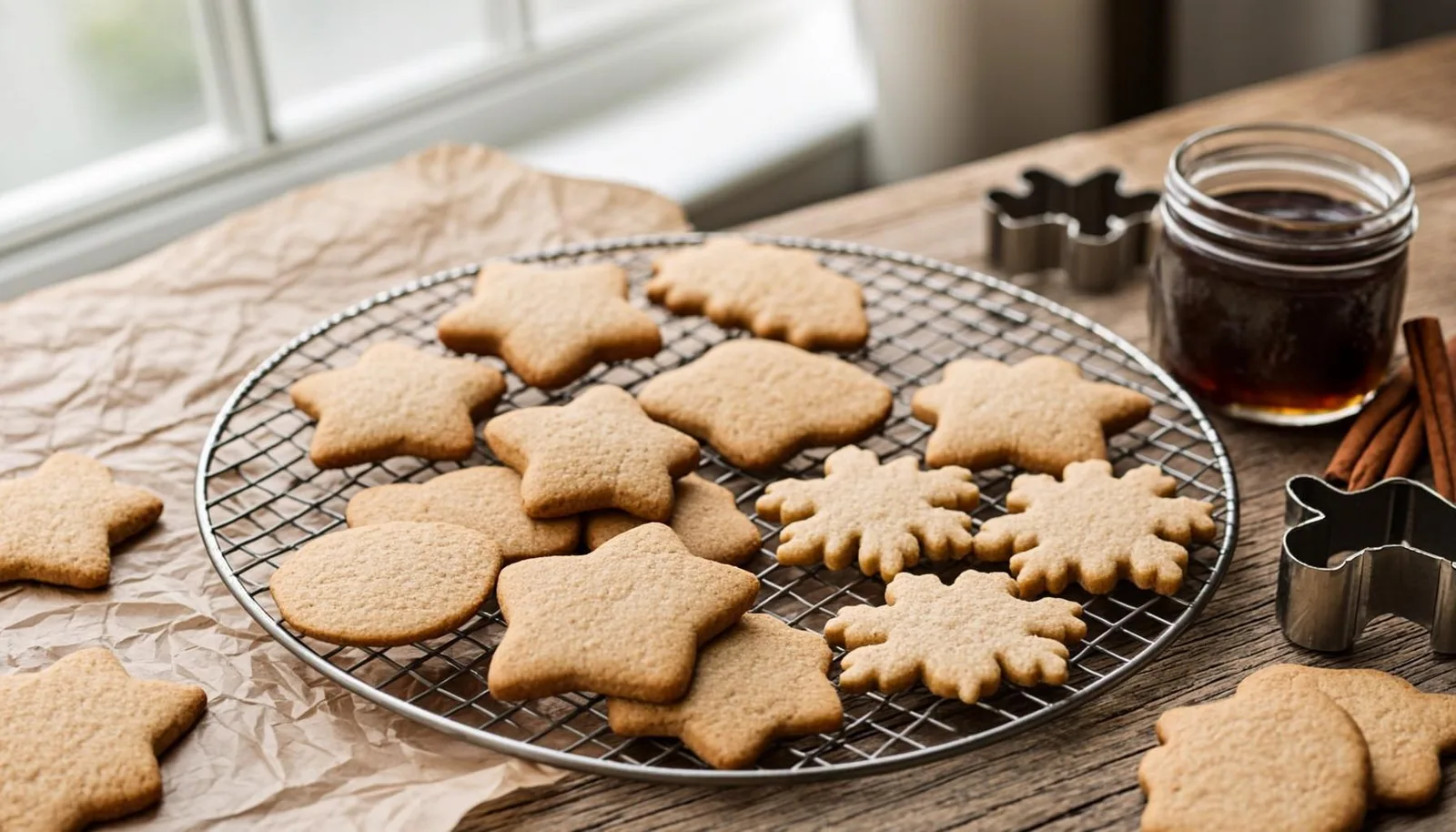
Ginger molasses cookies have been part of the holidays for a long time. According to an article from the University of Arkansas extension service, gingerbread first appeared in Western Europe at the end of the 11th century, when crusaders brought back spices and sugar from the Eastern Mediterranean.
Our version is adapted from a recipe published by that same service, converted to metric measures. It takes a little planning, since the dough must spend at least 2 hours in the fridge, but the cookies can be made ahead and frozen. They belong in our traditional réveillon menu, dish by dish.
- Prep
- 30 min
- Cook
- 30 min
- Servings
- 30
- Season
- Holiday season
- Rating
- Not rated yet
Ingredients
Dough
- 750 ml (3 cups) all-purpose flour
- 7 ml (1 ½ tsp) baking powder
- 4 ml (¾ tsp) baking soda
- 1 ml (¼ tsp) salt
- 15 ml (1 tbsp) ground ginger
- 10 ml (2 tsp) ground cinnamon
- 1 ml (¼ tsp) ground cloves
- 90 ml (6 tbsp) unsalted butter, softened
- 175 ml (¾ cup) brown sugar, packed
- 1 large egg
- 125 ml (½ cup) fancy molasses
- 5 ml (1 tsp) vanilla extract
Simple icing (optional)
- 250 ml (1 cup) icing sugar
- Milk, as needed
- Orange or lemon zest, to taste
Directions
- Mix. In a bowl, whisk together the flour, baking powder, baking soda, salt, ginger, cinnamon and cloves.
- Cream. In a large bowl, beat the butter, brown sugar and egg with an electric mixer on medium speed until smooth. Add the molasses and vanilla, then beat again.
- Combine. Gradually add the dry ingredients, mixing just enough to form a smooth dough. Overmixing makes dry, hard cookies.
- Chill. Divide the dough into two discs, wrap them and refrigerate for 2 to 8 hours.
- Preheat. Place the rack in the centre of the oven and preheat to 190°C (375°F). Line two baking sheets with parchment paper.
- Roll. Take out one disc at a time and let it warm up for a few minutes if it cracks. Roll it to 6 mm (¼ in) thick on a lightly floured surface or between two sheets of parchment paper.
- Cut. Cut out the cookies with floured cutters and place them on the baking sheets, 4 cm (1 ½ in) apart. Gather the scraps and roll them out again.
- Bake. Bake one sheet at a time for 7 to 10 minutes for soft cookies, or 1 to 2 minutes longer for crisp cookies.
- Cool. Let the cookies firm up for a few minutes on the sheet, then transfer them to a rack to cool completely.
- Decorate. Mix the icing sugar with milk, 5 ml (1 tsp) at a time, until the icing is smooth and thick. Flavour with zest to taste, decorate the cooled cookies and let set for about 2 hours.
Tried this recipe? Rate it
Be the first to rate it.
The dough: the right molasses, the spices and the cold
Molasses. The recipe calls for fancy molasses, not blackstrap. Common belief: "all molasses is the same." FALSE. Molasses is the syrup left over when sugar is extracted from cane or beet juice, a process repeated several times, explains Encyclopædia Britannica. The first extraction gives a lighter, sweeter molasses; the last one, blackstrap, is thick, dark and has lost nearly all its extractable sugar. Lighter molasses is used in baking, while lower grades, including blackstrap, go mainly into animal feed and industry. Swapping one for the other therefore changes the sweetness and colour of the cookies.
Spices. Ground ginger leads, backed by cinnamon and a hint of cloves. To choose your spices and keep them flavourful, see our guide to holiday spices.
The cold. The dough spends 2 to 8 hours in the fridge before rolling: well chilled, it spreads less during baking, according to the University of Arkansas. Common belief: "the colder the dough, the easier it rolls." FALSE. According to the same service, dough that cracks is probably too cold: let it warm up for a few minutes on the counter. On the other hand, if it sticks or spreads too much, put it back in the fridge for about an hour or add 15 to 30 ml (1 or 2 tbsp) of flour.
No nibbling. Common belief: "a little bite of raw dough isn't dangerous." FALSE. Health Canada points out that flour is a raw ingredient that can contain bacteria such as E. coli, and that even a small amount of raw dough can make you sick. Children aged 5 and under, older adults and people with weakened immune systems are at higher risk. Wash your hands with soap and warm water after handling the dough, and clean bowls and counters with hot soapy water.
Rolling, baking and decorating without food colouring
Roll the dough to 6 mm (¼ in) on a lightly floured surface. The University of Arkansas also suggests rolling it between two sheets of parchment paper, or dusting the surface with a mix of flour and icing sugar. Flour your cookie cutters so they don't stick. For large shapes, cut directly on the parchment, remove the scraps and slide the sheet onto the baking sheet. The scraps can be gathered and rolled again: nothing goes to waste.
Bake one sheet at a time, in the centre of the oven: 7 to 10 minutes for soft cookies, a minute or two longer for crisp ones. Dark baking sheets brown cookies faster, warns the same service: watch them closely. Let the cookies firm up on the sheet before moving them to a rack, and wait until they are completely cool before decorating. If they come out dry and hard, the dough may have been overmixed or overbaked.
No need for food colouring to make festive cookies. An icing of icing sugar and milk, flavoured with a little citrus zest, is enough to draw buttons and smiles. Before it dries, add dried cranberries, toasted almonds or shredded coconut, then let it set for about 2 hours before eating.
Storing, freezing and gifting in a reused jar
These cookies can be made up to two weeks ahead, according to the University of Arkansas: store them in airtight containers, in single layers separated by wax paper. To keep them longer, freeze them for up to 2 months. Common belief: "it's better to freeze cookies already decorated." FALSE. The same service recommends freezing them plain when possible, because the cookie can become moist under the icing. Wrap them well, label and date the container, then let them thaw for about 20 minutes on a plate, loosely covered.
Want to get ahead on the dough? The University of Arkansas suggests making a few batches, keeping them in the fridge in closed bags and rolling them out as needed. None of the sources consulted gives a time limit for frozen dough. In the freezer, food stays safe and only its quality declines over time, notes the National Center for Home Food Preservation. If you freeze the dough, wrap it well, date it and thaw it in the fridge, never on the counter, as Health Canada recommends.
For gifting, a reused glass jar makes lovely zero-waste packaging: stack cookies small enough to fit through the opening, separated by squares of parchment paper, and add a label with the date and the ingredients. Careful, an ordinary jar breaks easily in the freezer, warns the same centre: freeze the cookies in a bag and put them in the jar on gifting day. More ideas for reusing glass jars and for avoiding food waste all year long.
These cookies make a perfect pair with our traditional sucre à la crème in a box of sweets, and go very well with a hot mulled cider, with or without alcohol.
Free gift: get The Quebec Recipe Advent Calendar, 24 recipes ready in 30 minutes or less with local ingredients, one a day until Christmas Eve. The same page gathers all our holiday recipes and guides.
Sources
- Gingerbread Cookies and Christmas Are a Tradition, Carla Haley-Hadley, University of Arkansas Division of Agriculture, Cooperative Extension Service.
- Give Personalized Gifts of Christmas Cookies, Carla Haley-Hadley, University of Arkansas Division of Agriculture, Cooperative Extension Service.
- Solving Your Christmas Cookie Dilemmas, Carla Haley-Hadley, University of Arkansas Division of Agriculture, Cooperative Extension Service.
- Solutions for Holiday Cookie Dilemmas, Carla Due, University of Arkansas Division of Agriculture, Cooperative Extension Service.
- Molasses, Encyclopædia Britannica, updated in 2026.
- Safe handling of flour, Health Canada, 2021.
- Safely defrosting foods, Health Canada, 2017.
- How Long Can I Store Frozen Foods?, National Center for Home Food Preservation, University of Georgia.
- Containers for Freezing, National Center for Home Food Preservation, University of Georgia.
Frequently asked questions
Can I use blackstrap molasses?
It is not ideal. According to Encyclopædia Britannica, blackstrap comes from the final extraction of sugar: it is darker, thicker and much less sweet than lighter molasses, which is the kind used in baking. Your cookies would be less sweet and darker.
How long should the dough chill?
From 2 to 8 hours, according to the University of Arkansas recipe ours is adapted from. If the dough cracks when you roll it, let it warm up for a few minutes; if it sticks, put it back in the fridge for about an hour.
Can I taste the raw dough?
No. Health Canada points out that raw flour can contain bacteria such as E. coli and that even a small amount of raw dough can make you sick. Bake the dough before tasting it and wash your hands after handling it.
How long do the cookies keep?
Up to two weeks in an airtight container, in layers separated by wax paper, according to the University of Arkansas. In the freezer, they keep for up to 2 months, ideally without icing.
How can I decorate them without food colouring?
With a simple icing of icing sugar and milk, flavoured with a little zest, then dried cranberries, toasted almonds or coconut added before it dries. Let it set for about 2 hours before eating.