Traditional Quebec sucre à la crème: the fudge recipe that sets every time
Sucre à la crème that sets every time is not magic: cook it to 114°C, let it rest untouched, then beat it well. Here is the traditional version with brown sugar and cream, its maple variation, and how to rescue a batch that stays runny.
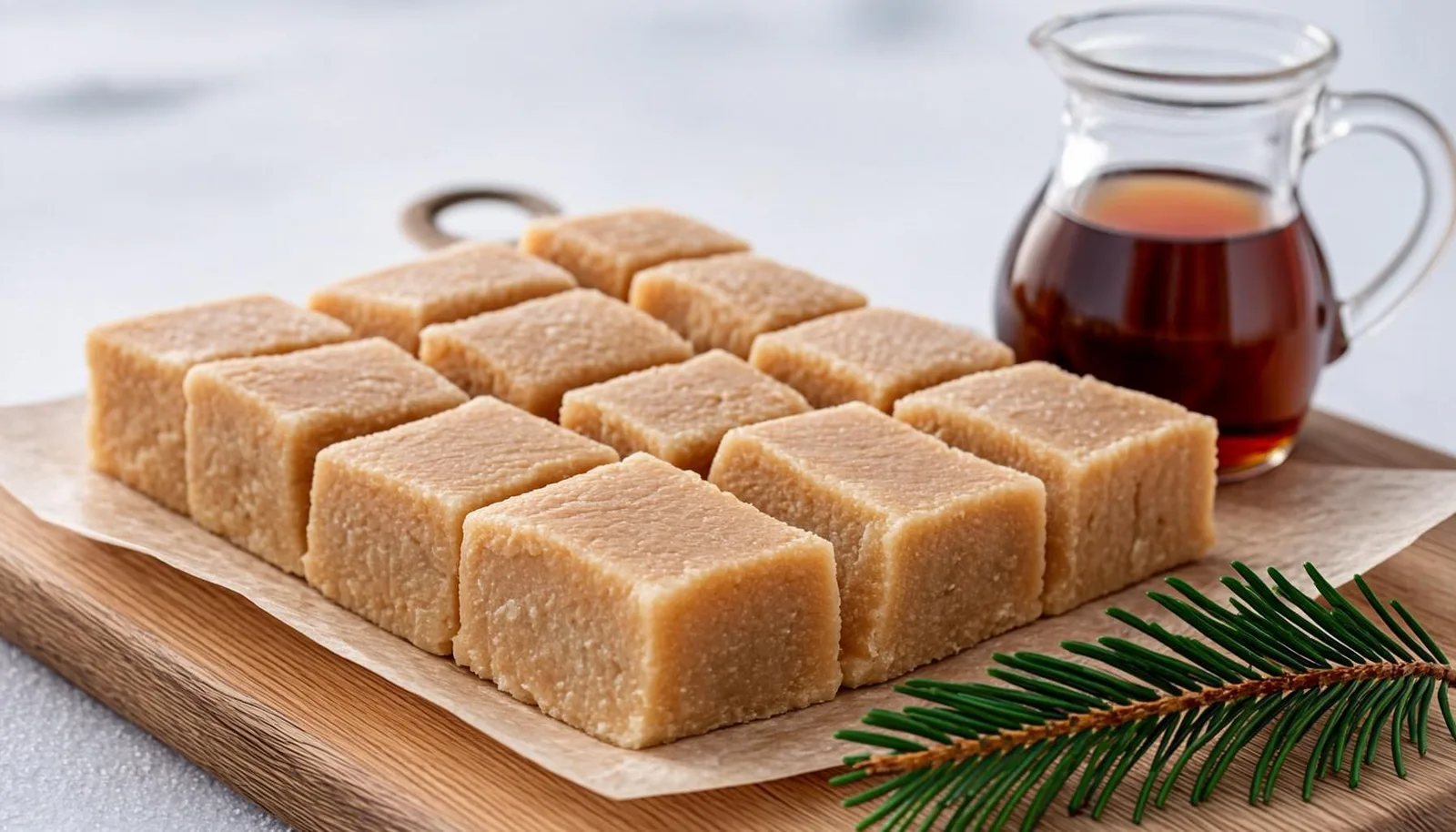
Sucre à la crème is the ultimate holiday treat in Quebec, and also the one that gives cooks the most trouble: one year it stays runny, the next it comes out grainy. The Office québécois de la langue française (OQLF) describes it as a soft confection cooked to the "petit boulé" (soft-ball) stage, cooled slightly, beaten, then cut into squares. It used to be made with maple sugar or maple syrup and cream; brown sugar or white sugar has often taken over.
Yet there is nothing temperamental about it. Our version relies on a checked thermometer, a rest without stirring and beating at the right moment. It belongs on the dessert platter of our traditional réveillon menu, dish by dish.
- Prep
- 10 min
- Cook
- 15 min
- Servings
- 36
- Season
- Holiday season
- Rating
- Not rated yet
Ingredients
- 625 ml (2 ½ cups) brown sugar, lightly packed
- 250 ml (1 cup) 35% cream
- 1 pinch salt
- 30 ml (2 tbsp) unsalted butter, diced
- 5 ml (1 tsp) vanilla extract
- 125 ml (½ cup) chopped nuts (optional)
Maple variation
- 375 ml (1 ½ cups) maple syrup, 250 ml (1 cup) brown sugar and 250 ml (1 cup) 35% cream, instead of the brown sugar and cream above
Directions
- Prepare. Line a 20 cm (8 in) square pan with parchment paper. Check your candy thermometer in water at a full rolling boil: it should read 100°C (212°F). If not, note the difference and adjust your target by the same amount.
- Dissolve. In a heavy-bottomed pot of at least 3 L, combine the brown sugar, cream and salt. Heat over medium heat, stirring, until the sugar dissolves and the mixture boils.
- Cook. Stop stirring. Brush the sides of the pot with a pastry brush dipped in water to dissolve any crystals, clip on the thermometer without letting it touch the bottom and boil to 114°C (237°F), about 10 to 15 minutes. Go by the temperature rather than the time. Without a thermometer, do the cold water test: a drop should form a soft ball that flattens between your fingers.
- Rest. Remove from the heat. Place the butter and vanilla on top, without stirring. Let cool untouched to 43 to 45°C (110 to 113°F): about 15 minutes in a sink of cold water (not ice water), up to 1 hour at room temperature.
- Beat. Beat with a wooden spoon (5 to 15 minutes) or an electric mixer (2 to 3 minutes), until the mixture thickens and loses its gloss. Add the nuts at the end, if using.
- Pour. Pour immediately into the pan, without scraping the sides of the pot, and smooth the top.
- Cut. Let set for a few hours at room temperature, or 30 minutes in the fridge if you are in a hurry, then unmould and cut into 36 squares.
Tried this recipe? Rate it
Be the first to rate it.
Why it sets (or doesn't): it's all about crystals
Its melt-in-your-mouth texture comes from sugar crystals so small that your tongue cannot feel them, explains the Exploratorium science museum. Getting them right happens in three stages.
Cooking. The target is the soft-ball stage: 112 to 115°C (234 to 240°F) according to Iowa State University's food preparation manual. Food chemistry columnist Christina Blais puts the ideal at 114 or 115°C: at 108°C, sucre à la crème stays soft; at 118°C, it turns hard and brittle. Careful: the temperature climbs slowly, then speeds up at around 104°C. Stay close to your pot.
Resting. Stir only to dissolve the sugar, then not at all. Some recipes, like the one shared by Ingenium, call for constant stirring; we followed Christina Blais and the Exploratorium, who say agitation makes crystals appear too early. Off the heat, let it cool untouched to 43 to 45°C, in a sink of cold water, but not ice water.
Beating. Then beat until the mixture thickens and loses its gloss. Common belief: "beating it as soon as it comes off the heat gives the same result." FALSE. Beaten hot, the syrup forms few crystal seeds, which grow large: the result is grainy. Beaten lukewarm, it forms a multitude of tiny ones, hence the smooth texture.
Common belief: "you don't need a thermometer." TRUE, if you master the cold water test (see the FAQ). A checked thermometer takes out the guesswork, though: in water at a full rolling boil, it should read 100°C (212°F), notes the University of Arkansas extension service. If it reads 99°C, aim for 113°C. This test also accounts for altitude, which lowers the boiling point of water, according to Colorado State University.
Common belief: "humid weather can ruin sucre à la crème." TRUE. The University of Arkansas recommends choosing a dry day and, in rainy weather, cooking it one or two degrees Fahrenheit higher (about 1°C).
Runny, too hard or grainy: what to do
Common belief: "sucre à la crème that didn't set belongs in the garbage." FALSE. If it stays runny, it was not cooked enough. Christina Blais suggests putting it back in the pot with 15 to 30 ml (1 or 2 tbsp) of 35% cream, bringing it to a boil while stirring until dissolved, then cooking without stirring to 114 or 115°C before letting it cool and beating it again. Too hard? Same method, with 45 to 60 ml (3 or 4 tbsp) of cream. Don't feel like starting over? NoovoMoi suggests serving the runny version as a spread or on a cake.
The grainy case is trickier: none of the sources consulted offers a fix, and Christina Blais advises starting over. Prevention is better: a wet brush on the sides of the pot at the start of cooking, no stirring after that and, when pouring, don't scrape the pot or the spoon, where the layer is often grainier.
Maple version, storage and safety
Maple. To go back to its origins, a collection from Cornell University's extension service suggests 375 ml (1 ½ cups) of maple syrup, 250 ml (1 cup) of brown sugar and 250 ml (1 cup) of cream, cooked to about 114°C (238°F). Same method: trust the thermometer, not the timer, because the pot and the heat change how fast the mixture evaporates. More equivalents in our guide to replacing sugar with maple syrup in holiday recipes.
Storage. Store the squares in an airtight container, with the layers separated by wax paper, as the Exploratorium and the University of Arkansas recommend. Keep them away from hard candies and caramels, which absorb the moisture that sucre à la crème loses and turn sticky. None of the sources consulted gives a precise shelf life at room temperature. To get ahead, freeze the squares well wrapped, labelled and dated, then let them thaw for 1 to 2 hours at room temperature, without unwrapping them. To give them in a reused jar, freeze them in a bag instead: an ordinary glass jar breaks easily in the freezer, warns the National Center for Home Food Preservation. More ideas for reusing glass jars.
Safety. At 114°C, the syrup is much hotter than boiling water, and it foams and can splatter as it cooks. Use a heavy-bottomed pot of at least 3 L, never leave the cooking unattended and keep young children away from the stove, as Health Canada reminds us. For the Exploratorium, it is clear: no candy making for kids without an adult.
To round out your box of sweets: ginger molasses Christmas cut-out cookies or a chocolate maple Yule log. And for gifts without a mountain of packaging, here is how to reduce holiday waste.
Free gift: get The Quebec Recipe Advent Calendar, 24 recipes ready in 30 minutes or less with local ingredients, one a day until Christmas Eve. The same page gathers all our holiday recipes and guides.
Sources
- Sucre à la crème (Grand dictionnaire terminologique entry; in French), Office québécois de la langue française, 2006.
- Secrets to Successful Fudge, Christina Blais, Food Chemistry column, RICARDO.
- For Successful Fudge Every Time, Christina Blais, Food Chemistry column, RICARDO.
- Sucre à la crème (recipe; in French), Ingenium – Canada's Museums of Science and Innovation.
- Sucre à la crème (recipe; in French), Natasha Loiseau, NoovoMoi, 2026.
- 4 trucs infaillibles pour ne pas rater votre sucre à la crème (4 foolproof tips for sucre à la crème; in French), Myreille Simard, NoovoMoi, 2024.
- Fudge Recipes (maple recipe collection), Dolores Desalvo, Cornell Cooperative Extension of Lewis County, 2007.
- Science of Candy: What's Special About Fudge?, Exploratorium.
- Fudge (recipe), Exploratorium.
- Food Preparation Lab, chapter 5.3: Amorphous Candies, Iowa State University Digital Press, 2023.
- Candy Making at High Elevation, Colorado State University Extension, 2019 (reviewed in 2025).
- Tips for Successful Candy Making, Jean Ince, University of Arkansas Division of Agriculture, Cooperative Extension Service.
- Containers for Freezing, National Center for Home Food Preservation, University of Georgia.
- Cooking safety, Health Canada, 2012.
Frequently asked questions
What temperature should sucre à la crème be cooked to?
To the soft-ball stage: 112 to 115°C (234 to 240°F) according to Iowa State University's food preparation manual. Christina Blais aims for 114 or 115°C. The 2006 entry from the Office québécois de la langue française (OQLF) puts the soft-ball stage higher, at around 117 to 119°C: we followed the candy-making guides. Check your thermometer in boiling water first: if it does not read 100°C, adjust your target by the same amount.
How do I do the cold water test?
Drop a few drops of syrup into very cold water. It is ready when they form a soft ball that flattens easily between your fingers. Threads, or drops that dissolve: not cooked enough. A hard ball: overcooked. Repeat the test every 2 or 3 minutes, with a clean spoon.
Why is my sucre à la crème grainy?
Most often, it was stirred during cooking or beaten too hot, before it had cooled to 43-45°C. Crystals stuck to the sides of the pot can also start crystallization too early. Christina Blais advises starting over: none of the sources consulted offers a way to rescue it.
Can sucre à la crème be frozen?
Yes. The University of Arkansas extension service recommends wrapping the pieces in plastic wrap or aluminum foil, labelling and dating them, then letting them thaw for 1 to 2 hours at room temperature, still wrapped.
Can I make it with maple syrup?
Yes. A collection from Cornell University's extension service suggests 375 ml of maple syrup, 250 ml of brown sugar and 250 ml of cream, cooked to about 114°C. The technique does not change: rest without stirring, then beat.