Old-fashioned ragoût de boulettes (Quebec meatball stew) with toasted flour
Pork meatballs scented with cinnamon and cloves, in a brown sauce thickened with dry-toasted flour: this is old-fashioned ragoût de boulettes. It can be made ahead and frozen in portions, ready for réveillon.
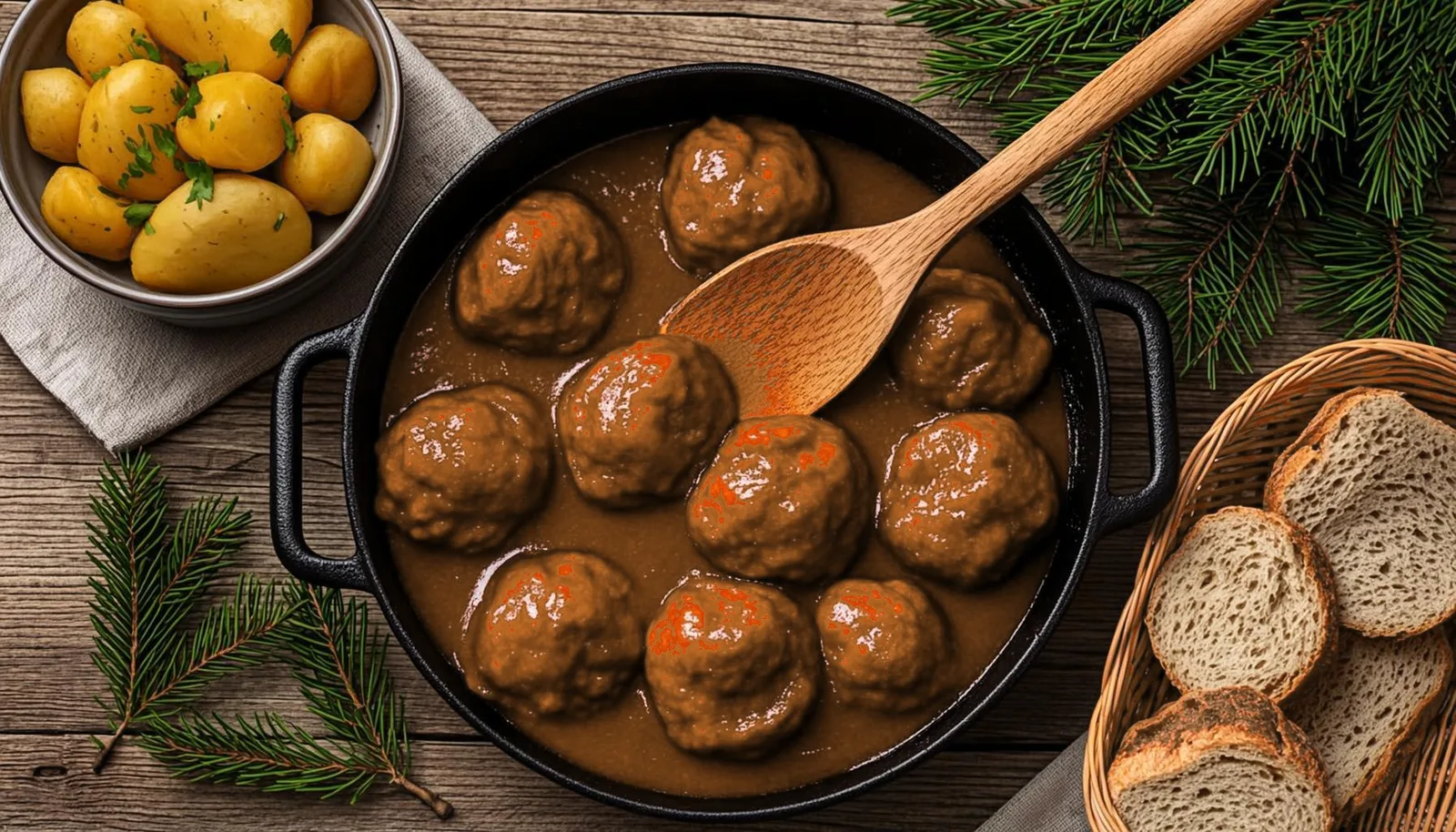
Ragoût de boulettes is first and foremost a sauce: brown, smooth, with a toasty flavour that comes from a very simple ingredient, flour toasted dry in a skillet. In it simmer pork meatballs seasoned with cinnamon, cloves and allspice, the same warm spices that give tourtière its character.
It is one of the dishes on our traditional réveillon menu, alongside the traditional tourtière and its cousin, the vegetarian lentil tourtière. Because it can be made ahead and frozen, it also has its place in our make-ahead holiday freezer calendar.
- Prep
- 30 min
- Cook
- 70 min
- Servings
- 6
- Season
- Holiday season
- Rating
- Not rated yet
Ingredients
Sauce
- 125 ml (½ cup) all-purpose flour, for toasting
- 1.25 L (5 cups) chicken or pork broth, preferably homemade
- 125 ml (½ cup) cold water
- 1 bay leaf
- Salt and pepper, to taste
Meatballs
- 250 ml (1 cup) diced stale bread, crusts removed
- 80 ml (⅓ cup) milk
- 900 g (2 lb) medium ground pork
- 1 onion, very finely chopped
- 30 ml (2 tbsp) chopped fresh parsley
- 2 ml (½ tsp) ground cinnamon
- 2 ml (½ tsp) ground allspice
- 1 ml (¼ tsp) ground cloves
- 1 ml (¼ tsp) ground nutmeg (optional)
- 5 ml (1 tsp) salt
- 2 ml (½ tsp) pepper
- 30 ml (2 tbsp) canola oil
Directions
- Toast the flour. In a large heavy skillet, ideally cast iron, toast the flour dry over medium heat, stirring constantly, until it is light brown and smells toasted. Immediately pour it into a bowl and let it cool. In the oven, allow about 1 hour at 175°C (350°F) on a baking sheet, stirring every 15 minutes.
- Soak the bread. In a large bowl, soak the bread in the milk for about 5 minutes, then mash it with a fork.
- Shape. Add the pork, onion, parsley, spices, salt and pepper. Mix with your hands without overworking, then shape about 30 meatballs, about 4 cm (1 ½ inches) across.
- Brown. In a large Dutch oven, heat the oil over medium-high heat and brown the meatballs on all sides, a few at a time, without crowding. Set them aside on a plate.
- Simmer. Pour the broth into the pot, add the bay leaf and bring to a boil, scraping the bottom. Return the meatballs, lower the heat, cover and simmer gently for 15 minutes.
- Thicken. Whisk the cooled toasted flour into the cold water until smooth. Pour it gradually into the simmering broth, stirring gently. Simmer uncovered for 25 to 30 minutes, stirring occasionally, until the sauce coats the spoon. Too thin? Add 30 to 60 ml (2 to 4 tbsp) of toasted flour mixed with a little cold water. Too thick? Thin it with broth.
- Check. Insert a digital thermometer into the centre of the largest meatballs: they must reach 71°C (160°F). Remove the bay leaf, adjust the seasoning and serve with mashed potatoes.
Tried this recipe? Rate it
Be the first to rate it.
Toasted flour: more flavour, less thickening power
Toasting flour means heating it dry, with no fat, stirring constantly, until it turns from white to light brown. Louis-François Marcotte simply toasts it in a dry skillet, Thierry Daraize wants it light brown, and a family recipe digitized by Bibliothèque et Archives nationales du Québec (BAnQ) even calls for "dark toasted" flour. The cooking site The Culinary Pro describes the same technique, in a cast iron skillet or in the oven. Good news: once cooled, it is shelf-stable. Toast a big batch ahead of time and keep it in a clean jar.
Myth: "toasted flour thickens as much as white flour." False. Dry heat weakens the starch granules in the flour: once in the broth, they swell less, and the sauce thickens less. According to The Culinary Pro, a brown roux loses up to half of its thickening power, so you need to use more of it. Hence the generous amounts in stew recipes: 125 ml (½ cup) of toasted flour for 1.25 L of broth in Louis-François Marcotte's recipe. Another tip from the same site, about roux: avoid having both the thickener and the liquid hot, or watch out for lumps. Instead, mix the toasted flour into cold water or cooled broth, as in the Noovo Moi recipes, then pour it gradually into the simmering stew, stirring.
Well-seasoned meatballs, cooked through
For the meat, pork is the natural choice, and it is easy to buy local: according to the Quebec government, the province is Canada's leading producer of slaughter hogs, with nearly 34% of Canadian hog slaughter. Some recipes add a little beef or veal; keep the total at around 900 g. The bread soaked in milk comes from Louis-François Marcotte's recipe, and it is a great way to use up stale bread: more ideas in our tips for cooking without waste. As for spices, the recipes we consulted range from a few pinches to 2 ml (½ tsp) of cinnamon and cloves; to choose them and keep them fresh, see our guide to holiday spices.
Myth: "a meatball that is no longer pink in the centre is cooked." False. Health Canada points out, for ground beef, that colour does not always tell you if it is safe to eat: at 71°C (160°F), a safely cooked patty may range from slightly pink to brown. For ground pork, meatballs included, Health Canada calls for 71°C (160°F) in the centre. The reliable way to know is a digital thermometer inserted in the centre of the largest meatballs.
Pork hock variation, freezing and reheating
With pork hocks. For a ragoût de pattes et boulettes, start with a homemade broth. Simmer 500 g to 1 kg (1 to 2 lb) of pork hocks or pig's feet in water with an onion, a garlic clove and 2 whole cloves until the meat comes off the bone: about 3 hours in Louis-François Marcotte's recipe, 3 ½ hours in Thierry Daraize's. Strain the broth to replace the one in the recipe, and add the shredded meat with the meatballs. Do this the day before: divide the broth among shallow containers so it cools quickly, refrigerate it, then skim off the fat the next day. No hocks? A homemade poultry broth, such as our turkey carcass broth, works very well.
In the freezer. The stew freezes, as long as you keep the potatoes separate: Clemson University and Ohio State University advise leaving them out of stews meant for the freezer, because they turn grainy. Make sure the meatballs are covered with sauce and leave a little headspace in the containers (Clemson). Health Canada gives 2 to 3 months in the freezer for cooked dishes; Clemson goes up to 4 to 6 months for stews. Clemson also suggests freezing the broth and making the gravy just before serving: with your toasted flour ready ahead of time, it is quick.
Myth: "you can leave the pot to cool on the counter overnight." False. Health Canada says to throw away any cooked food left at room temperature for more than 2 hours. Divide the stew among shallow containers so it cools quickly, then refrigerate or freeze it. Same logic on the buffet table: see our article on the 2-hour rule for holiday buffets.
Myth: "a flour-thickened sauce that looks curdled after thawing is ruined." False. Clemson warns that gravies made with wheat flour tend to separate when thawed, but Ohio State University specifies that they usually recombine when stirred. Thaw the stew in the fridge, then reheat it, stirring, to a full rolling boil, as Health Canada recommends for sauces; the meatballs must reach 74°C (165°F). For your other leftovers, see our article on holiday leftovers in the fridge and freezer.
Free gift: get The Quebec Recipe Advent Calendar, 24 recipes ready in 30 minutes or less with local ingredients, one a day until Christmas Eve. The same page gathers all our holiday recipes and guides.
Sources
- Ragoût de boulettes (meatball stew; in French), Louis-François Marcotte, Noovo Moi, 2012.
- Ragoût de boulettes ancestral (old-fashioned meatball stew; in French), Thierry Daraize, Noovo Moi, 2012.
- Ragoût de boulettes classique et facile (classic meatball stew with a slow cooker option; in French), Noovo Moi, 2026.
- Ragoût de pattes « de cochon » (pork hock stew; in French), family recipe by Cécile Lemay St-Hilaire, BAnQ digital collections.
- The Science of Thickening Agents, John Reiss, The Culinary Pro, 2026.
- Tourtière Two Ways (Pork & Vegetarian) with a Biscuit Crust, Julie Van Rosendaal, CBC News.
- Élevage porcin (porc) (hog farming in Quebec; in French), Gouvernement du Québec, 2026.
- Safe cooking temperatures, Health Canada, 2020.
- Hamburger safety tips, Health Canada, 2013.
- Food safety tips for leftovers, Health Canada, 2025.
- Storing leftovers (infographic), Health Canada, 2024.
- Freezing Prepared Foods (HGIC 3065), Clemson Cooperative Extension, 2012.
- Food Preservation: Freezing Cooked Foods (HYG-5308), Ohio State University Extension, 2015.
Frequently asked questions
Why toast the flour?
To give the sauce its brown colour and toasty flavour. The trade-off is that toasted flour thickens less: according to The Culinary Pro, a brown roux loses up to half of its thickening power. So you need more of it than white flour.
Can I toast the flour ahead of time?
Yes. The Culinary Pro notes that dry-toasted flour is shelf-stable. Let it cool completely and store it in a clean, tightly closed jar, ready for the next stew.
What temperature should pork meatballs reach?
71°C (160°F) in the centre, according to Health Canada, for ground pork, beef, veal and lamb, meatballs included. Check with a digital thermometer: the colour of the meat is not a reliable indicator.
Can I make this stew in a slow cooker?
Yes. Noovo Moi suggests browning the meatballs, transferring them to the slow cooker, pouring over 375 ml (1 ½ cups) of broth with the flour mixed in, then cooking for 6 to 8 hours on low. Still check that the meatballs reach 71°C (160°F).
How long does the stew keep?
In the fridge, 2 to 3 days according to Health Canada's tips on leftovers (its infographic gives 3 to 4 days for cooked dishes). In the freezer, 2 to 3 months according to Health Canada, and up to 4 to 6 months for stews according to Clemson. Reheat to a rolling boil, and to 74°C (165°F) in the centre of the meatballs.