Traditional tourtière (Quebec meat pie): the réveillon recipe
Pâté à la viande, or tourtière, is the ultimate réveillon dish: a spiced ground pork filling, cooked ahead, in a golden crust. This recipe makes two pies, one for the party and one for the freezer, with the temperatures to follow to serve them safely.
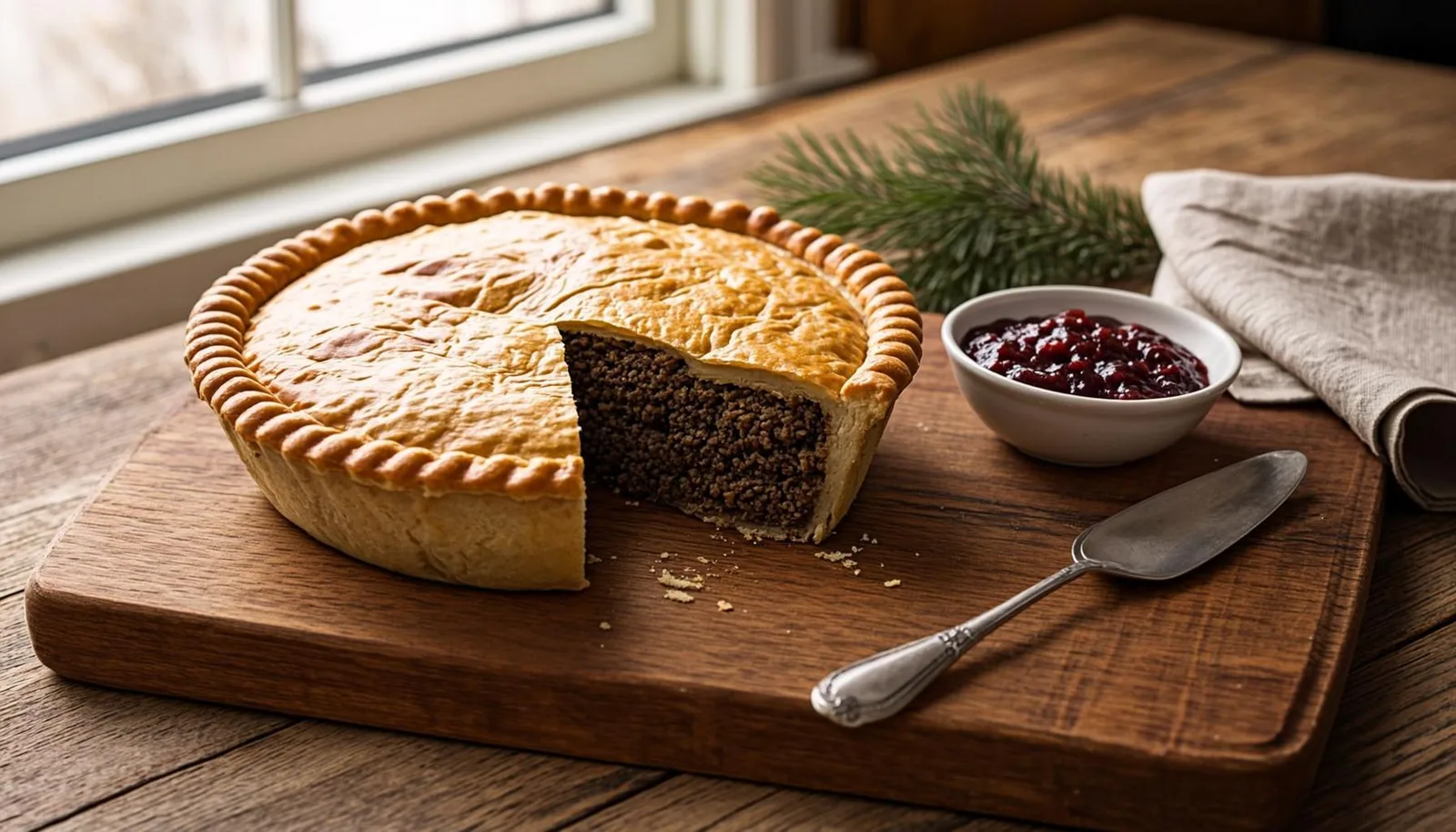
In Quebec, réveillon has its signature dish: pâté à la viande, or tourtière. A golden crust and a ground pork filling scented with cloves and cinnamon: the recipe is simple, as long as you cook and cool the filling before putting it in the crust, and get out the thermometer.
This version makes two 23 cm pies, one for réveillon and one for the freezer. For the crust, make our all-butter pie crust twice. For vegetarians, there is our vegetarian tourtière with lentils and mushrooms, and the rest of the menu is in our guide to traditional réveillon recipes.
- Prep
- 45 min
- Cook
- 85 min
- Servings
- 12
- Season
- Holiday season
- Rating
- Not rated yet
Ingredients
Filling
- 700 g (1 ½ lb) medium ground pork
- 300 g (⅔ lb) ground veal or beef (or 300 g more pork)
- 1 large onion, finely chopped
- 2 garlic cloves, finely chopped
- 1 medium potato (about 200 g), peeled and finely grated
- 250 ml (1 cup) water or unsalted chicken broth
- 5 ml (1 tsp) salt, plus more to taste
- 2 ml (½ tsp) pepper
- 5 ml (1 tsp) dried summer savoury
- 2 ml (½ tsp) ground cinnamon
- 1 to 2 ml (¼ to ½ tsp) ground cloves
- 1 ml (¼ tsp) ground allspice or nutmeg
- 60 to 125 ml (¼ to ½ cup) breadcrumbs, as needed
Pastry and egg wash
- Pastry for four 23 cm (9-inch) crusts, i.e. our all-butter pie crust recipe made twice
- 1 egg
- 15 ml (1 tbsp) milk or water
Directions
- Simmer. In a large saucepan, combine the pork, veal, onion, garlic, potato, water, salt, pepper and spices. Bring to a boil over medium heat, breaking up the meat with a wooden spoon.
- Reduce. Simmer uncovered for about 30 minutes, stirring often, until the liquid has almost evaporated and the potato has melted into the filling. The meat must reach 71°C (160°F) on a thermometer.
- Adjust. Taste and adjust the seasoning. If the filling is still greasy or wet, stir in the breadcrumbs 30 ml at a time, waiting a few minutes between additions.
- Cool. Spread the filling in a shallow dish. As soon as it stops steaming, cover loosely and refrigerate until cold, ideally overnight.
- Preheat. Place the rack in the lower third of the oven and preheat to 190°C (375°F).
- Line. Roll out 2 discs of pastry and fit one into each of two 23 cm (9-inch) pie plates. Divide the cold filling between them and level it without packing it down.
- Cover. Roll out the other 2 discs. Moisten the edges of the bottom crusts, cover, trim the excess leaving about 1 cm, fold under and crimp to seal. Cut a few slits in the top to let the steam escape.
- Glaze. Beat the egg with the milk and brush it over the tops.
- Bake. Set the pies on a baking sheet and bake for 45 to 55 minutes, until the crust is deep golden and the centre reaches 74°C (165°F). Cover the edges with foil if they brown too quickly.
- Rest. Let stand for 15 minutes before cutting.
Tried this recipe? Rate it
Be the first to rate it.
Where tourtière comes from, and how to spice it
The Office québécois de la langue française (OQLF) describes it as a pie of ground pork, sometimes with beef or veal, in which the meat is precooked with water, onion and seasonings, then cooled; it is sometimes bound with mashed potatoes or breadcrumbs. According to The Canadian Encyclopedia, recipes already appear in La cuisinière canadienne, published in 1840, and it is the dish of réveillon, the feast that follows midnight Mass.
When it comes to spices, every family has its signature. In the published recipes we consulted, cloves are almost always there, along with cinnamon, nutmeg, allspice or savoury, depending on the recipe. Our quantities stay moderate: taste the cooked filling and adjust. For spices that still have their aroma, see our holiday spice guide.
A Canadian food magazine recommends having the meat freshly ground at the butcher's: ask for Quebec pork and veal, and buy only what you need (see our food quantities per guest). For serving, the same magazine suggests a tomato chutney or a relish to balance the filling; homemade fruit ketchup or our cranberry sauce also do the job.
Making it ahead, freezing and reheating safely
The filling. Health Canada sets the safe internal temperature for ground pork, beef and veal at 71°C (160°F): check it with a digital thermometer. Then spread the filling in a shallow dish and refrigerate it as soon as it stops steaming, as Health Canada advises. Hot food does not "go bad" in the fridge, the Quebec government points out: the danger is slow cooling. Two of the recipes we consulted note that a cold filling makes a better tourtière: make it the day before.
Baking and the fridge. Since the filling is already cooked, aim for 74°C (165°F) in the centre, Health Canada's target for leftovers and casseroles. Then the clock starts: Health Canada says to discard cooked food left at room temperature for more than 2 hours (our article on the 2-hour rule explains it all). So put the leftovers away before opening the presents. In the fridge, baked tourtière should be eaten within 2 or 3 days, according to Health Canada.
Frozen unbaked. Clemson University suggests freezing meat pies unbaked, wrapping them once they are hard, then baking them without thawing at 200°C (400°F), for about 1 hour, cutting vents in the crust at the last minute, until the centre reaches 74°C. Clemson does, however, advise leaving out potatoes (use 125 to 250 ml of breadcrumbs instead) and notes that the bottom crust of pies frozen unbaked tends to get soggy.
Frozen baked. Cool it in the fridge, wrap it tightly and freeze. Thaw it in the fridge, the safest method according to the Quebec government, then reheat it at 190°C (375°F) under foil: one tested recipe allows about 30 minutes for a cold tourtière. The United States Department of Agriculture (USDA) also allows reheating a dish that is still frozen; it just takes longer.
As for storage time, sources vary: 2 to 3 months for cooked dishes with meat according to Health Canada, 2 to 4 months according to the University of Illinois; for a tourtière frozen raw, Clemson gives 4 to 6 months. These are quality guidelines: according to the USDA, frozen leftovers stay safe indefinitely, but lose moisture and flavour. Aim for 2 to 3 months and date the package. To get organized, follow our make-ahead holiday freezer calendar and our guidelines for holiday leftovers.
True or false: 4 myths about tourtière
"Tourtière is named after the tourte, a pigeon." Probably false.
The Canadian Encyclopedia files the story of passenger pigeons baked into pies under myths: the name more likely comes from the tourtière, a shallow dish still used in France for pies (tourtes). Other writers still present both theories.
"Tourtière, pâté à la viande and cipaille are the same thing." False.
For the OQLF, "tourtière" is a common synonym for "pâté à la viande", except in Charlevoix, Saguenay and Lac-Saint-Jean, where the word means a large pie slow-cooked in a deep dish, filled with cubes of meat, potatoes and onions. Cipaille, for its part, stacks layers of meat and potatoes separated by sheets of pastry, often six; its name may come from the English sea-pie, according to the federal Translation Bureau.
"When the meat is no longer pink, it is cooked." False.
Health Canada says so about ground beef: its colour does not tell you whether it is cooked enough, and a patty cooked to 71°C can range from pink to brown. Only a thermometer is reliable.
"In winter, the porch makes a great fridge." False.
Iowa State University advises against keeping food outdoors in winter, except briefly in a pinch: the temperature changes from hour to hour, the sun can thaw food even in bitter cold, and animals can contaminate it. Make room in the freezer ahead of time instead.
Free gift: get The Quebec Recipe Advent Calendar, 24 recipes ready in 30 minutes or less with local ingredients, one a day until Christmas Eve. The same page gathers all our holiday recipes and guides.
Sources
- Tourtière, Sasha Chapman, The Canadian Encyclopedia, 2014 (edited in 2015).
- pâté à la viande (Grand dictionnaire terminologique entry; in French), Office québécois de la langue française, 2010.
- tourtière du Saguenay–Lac-Saint-Jean (Grand dictionnaire terminologique entry; in French), Office québécois de la langue française, 2010.
- cipaille, tourtière, pâté à la viande (Clés de la rédaction writing guide; in French), Translation Bureau, Public Services and Procurement Canada, 2025.
- Meat Pie Magic: The History of Tourtière, Gabby Peyton, Canadian Food Focus, 2024.
- Madame Benoît's Quebec Tourtière, Canadian Museum of Immigration at Pier 21.
- Classic Canadian Dish: Classic Tourtière, Gabby Peyton, Canadian Food Focus, 2024.
- Classic Tourtière, Chatelaine, 2023.
- How To Make The Best Tourtière, Ever, Kristen Eppich, Chatelaine, 2023 (updated in 2025).
- Classic Tourtière, CBC Life.
- Tourtière-Style Pot Pie, Foodland Ontario, Government of Ontario.
- Safe cooking temperatures, Health Canada, 2024.
- Hamburger safety tips, Health Canada, 2013.
- Food safety tips for leftovers, Health Canada, 2025.
- Storing leftovers (infographic), Health Canada, 2024.
- Holiday food safety, Health Canada, 2017.
- Refroidir, réchauffer et décongeler les aliments (cooling, reheating and thawing food; in French), Gouvernement du Québec (MAPAQ), 2025.
- Freezing Prepared Foods (HGIC 3065), Clemson Cooperative Extension, 2012.
- What Can I Freeze?, University of Illinois Extension, 2025.
- Leftovers and Food Safety, Food Safety and Inspection Service, USDA.
- Should Food Be Stored Outdoors in Winter or in the Snow?, Marlene Geiger, AnswerLine, Iowa State University Extension and Outreach, 2022.
Frequently asked questions
Can I freeze an unbaked tourtière?
Yes. Clemson University's extension service recommends freezing meat pies unbaked, then baking them without thawing at 200°C (400°F), about 1 hour for a large pie, until the centre reaches 74°C (165°F). Clemson also advises leaving out potatoes in that case: use breadcrumbs as the binder instead.
How long does baked tourtière keep in the fridge?
Two or three days, according to Health Canada's advice on leftovers. Its infographic goes up to 3 or 4 days for cooked dishes with meat, but the shorter time is the safer one. Whatever you will not eat in time goes in the freezer.
What temperature makes tourtière safe?
For the filling, Health Canada calls for 71°C (160°F) for ground pork, beef and veal. Once the tourtière is in the oven, or when you reheat it, aim for 74°C (165°F) in the centre, Health Canada's target for leftovers and casseroles.
Do I need to thaw a baked tourtière before reheating it?
It is not required. The Quebec government presents thawing in the fridge as the safest method, but the United States Department of Agriculture allows reheating a dish that is still frozen in the oven: it just takes longer. Either way, the centre must reach 74°C.
Which spices go in a tourtière?
Cloves show up in almost every published recipe we consulted. Depending on the family, cinnamon, nutmeg or allspice are added, and often savoury, which the OQLF lists alongside sage among the classic seasonings.