Chocolate maple yule log (bûche de Noël)
Under its ganache, a bûche de Noël is just a rolled cake: a cocoa sponge, maple syrup whipped cream and a chocolate icing streaked like bark. With the towel trick, it rolls without cracking, and it can be made the day before or frozen ahead.
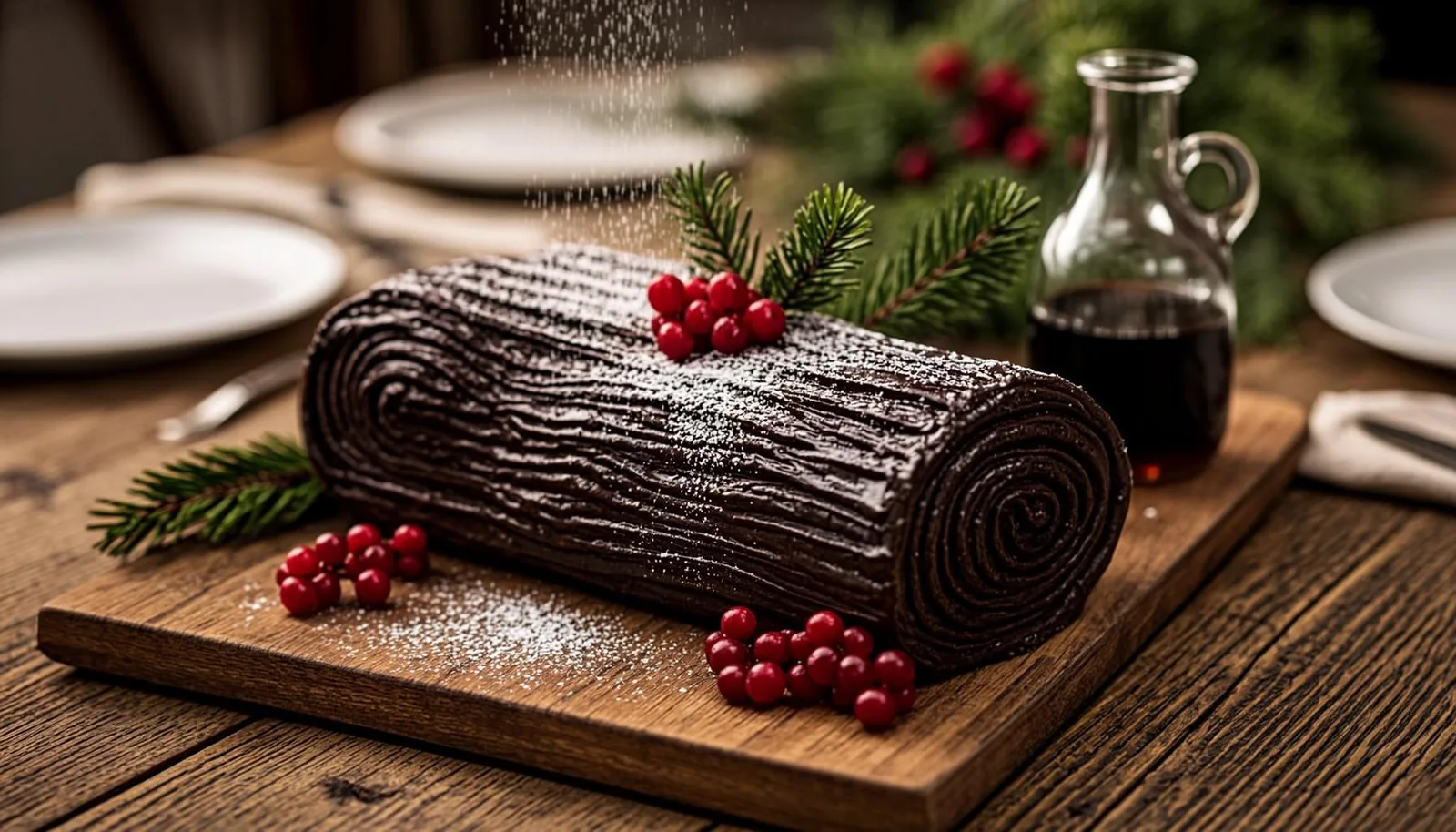
A bûche de Noël always makes an impression when it arrives at the table. Yet under the ganache, it is a simple rolled cake: a thin cocoa sponge, maple syrup whipped cream and a chocolate icing streaked with a fork to look like bark. The step people dread, the rolling, becomes easy with the towel trick.
This version puts Quebec maple syrup in both the sponge and the filling, and it can be made ahead. It is the perfect ending to the menu in our guide to traditional Quebec réveillon recipes. To bake with maple elsewhere, see our guide to replacing sugar with maple syrup.
- Prep
- 45 min
- Cook
- 12 min
- Servings
- 10 to 12
- Season
- Holiday season
- Rating
- Not rated yet
Ingredients
Cocoa sponge
- 175 ml (¾ cup) all-purpose flour
- 60 ml (¼ cup) unsweetened cocoa powder
- 5 ml (1 tsp) baking powder
- 1 pinch salt
- 4 large eggs
- 125 ml (½ cup) sugar
- 60 ml (¼ cup) maple syrup
- 30 ml (2 tbsp) icing sugar, for the towel
Maple filling
- 250 ml (1 cup) well-chilled 35% whipping cream
- 30 to 45 ml (2 to 3 tbsp) maple syrup
Chocolate ganache
- 200 g (7 oz) bittersweet chocolate, chopped
- 180 ml (¾ cup) 35% whipping cream
- 15 ml (1 tbsp) maple syrup (optional)
Decorations (optional)
- Fresh cranberries, chocolate shavings and icing sugar
Directions
- Prepare. Take the eggs out of the fridge 30 minutes before you start. Preheat the oven to 190°C (375°F), with the rack in the centre. Line a rimmed baking sheet of about 43 x 28 cm (17 x 11 inches) with parchment paper.
- Sift. In a bowl, sift together the flour, cocoa, baking powder and salt.
- Beat. With an electric mixer, beat the eggs and maple syrup until slightly thickened. Gradually add the sugar and keep beating until the mixture is pale and thick and falls back in a ribbon.
- Fold. Sift the dry ingredients over the eggs in three additions, gently folding with a spatula after each one to keep as much air as possible. Spread the batter evenly in the pan.
- Bake. Bake for 10 to 12 minutes, until the top springs back when lightly pressed with a finger. Do not overbake: an overbaked sponge is more likely to crack when rolled.
- Roll. Sift the icing sugar over a clean tea towel. Turn the hot sponge out onto the towel, remove the pan and the parchment, then roll up the sponge with the towel, starting from a short side. Let it cool completely on a rack, still rolled.
- Heat. In a small saucepan, heat the cream for the ganache until small bubbles form around the edge. Pour it over the chocolate, wait 5 minutes, then stir until smooth. Add the maple syrup, if using. Let stand for about 1 hour at room temperature, until the ganache is spreadable.
- Fill. In a chilled bowl, whip the cold cream with the maple syrup to firm peaks. Gently unroll the sponge, spread the cream over it, leaving a 1 cm (½ inch) border, then roll it up again, without the towel. Place it on the serving platter, seam side down.
- Ice. Cut the ends on an angle. Cover the log with ganache, then drag a fork through it to imitate bark. If you like, stick one of the cut ends on the side to make a branch.
- Chill. Cover and refrigerate for at least 1 hour, or until the next day. Decorate just before serving and put leftovers back in the fridge within 2 hours.
Tried this recipe? Rate it
Be the first to rate it.
Where the yule log comes from: first, a real piece of wood
Before it was a cake, the yule log was a real log. According to the France.fr website, families gathered around the hearth on Christmas Eve, where a huge log of very hard wood, decorated with foliage and ribbons, burned slowly. The youngest and oldest members of the household lit it together, and its ashes were kept, as they were believed to protect the house from lightning. The site dates the custom to the 12th century and says it was common across most of Europe, as well as in Quebec. National Geographic Traveller adds that it was relit every day until Twelfth Night.
According to France.fr, the big log disappeared at the end of the 19th century, when large hearths gave way to small stoves; National Geographic Traveller instead places its decline in the 18th century. Parisian pastry chefs took over. Pierre Lacam is often credited with the first published recipe, in 1890: sponge, buttercream and bark piped with a pastry bag. But Lacam himself later credited Antoine Charabot, of the Quillet pastry shop, with inventing it in 1879. Sources therefore disagree on the inventor. One thing is certain: the bûche was already very popular in Paris around 1886, before making its way into home cookbooks in the early 20th century.
Common belief: "The bûche de Noël comes from a real log." True. The cake imitates the log that was burned in the hearth. The streaked bark, the ends cut like wood and the icing sugar standing in for frost are all there for that reason.
Rolling without cracking, filling without raw eggs
Common belief: "A rolled sponge always cracks." False. The two published recipes we based ours on, one from Foodland Ontario (Government of Ontario) and one from Yankee Magazine, use the same trick: turn the sponge out onto a sugar-dusted towel while it is still hot, roll it up with the towel and let it cool that way. Once cold, it is unrolled, filled and rolled up again. The real pitfall is overbaking: Yankee warns that an overbaked sponge is more likely to crack. And if a small crack appears anyway, the ganache hides it.
Common belief: "A chocolate mousse made with raw eggs is safe in a yule log." False. Raw eggs can contain Salmonella, a greater risk for young children, older adults, pregnant women and people with weakened immune systems. Health Canada recommends not eating dough or icing made with raw eggs, and using pasteurized egg products in uncooked preparations. Here, the filling has no eggs, and the eggs in the sponge are baked. Do not taste the raw batter either: raw flour can carry E. coli bacteria, Health Canada points out. Our homemade cooked eggnog solves the same problem for another holiday recipe.
Maple buttercream. Beat 125 ml (½ cup) of soft butter with 500 ml (2 cups) of icing sugar and 45 to 60 ml (3 to 4 tbsp) of maple syrup, modelled on the egg-free buttercream in the Yankee recipe. Alcohol-free. Some classic logs, like the Cordon Bleu one, soak the sponge with a rum syrup; a little maple syrup thinned with hot water does the job. Local decorations. Fresh cranberries, as in the Ontario recipe, and chocolate shavings. Our guide to Quebec cranberries explains how to keep some in the freezer until the holidays.
Making it ahead, freezing it and wasting nothing
According to Foodland Ontario, the assembled log can be covered and kept in the fridge until serving, or wrapped and frozen, once filled or once iced, up to 3 weeks ahead; move it to the fridge 30 minutes before serving. Yankee, on the other hand, considers its version fragile and advises eating it the same day: the recipes disagree. The simplest approach is still to assemble it the day before and decorate it just before serving. To plan the rest of the menu, follow our make-ahead holiday dishes calendar.
Common belief: "A whipped cream yule log cannot be frozen." False. That is exactly the method of the Ontario recipe: a log filled and covered with maple whipped cream, wrapped and frozen for up to 3 weeks.
At the table, remember that it is a cream dessert. Health Canada says to throw out perishable food left at room temperature for more than 2 hours, and suggests setting cold buffet dishes on crushed ice. Leftovers go back in the fridge and should be eaten within 2 or 3 days, or frozen right away. All the guidelines are in our article on holiday leftovers in the fridge and freezer.
On the waste front, a log with 10 to 12 servings is enough for a big table, and leftover slices can be frozen individually wrapped. The ends cut on an angle can become a branch, stuck on with a little ganache. Want another local dessert? Try our maple sugar shortbread or our old-fashioned Quebec holiday doughnuts.
Free gift: get The Quebec Recipe Advent Calendar, 24 recipes ready in 30 minutes or less with local ingredients, one a day until Christmas Eve. The same page gathers all our holiday recipes and guides.
Sources
- Maple Yule Log, Foodland Ontario, Government of Ontario.
- Chocolate Bûche de Noël, Yankee Magazine (NewEngland.com), 2020.
- Recette de bûche de Noël au chocolat (chocolate yule log recipe; in French), Le Cordon Bleu, based on L'École du chocolat (Le Cordon Bleu and Larousse).
- Why yule log has become a Christmas favourite, Sam Bilton, National Geographic Traveller (UK), 2023.
- La Bûche de Noël – traditioneller Kuchen der Weihnachtszeit (the traditional Christmas cake; in German), France.fr, 2012, updated in 2025.
- Egg safety, Health Canada, 2024.
- Holiday food safety, Health Canada, 2017.
Frequently asked questions
Why roll the sponge while it is still hot?
That is the method used by both published recipes we based ours on: the hot sponge is rolled up in a towel dusted with sugar, cools rolled, then is unrolled to be filled. Yankee Magazine also warns that an overbaked sponge is more likely to crack.
Can I make the yule log the day before?
Yes. According to Foodland Ontario, the assembled log can be covered and kept in the fridge until serving. Save the decorations (cranberries, chocolate shavings, icing sugar) for the last minute.
How long does a yule log keep in the freezer?
The Government of Ontario recipe can be made, assembled and frozen up to 3 weeks ahead, well wrapped. Move it to the fridge 30 minutes before serving.
Can I fill the log with chocolate mousse?
Only if the mousse contains no raw eggs. Health Canada recommends using pasteurized egg products in uncooked preparations such as icing. Otherwise, choose an egg-free filling, like the maple whipped cream in this recipe.
How long can the yule log stay on the table?
No more than 2 hours at room temperature, according to Health Canada, which says to throw out perishable food left out longer. Put leftovers back in the fridge right away and eat them within 2 or 3 days, or freeze them.