Replacing sugar with maple syrup: conversions for your holiday recipes
Maple syrup can replace sugar in most holiday recipes, in equal amounts, as long as you remove a little liquid. Here are the conversions from Quebec's maple producers, the recipes where it gets tricky, which syrup to choose and what it is really worth nutritionally.
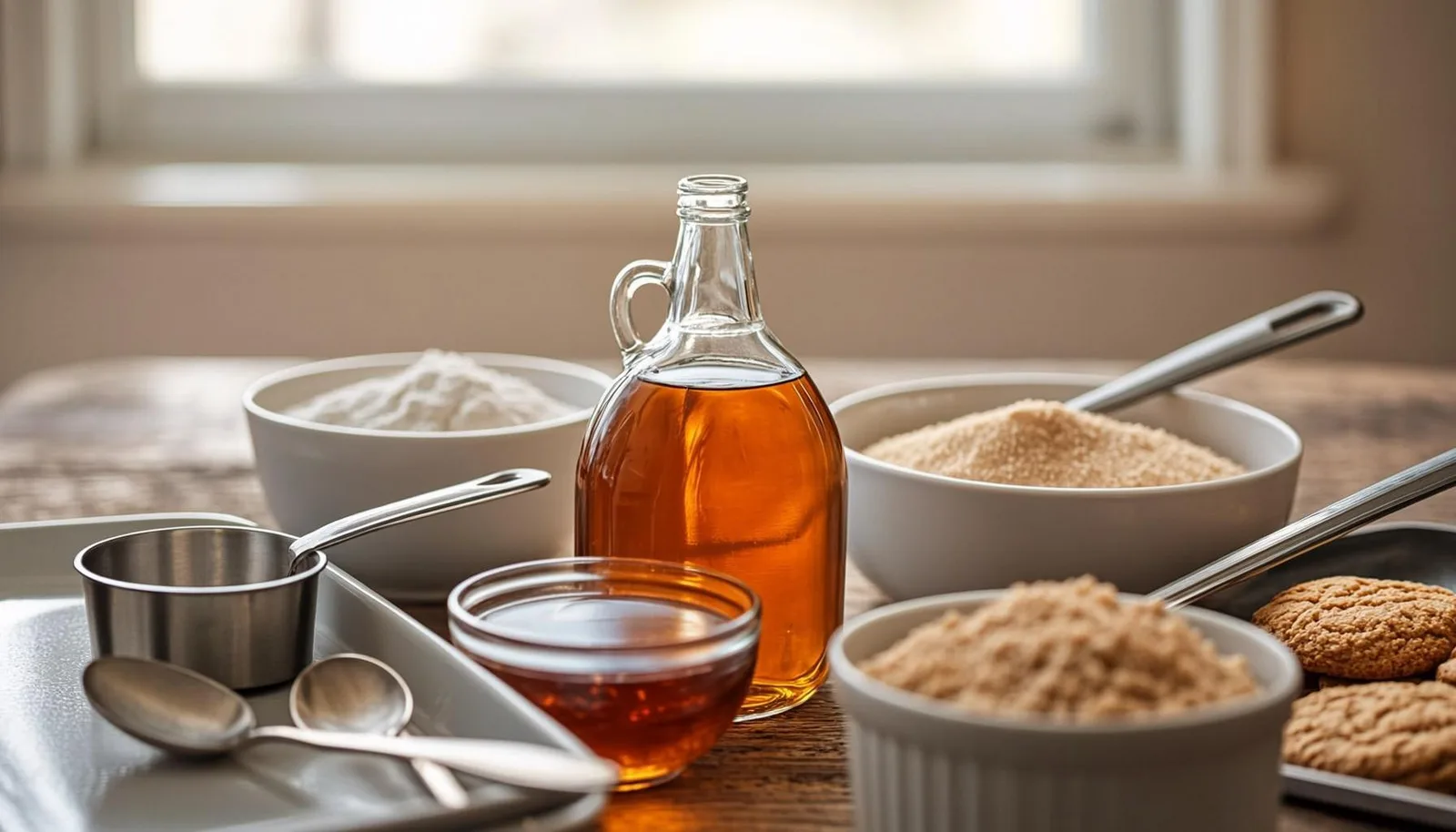
During the holidays, maple finds its way into almost everything: the Yule log, sucre à la crème, cranberry sauce and cookies. It is also a truly local ingredient, one that takes an average of 40 litres of maple sap for every litre of syrup. The good news: most of your recipes can switch from sugar to syrup without starting from scratch, as long as you know one simple rule and its few exceptions.
Here are the conversions from the Producteurs et productrices acéricoles du Québec (PPAQ), Quebec's maple producers, the recipes where maple shines and those where you are better off following a recipe designed for it, which syrup to choose for each use, the right way to store it and what it is really worth nutritionally. For the complete réveillon menu, dish by dish, see our guide to traditional Quebec holiday recipes.
The basic rule: same amount, a little less liquid
The producers sum up the conversion in one formula. Maple sugar replaces sugar in equal amounts, 1 for 1. So does maple syrup, but with one adjustment: for every 250 ml (1 cup) of syrup, reduce the other liquids in the recipe, such as water, milk or juice, by about 60 ml (¼ cup). This adjustment applies to cakes and most desserts. Otherwise, syrup can replace sugar in most recipes, sweet or savoury.
Why remove liquid? Because the syrup brings its own. According to Health Canada's Canadian Nutrient File (CNF), 100 g of maple syrup contains about 32 g of water, while granulated maple sugar contains only 3.5 g. Hence the direct swap for maple sugar, and the small calculation for syrup.
| In your recipe | Replace with | Adjustment |
|---|---|---|
| 250 ml (1 cup) sugar | 250 ml (1 cup) maple syrup | Remove about 60 ml (¼ cup) of liquid |
| 175 ml (¾ cup) sugar | 175 ml (¾ cup) maple syrup | Remove about 45 ml (3 tbsp) of liquid |
| 125 ml (½ cup) sugar | 125 ml (½ cup) maple syrup | Remove about 30 ml (2 tbsp) of liquid |
| 60 ml (¼ cup) sugar | 60 ml (¼ cup) maple syrup | Remove about 15 ml (1 tbsp) of liquid |
| 250 ml (1 cup) sugar | 250 ml (1 cup) maple sugar | None |
| Recipe with little or no liquid (shortbread, cookies) | Maple sugar, in equal amounts | None: there is no liquid to remove to make up for the syrup |
The in-between adjustments are calculated from the producers' rule (60 ml less liquid per 250 ml of syrup), then rounded to the nearest spoonful. And the oven temperature? The producers do not mention it, and none of the official sources consulted calls for changing it. Keep your recipe's temperature and check doneness with the usual tests: a toothpick that comes out clean for a cake, golden edges for cookies.
Where maple shines, and where it gets tricky
The easiest recipes to convert are those where sugar is mainly there to sweeten and where there is liquid to adjust: cakes, muffins, puddings, custards, but also sauces, salad dressings and marinades. Our chocolate maple Yule log is a good example, with syrup in both the sponge cake and the filling. Our homemade cranberry sauce offers a variation where 125 to 175 ml of syrup replaces the sugar, and a drizzle of syrup nicely sweetens a hot mulled cider, with or without alcohol.
For cookies and shortbread, whose dough often contains little or no liquid to remove, maple sugar is simpler: it replaces sugar 1 for 1. It is what sweetens our birch bark flour and maple sugar shortbread, and it is the option to try if you want a hint of maple in our ginger molasses Christmas cut-out cookies.
Things get complicated in recipes where sugar is the main ingredient. The producers say so themselves: their formula may not suit pastry recipes that contain a large amount of sugar. Think meringues, caramel or sucre à la crème. For those, do not convert a sugar recipe: use a recipe designed for maple, or save the maple for the finishing touch.
Sucre à la crème shows the difference clearly. Our traditional sucre à la crème is made with brown sugar. The producers' maple version starts instead with 500 ml (2 cups) of syrup, a little butter and 250 ml (1 cup) of 35% cream, cooked without stirring to 114 to 115°C (237 to 239°F) on a candy thermometer. Allow plenty of time: the recipe warns that this cooking can take an hour. Then let it cool to between 43 and 50°C, and beat until the mixture thickens and turns matte. Pour it out without scraping the pot, whose sides are often coated with grainier sugar. The producers put it plainly: the candy thermometer is the secret to success.
Golden, amber, dark or very dark: which syrup to choose?
In Canada, Grade A maple syrup is divided into four colour classes, each paired with a taste: Golden, Delicate Taste; Amber, Rich Taste; Dark, Robust Taste; Very Dark, Strong Taste. According to the Canadian Food Inspection Agency (CFIA), Grade A syrup traded between provinces, exported or imported must show its colour class on the label, in both English and French. According to the producers, golden syrup comes from sap collected at the start of the season, and very dark syrup from sap collected at the end. Here are their suggested uses:
- Golden: mild, ideal uncooked on yogurt or ice cream, and for delicate cooking such as fish or poultry.
- Amber: for salad dressings and for topping dishes and desserts.
- Dark: more caramelized, it works well for cooking, baking, sauces and fruit-based preparations.
- Very dark: to flavour and colour sauces, glazes and marinades.
For your holiday recipes, dark is therefore the best starting point, since the producers recommend it specifically for cooking and baking. It is also the one they recommend for their sucre à la crème. Save golden for uncooked uses, such as yogurt or ice cream.
Pure maple syrup, table syrup and "pole syrup"
The producers point out that maple syrup has only one ingredient: maple sap. According to the CFIA, a product that does not meet the maple syrup standard cannot use that name. Table syrup, often nicknamed sirop de poteau ("pole syrup") in Quebec, may not contain a single drop of maple: a mix of sugar, water and maple flavouring can be called "table syrup" or "gourmet syrup". If it does contain maple syrup, the CFIA gives example names that state the proportion, such as "table syrup with x% maple syrup". In Quebec and Ontario, provincial authorities also regulate the use of the word "maple" on substitutes.
Before converting a recipe, then, read the product name and the ingredient list: the rules in this guide come from the producers and apply to pure maple syrup. A telling detail along the way: in a food with several ingredients, such as cookies or candy, maple syrup must be grouped in parentheses after the term "Sugars" in the ingredient list. Even the label says it: it is a sugar.
Storing syrup: cans, jugs, fridge and freezer
An unopened can of maple syrup keeps for several years, the producers say, as long as production and packaging were done properly: the syrup is canned hot, at 85°C, which sterilizes the container. Glass and plastic bottles also keep for a very long time at room temperature. One exception: the beige plastic jugs decorated with sugar bush scenes. Because some containers let oxygen through, the producers recommend putting these jugs in the fridge as soon as you buy them.
Once the can is open, there are two basic rules: limit the syrup's exposure to air and keep it cool in an airtight container. Beyond that, the producers admit that everyone has an opinion. Some put the opened can in the freezer, where the syrup does not freeze; others feel syrup should never be left in the can once it has been opened. The simplest compromise: pour it into a clean, tightly closed glass jar and keep it in the fridge. It is a nice second life for a jar; you will find more ideas in our article on reusing glass jars.
And if mould appears on the surface? None of the official sources consulted specifically addresses mouldy maple syrup. For jams and jellies, the United States Department of Agriculture (USDA) is clear: throw them out, without scooping out the mould, because it could be producing mycotoxins. With no guidance specific to syrup, we apply the same caution: mouldy syrup gets thrown out instead of going into a cake batter. To limit the risk, use a clean utensil and close the jar tightly after each use.
Nutrition: it is sugar, with a few extras
Maple syrup has a reputation as a "healthier" sweetener. The CNF figures add a lot of nuance. Per 100 g, syrup seems less sweet than white sugar, but that is mainly because it is one-third water. In the kitchen, though, we measure by volume, and there the two come close: 15 ml (1 tbsp) of syrup provides about 56 kcal and 12 g of sugars, compared with 49 kcal and 12.7 g for 15 ml of white sugar. For 250 ml (1 cup), that is about 913 kcal and 198 g of sugars for syrup, compared with 818 kcal and 211 g for sugar. Replacing sugar with syrup cup for cup therefore barely reduces the sugar in your recipe.
| Per 100 g (CNF) | Maple syrup | Granulated maple sugar | Granulated white sugar |
|---|---|---|---|
| Energy | 270 kcal | 384 kcal | 387 kcal |
| Total sugars | 58.6 g | 85.2 g | 99.8 g |
| Water | 32.1 g | 3.5 g | Trace |
| Manganese | 3.8 mg | 1.3 mg | Trace |
| Riboflavin (vitamin B2) | 0.73 mg | 1.81 mg | 0.02 mg |
| Calcium | 73 mg | 161 mg | 1 mg |
| Potassium | 215 mg | 320 mg | 2 mg |
Maple syrup and maple sugar do provide manganese, calcium, potassium and riboflavin, which white sugar has practically none of: 15 ml of syrup provides about 0.8 mg of manganese. The producers also highlight the syrup's 67 polyphenols. These assets, however, come with a good dose of sugar and do not justify eating more of it: this is a marketing argument, not a health reason. Health Canada lists "honey and syrups (like maple syrup)" among foods that contain large amounts of sugars, and notes that too much added sugar is linked to tooth decay in children and to excess calories. Choose maple for its flavour and because it is produced here, not for your health.
Four maple myths, settled
"Maple syrup is healthier than white sugar." FALSE. Spoon for spoon, it provides almost as much sugar (12 g versus 12.7 g per 15 ml, according to the CNF), and Health Canada lists it among foods high in sugars. Its minerals and polyphenols do not change that.
"You can replace sugar with syrup cup for cup without changing anything else." FALSE. The amount stays the same, but you need to remove about 60 ml of liquid per 250 ml of syrup, and the formula may not suit very sweet pastries, the producers warn.
"The darker the syrup, the lower the quality." FALSE. All four colour classes belong to the same grade, Grade A. Colour tells you about taste, not quality, and dark is precisely the one the producers recommend for cooking.
"Maple syrup does not freeze in the freezer." TRUE. The producers report it: an opened can placed in the freezer does not freeze, and some people use this to keep it for a long time. A tightly closed jar in the fridge is still the simplest solution, though.
Ready to switch to maple? Start with an easy recipe like the Yule log, save the maple sucre à la crème for the day you have a candy thermometer in hand, and choose dark syrup. For more ideas on buying local, take a look at our tips for eating more local food in Quebec.
Free gift: get The Quebec Recipe Advent Calendar, 24 recipes ready in 30 minutes or less with local ingredients, one a day until Christmas Eve. The same page gathers all our holiday recipes and guides.
Sources
- Le sirop d'érable : un ingrédient polyvalent (maple syrup, a versatile ingredient; in French), Érable du Québec, Producteurs et productrices acéricoles du Québec.
- Le saviez-vous? (did you know?; in French), Érable du Québec, Producteurs et productrices acéricoles du Québec.
- Sirop d'érable (maple syrup; in French), Érable du Québec, Producteurs et productrices acéricoles du Québec, 2022.
- Sucre à la crème à l'érable (maple sucre à la crème recipe; in French), Érable du Québec, Producteurs et productrices acéricoles du Québec, 2025.
- Labelling requirements for maple products, Canadian Food Inspection Agency, 2025.
- Canadian Nutrient File: maple syrup, prepackaged (6175), granulated maple sugar (6176) and granulated sugar (4318), Health Canada, 2015.
- Sugars: Sugars and your health, Health Canada, 2022.
- Molds on Food: Are They Dangerous?, Food Safety and Inspection Service, United States Department of Agriculture (USDA), 2013.
Frequently asked questions
How much maple syrup replaces 1 cup of sugar?
The same amount: 250 ml (1 cup) of syrup. The Producteurs et productrices acéricoles du Québec then advise reducing the other liquids in the recipe, such as milk, water or juice, by about 60 ml (¼ cup) for every 250 ml of syrup, especially in cakes and desserts.
Should I lower the oven temperature when baking with maple syrup?
The producers give no instructions on this, and none of the official sources consulted calls for it. Keep your recipe's temperature and check doneness with the usual tests, such as a toothpick that comes out clean.
Which maple syrup is best for cooking and baking?
Dark, with its robust taste: the producers recommend it for cooking, baking and sauces. Very dark suits glazes and marinades, amber suits salad dressings, and golden is best used uncooked, for example on yogurt.
My maple syrup has gone mouldy. Should I throw it out?
Yes, to be safe. None of the official sources consulted addresses mouldy syrup, but for jams and jellies, the USDA recommends throwing out the whole thing rather than removing the mould, which can produce mycotoxins.
Does maple sugar replace sugar in equal amounts?
Yes. According to the producers, maple sugar replaces sugar 1 for 1, with no other adjustment. It is the simplest option for cookies and shortbread, which contain little or no liquid to remove.